Mimiudon 耳うどん
| Prefecture | Tochigi (栃木県) |
|---|---|
| Region | Kanto |
| Japanese name | 耳うどん(みみうどん) |
| Reading | Mimiudon |
| Home area | Utsunomiya City. |
| Main ingredients | I'm going to have to do something with it. |
History and Origins
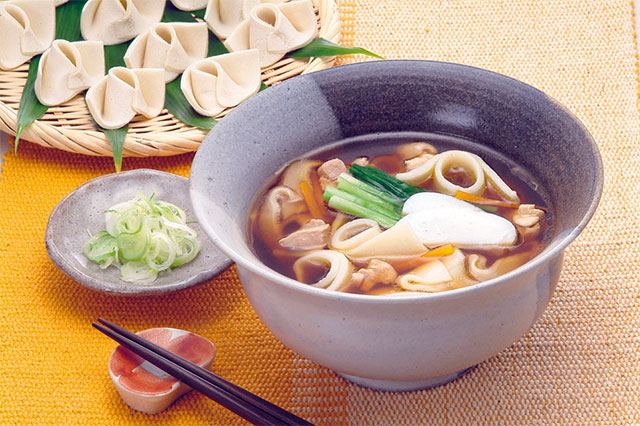
"Oo" is a dish passed down to the Sano City Fukuoka and Utsunomiya City district. If you say it like that, you usually think of long, thin strings, but your ears look a little strange. Because the shape of the woven flour resembles the shape of the ear, it's called the "Objectia." In Sano City, there is a custom of holding this ear shape in your hand and holding it in your ear and praying that it will be good for a year. In Utsunomiya City it is a dish for the New Year's festival between Mr. and Mr. Akimi's shrine.
When It Is Eaten
Since it is difficult to prepare a difficult meal for visitors on New Year's Eve, in the Sasaka City area, they made and stored their ears in cold water at the end of the year and behaved like visitors on New Year's Eve. The ear that you can make easily can be made with wisdom in life. Also, at Utsunomiya City, they were made in the evening and preserved dry and eaten at a festival party at the Miyagi shrine of the stars. Now they eat all year round as well as New Year's.
How It Is Eaten
We boil water in the pan, put a casserole in it, and then we boil it up. I have carved a lily potato, root, carrots, gobows, and so on, and I've seasoned them with soy sauce, such as soy sauce and lentils, but I add a sauce similar to the shape of my ears. Since it's like the common rice, you can boil it with your favorite ingredients. The ears of the ears are joined by soft water and salt. The flour is ground into flour and stretched flat and cut into a rectangle the size of a matchbox. While folding, I'll close the edges of both sides of the inside and prepare each.
Recipe — Serves 4
Ingredients
- 500 g all-purpose flour
- 30) 200–220 ml lukewarm water
- 1 tsp salt
- a pinch dusting flour
- Broth: 4 cups water
- Broth: 300 g taro
- Broth: 5(100 g) shiitake mushrooms
- Broth: 1/2(100 g) carrot
- Broth: 40 g green onion
- Broth: 1/3(50g) burdock root
- Broth: 30–50 g bonito flakes
- Broth: 4 tbsp soy sauce
- Broth: 4 tbsp mirin
- to taste 。 ※基本的にうどんの料理方法と同じなので
Method
- A large ball is made up of flour mixed with soft water and salt, then put it in a plastic bag for about an hour.
- Put one on the board and roll it with a stick. If I'm a dork, I'll cut it into a rectangle with a matchbox 6 x 4cm. We fold it in half, then we close the edges of the inside and make earwashes.
- When the water boils, put the bar in a light boil and then stop the fire. I'll take the pot and after a while I'll boil it and make the soup.
- So when you boil the juice in the fire, you cut it into pieces.
- If the tools are soft, then we will taste them with soy sauce, soy sauce and salt.
More About Mimiudon
The native dish of Tochigi Prefecture, Utsunomiya City, and Utsunomiya City
Noodle food, shaped like an ear made out of flour.
Overview
It's called earbrow because the shape of the noodles is the shape of the ear.
In Sano City, there is a custom of eating freshly prepared rice as a New Year's dish, holding the ear-shaped noodles in hand and praying for good ears and a year of prayer.
At Utsunomiya City, we eat rice as a treat for the New Year's festival between Mr. and Mrs. Akino.
In Sano City, it was difficult to prepare a difficult meal for New Year's guests, so they cooked their ears at the end of the year and stored them in cold water and acted upon them for New Year's Eve. Even Utsunomiya City made it in the same darkness and kept it dry and eaten during the festival of the Akino Miyagi.
There are also reports that noodles can be used for "Enough of the Devil" or "Enoch of the Devil" or "Enoch of the Devil" or "Enough of the Devil" or that they will not be heard by the devil for a year, or that they will not be bad for a year, or that they will not hear bad things, so they will be able to keep close to their neighbors.
Since the opening of December 22, 2012, Chiba has recorded sales for the top month in a series of five months.
Now they eat all year round as well as New Year's. It's not a dish like Uni, but like pasta, it's sometimes eaten with tomato sauce.
History
It came about the end of the Edo and was eaten as a charm in the era of the Great War.
It is also estimated that in the Sano city area of Fukuoka, it is customary not to eat rice on New Year's Eve and that it has come to be eaten instead of expensive rice.
Cooking.
Just like common rice.
Soy sauce is made of soft water mixed with salt, and then spread out flatly, doubles the cubes of matchbox size, and closes the inside edges together.
It's made of casserole, and it's made of soup, and it's made of chicken, dicon, carrots, gobou, etc. I've tasted it with flavored flavors, such as citrus oil and garlic, but I've made the juice and put it in an ear-shaped citrus.
Text adapted and translated from the Japanese Wikipedia article 耳うどん by its contributors, licensed CC BY-SA 4.0.
Dish data: Ministry of Agriculture, Forestry and Fisheries (MAFF), “Uchi no Kyodo Ryori” (Our Regional Cuisines) database, used under the Public Data License (PDL1.0); translated and adapted from the Japanese original.