28 16 そばかっけ
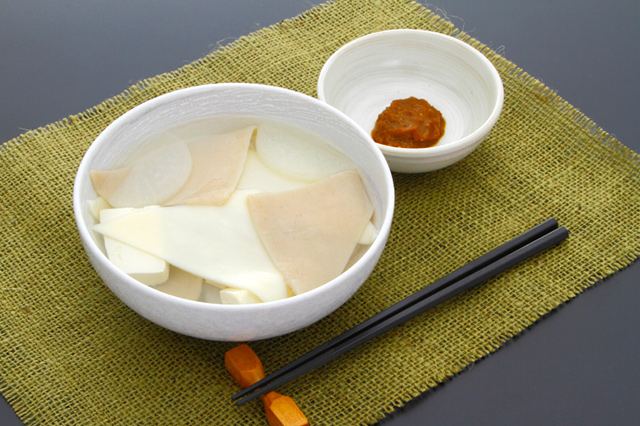
| Prefecture | Iwate (岩手県) |
|---|---|
| Region | Tohoku |
| Japanese name | そばかっけ |
| Home area | Northern District |
| Main ingredients | It's not just flour, it's flour. It's flour. |
History and Origins
North Iwate Prefecture is a cool east wind, and it has a severe cold, and at one time low rice rice was valuable. In order to compensate for this, the production of wheat, brambles, and knolls has been high, and culture has developed to use powdered materials. "Isn't it near?" is a traditional dish from the time when Koji was ruling the land. Cut the florida into smaller triangles and boil it with tofu, tofu, and so on, and eat it with garlic. It's been known as a special occasion, a warm hospitality dish, such as guests. Speaking of "smooth" used to be a black "narrow" made of slats, but in recent years we also like the faint taste of white flour. It is also reported that the origin of the "smooth" is the part that is made from when you hit it, or is derived from the word "eat now," which means "eat now," which is the local dialect.
When It Is Eaten
Special occasions such as guests, made at home as a warm treat, and have been close friends.
How It Is Eaten
The florida is softer than the sides and the thinnest pieces are cut into triangles. I put some soap in it, sweetened it, and served it with garlic. You may eat it as if it were fried in a table stove. Sometimes it's just a hint. In recent years, new oven studies have been made, such as fried and salt peppered, or baked and pizzad.
Recipe — Serves 3
Ingredients
- Soba-kakke (buckwheat dumplings)
- 240 g buckwheat flour
- 60 g wheat flour
- as needed buckwheat flour (打ち粉用)
- 130–150 ml water
- Mix
- 3 g dashi kelp
- 300 g tofu
- 200 g daikon radish
- Garlic miso
- 100 g miso
- 2 tsp sake
- 2 tsp sugar
- 25 g grated garlic
Method
- The sieve - flour and flour are put in a bowl and mixed with it, and the water is added a little bit into the spiral - shaped ditch.
- We mix it into air to make the water comfortable and then gradually leave it on its bare feet.
- The fabric will be packed and stuck for about 15 minutes until the surface is free of cracks.
- Rolling the sticks and stretching out the sides until they are about 30 centimeters.
- Repeat the spread of the cloth around the rod and stretch until it is one millimeter thick, making sure it is square.
- I will cut half of the flour on the side and then roll it on the top and half the base. I'll cut it by half in the vertical direction so that it becomes a convex triangle.
- Put water and cloth in the pot, and when it is boiling, take out the cloth, and boil it down.
More About 28 16
It's a local dish that goes to the old Iwate Prefecture, Aomori Prefecture.
A dish that is spread out in a flat spread of dough and cut into small triangles, as well as a dish that is cooked and eaten with garlic and garlic, along with daisy and tofu.
Overview
It was a cold land in southern China. During the Edo era, severe famines were frequent. People have developed the art of eating junk. It's one of the dishes that you use for making such a mess into flour.
In the southern part of the country, it is a household dish that is regularly eaten, and garlic garlic in soaps has different flavors for each household. Sometimes we eat with onions, gum, and nut. I've been known as a warm, hospitable dish and a special day's food for guests and others.
northeastern Akita Prefecture is also included in the Old Sung, although there are reports of soap being eaten in the mountains of Akita Prefecture.
Proliferation
Some manufacturers set up a set of raw rice and garlic flavors to be shipped across the country, and they are sending out information to try to spread as B-grade Gurmme. Not only do they cook with traditional dichon and tofu, but they also use soap in boiling, soy sauce, and so on, and so on, and so forth.
Iwate Prefecture identifies a person or group who is a resident of native food as "The Master of Iwate Prefecture" and also "The Master of the Iwate Prefecture Foods."
Origins
"Imagination" is a word from the Kosaka area, meaning "t" or "best."
Once upon a time, when the lord of Zhang had eaten the rice, it was so delicious that he made it a law that "the natives should not eat such a delicious dish." So when people make a cucumber, they cut the ends into triangles and paste them into flavor and start eating them. There are also theories that when you hit a bat, the part of the sieve that was made into a finely tapered bowl used to cook the guests, and that you ate the rest of it yourself.
This other theory contains the following:
From the look of the triangle that is derived from the word "no," meaning "no, no," meaning "no, please." I've had some soap and I've recovered my leg.
In three-towns of Aomori Prefecture, and in Taako and Southtown, we call it "the best in the world." The root of the word "total" is unknown.
It used to be made of flour when it was called "smooth," but in recent years it has been made from flour and it has been called "smooth or sour." Although "television" is common as well as "malting" made from flour, the "stirring" is what is made from flour.
Text adapted and translated from the Japanese Wikipedia article かっけ (料理) by its contributors, licensed CC BY-SA 4.0.
Dish data: Ministry of Agriculture, Forestry and Fisheries (MAFF), “Uchi no Kyodo Ryori” (Our Regional Cuisines) database, used under the Public Data License (PDL1.0); translated and adapted from the Japanese original.