Kusa mochi 草餅
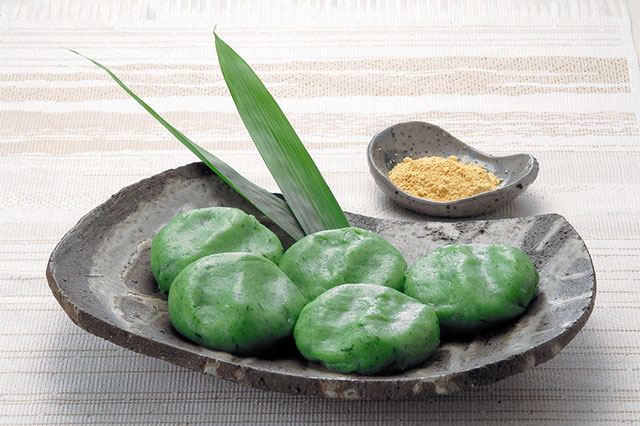
| Prefecture | Tochigi (栃木県) |
|---|---|
| Region | Kanto |
| Japanese name | 草餅(くさもち) |
| Reading | Kusamochi |
| Home area | All Tochigi Prefecture |
| Main ingredients | (Laughter) |
History and Origins
"Weeding" is a plant that has been put in it, and it has the custom of eating during activities between mid- March and mid- April, when the plants have sprouted and some of them grow. There is a custom of eating in the foyer's phrase (also called 'symbolic' and 'song') with a grassy dress and fine flour and other things, but it is originally in the old calendar. As recently as in recent years, when you start to do a new phrase on March 3rd, you often don't get any plants, and you often use the grass that you made in the Japanese sweet shop. In a home where the first girl is born with her first phrase, she prays for her child to grow up safely, such as in a house with a doll from her husband's family or her son-in-law. There are some houses in their dress that offer red sauce and white wine, but we always gave them vegetables.
When It Is Eaten
The traditional dish that I offered for my daughter's growth in prayer, the traditional dish that I gave her as a gift for her adornment. It's about time for the reeds to sprout in late March and early April of the new calendar. New sprouts have a unique smell, and the grass with freshly sprouted leaves is high in smell and is food at this time.
How It Is Eaten
Koki picks soft leaves and cleans well, puts a soda in a lot of water, boils it, dips it in water, and narrows it down. If you want to break it with a blender, add a little water. You can cut it with a knife in the spring. You put rice flour in a large ball, you add boiling water, you stir quickly, you put a little bit of ears, you put a stick in it, and then you roll it even more. If you keep the boiled rice frozen, you can use it even after the season. If you can't get a daisy, you can use the leaves part of the spring plant.
Recipe
Ingredients
- 2 cups(260 g) rice flour (joshinko rice flour)
- 11/2 cups boiling water
- 80 g() mugwort
- Kinako (roasted soybean flour): 5 tbsp kinako (roasted soybean flour)
- Kinako (roasted soybean flour): 3 tbsp sugar
- Kinako (roasted soybean flour): 1/2 tsp salt
Method
- I've narrowed down the rice bowl well, or add a small amount of water in a blender and break it well.
- The hot water that stirs with hot water, with hot water, and with a hardness of the ears (helicopter water, which is mixed with a small ball, will rip it to a handful size for about 15 minutes).
- The steamed rice flour is transferred to the ball, and it's being ground with saws, and it's being stirred well, adding one nail to it, and it's being made even better.
- If you mix it without breaking, round each one 50 gs to the size of 70g, and add your finger to it, and fold it lightly.
- The powder mixes sugar and salt. We eat with a piece of grass dust.
More About Kusa mochi
Kusa mochi (草餅, lit. "herb mochi"), also known as yomogi mochi (蓬餅), is a Japanese confection. It is made from mochi and leaves of yomogi (Japanese mugwort). The leaves are kneaded into the mochi, giving it a vivid green color. The greenness depends on the amount of Japanese mugwort blended in the mochi.
History
The custom of kneading Japanese mugwort was adopted from the Chinese. Documents state that nobles ate kusa mochi during palace events in the Heian era. It used to be made with Jersey cudweed before the Heian era. Another purported reason for the change in ingredients was because Jersey cudweed is called Haha-ko-gusa which literally translates to "mother-and-child grass". As kusa mochi was eaten with a purpose of wishing for the health and well-being of mother and her children, it was considered ominous to knead jersey cudweed into the mochi.
Since the Edo-era, kusa mochi began to be used as offering for Hinamatsuri (the Girl's Festival). The reason it was chosen as the offering was because of the vivid green color that represents fresh verdure. Japanese mugwort is known for its vitality, which makes it difficult to eradicate. Kusa mochi was used as an offering that wishes health and longevity.
As medicinal food
The idea of food being fundamentally connected to medication has been present for a long time. The Japanese mugwort, which is the main ingredient of kusa mochi, has a history of at least 2,500 years of use. In one piece of Japanese ancient literature, it is stated that Japanese mugwort can be used as a hemostatic, a medicine for diarrhea, and for miscarriage prevention, and these uses are still put to practical use today. Research done in by the Hokkaido Tokachi Area Regional Food Processing Technology Center has claimed that Japanese mugwort is effective in improving blood flow.
The Japanese mugwort is a member of the asteraceae plant family, which some people have allergies to.
Text adapted from the English Wikipedia article Kusa mochi by its contributors, licensed CC BY-SA 4.0.
Dish data: Ministry of Agriculture, Forestry and Fisheries (MAFF), “Uchi no Kyodo Ryori” (Our Regional Cuisines) database, used under the Public Data License (PDL1.0); translated and adapted from the Japanese original.