Koshinejiru こしね汁
| Prefecture | Gunma (群馬県) |
|---|---|
| Region | Kanto |
| Japanese name | こしね汁(こしねじる) |
| Reading | Koshinejiru |
| Home area | Tokuoka City |
| Main ingredients | It's really cool, you know? |
History and Origins
Toshioka City, south of Gunma Prefecture, is a city of natural abundance. In addition to a strange mountain called Mount Hakoku, Akiyama, and Akiyama, there is a first-class river in the center of the city. Since the climate is even warmer, crops such as meat and vegetables are grown deliciously and produce a lot of special products. The three vegetables that are famous for growing in the sweet and Tomaoka region are the vegetables that are grown in the green and green rice. In the weather of Toshioka City, there are many rich and fine rice plants that grow well, such as the tall, well-dressed rice paddy. So the Council of the Women's Association of Tooka City created a local dish of soup rich in these products. I took the initials of "I'm sorry," "I'm sorry," and I named them "I'm sorry."
When It Is Eaten
As can be seen from the existence of the Toshioka silk mill registered in the World Heritage site, Toshioka City was once a well-fed area. But with the changing times, the consumption of silk products has been reduced, so that more and more farmers have adopted the climate. In it came to be a slow-growing potato production, and local dishes like gravy were made.
How It Is Eaten
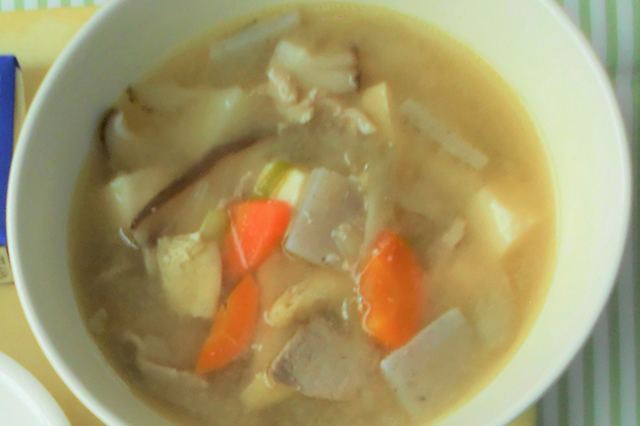
It's decided to put three of them in a pot, either sweet or sweet, but the vegetables and tastes used vary according to the family's. It's delicious to add a lot of local produce such as raw potatoes, carrots, tofu, pork and so on. First, we roast vegetables and meats that are hard to pass through, but then we boil them in broth, and when the vegetables are cooked, we taste them with a tastey sauce or a broth oil. I'll add to it some that will make it easier to pass through the fire, such as refueling oil, tofu, and cucumbers.
Recipe — Serves 4
Ingredients
- 40 g konnyaku
- 35 g(2) shiitake mushrooms
- 20 g(10cm) green onion
- 80 g(1) potato
- 25 g(15cm) burdock root
- 30 g(2cm) carrot
- 20 g(1/2) aburaage (fried tofu pouch)
- 60 g tofu
- 80 g 豚もも肉こま切れ
- Mix: 34 g(2 tbsp) miso
- Mix: a pinch dashi powder
- Mix: 2 g(1/3 tsp) soy sauce
- 4 g(1 tsp) sake
- 3 g(1 tsp) oil
- 500 ml water
Method
- Cut into easy-to-eat size, and undercut, and pull out the pot. I'll cut short a book of oil, boil it down, oil it out, and keep the water in check. The stone will continue to be sliced. We peel the vegetables, and the potatoes are cut into two and a half-inch angles and the carrots. The bladder is thinly cut out and then pull out the pot against the water. I'll cut her throat. The tofu is cut into a tiny half-inch eye.
- We can add oil to the pan and heat it, and then we can put a cut-and-stain bladder in it and cook it. Next, add pork and wine and roast them. I can cook the carrots, potatoes, and more.
- Put water in and cook until the ingredients are soft.
- I'm going to make them boil up, fatten up, add to themselves.
- Add a sieve and taste it.
- I'm going to put in a bow and stop the fire for the last time.
Dish data: Ministry of Agriculture, Forestry and Fisheries (MAFF), “Uchi no Kyodo Ryori” (Our Regional Cuisines) database, used under the Public Data License (PDL1.0); translated and adapted from the Japanese original.