Home / Kanagawa / Wariboshidaikonnohariharizuke
Wariboshidaikonnohariharizuke 割り干し大根のはりはり漬け
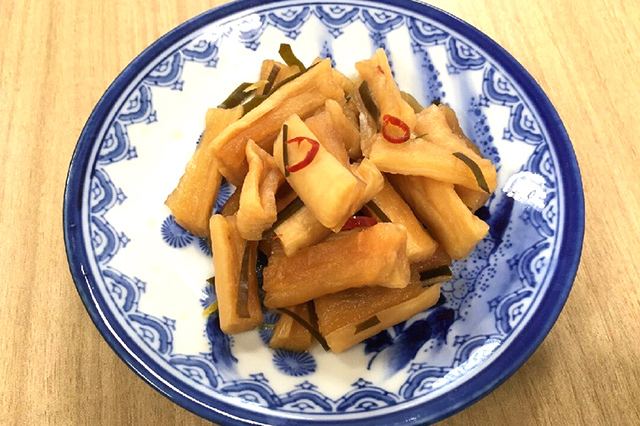
| Prefecture | Kanagawa (神奈川県) |
|---|---|
| Region | Kanto |
| Japanese name | 割り干し大根のはりはり漬け(わりぼしだいこんのはりはりづけ) |
| Reading | Wariboshidaikonnohariharizuke |
| Home area | Miura City |
| Main ingredients | Big root |
History and Origins
Local food is passed on to the city of Sanura, which lies at the tip of Miura Peninsula. The main root, a local product, was cut more thick than the cut and cut into "silver radish" and then soaked in citrus oil and citrus and other flavors. Miura City is a city surrounded by the sea on three sides. Although winters are cool in winter and summers are cool, the whole year is full of various vegetables, but the main root is proud of Japan's best production and is the country's designated source. There was already a large root growing in this area by the time Edo. It was the famous triura root that was born in the latter part of Meiji and the traditional triura of Sanura and Tokyo. When it was shipped from New York to the Tokyo market in New York, it was named Miura root and became known throughout the country as a special product. In the '50s and '50s, the typhoon destroyed the main root of the basalt, which began to grow, and today the easy - to - harvest stem roots account for most of the shipment. However, it is still very popular with the basilica root and is being sold around the center of the store. In the city of Miura, which is very familiar to the heart, old-fashioned roots have been made as one of the main cooking methods. The regular dish with a cut-and-a-half root is glueed and the flavor of Paris is enjoyed.
When It Is Eaten
The main root crop in Miura City is in March of November. That's why local roots are also made in winter. Many farmers are frequently eaten as a daily diet.
How It Is Eaten
If you cut off the root root, you divide 16 by 20 in a vertical order, and if you dry the sun for about two weeks, you will get a large root. If you dip the root in a liquid like stamen, sulme or soy sauce, it's done with a glue. There are many kinds of events that are enjoyable these days, such as putting in materials like sazae and walnuts, or popping with hawk claws, or using kimchi pigments.
Recipe — Serves 5
Ingredients
- 100 g split dried daikon
- 10 g kelp (konbu)
- 10 g dried squid
- 4 chili pepper
- Mix: 200 ml water
- Mix: 60 ml soy sauce
- Mix: 35 ml vinegar
- Mix: 35 g sugar
- Mix: 15 ml mirin
Method
- Wash the root with water.
- Cut the large root to about one centimeter.
- I'll cut the cloth in half.
- I'll cut off the sulme.
- The peppers are cut out of seeds and cut into small mouths.
- I'm going to boil the juice in the pan and then boil it.
- Add to the bat two striped daisies and three cloths, four sulme and five peppers and mix them gently.
- Put a seven-bed-up ingredient in the container.
- I pour six flavors into it.
- I'm going to make a heavy stone.
- Sometimes I mix and store the whole with chopsticks.
- It's the sixth day of the day. It's a good taste and it's a good meal.
Dish data: Ministry of Agriculture, Forestry and Fisheries (MAFF), “Uchi no Kyodo Ryori” (Our Regional Cuisines) database, used under the Public Data License (PDL1.0); translated and adapted from the Japanese original.