40 4 かつめし
| Prefecture | Hyogo (兵庫県) |
|---|---|
| Region | Kinki |
| Japanese name | かつめし |
| Home area | Kagawa City and the surrounding area. |
| Main ingredients | I've got beef, cabbage, rice. |
History and Origins
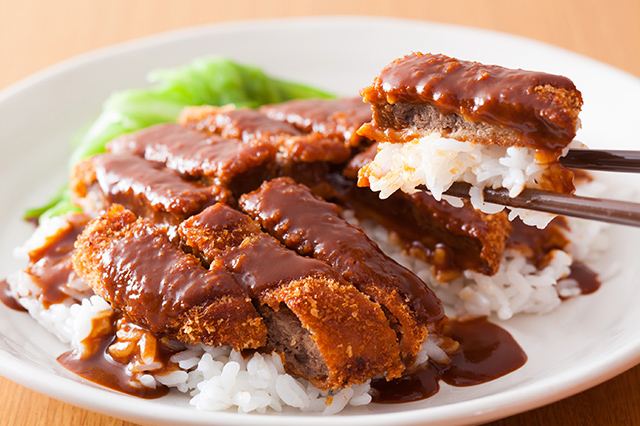
The "shoe" is a sea dish with flat beef cabbage on top of a plate on an ocean dish, with a demics sauce on top, and a cabbage on the side with a cucumber on it, and a native dish of the Kaji River. Soon after the war, when beef catches were still rare, it began in the city dining room as "a meal that can be eaten easily without a knife and fork." Later, in other dining rooms, he began to add and provide a lot of hard work, such as greasyness, and spread throughout the city. Now, not only beef, but also rice and other freshly prepared sauces, such as rice, chicken, shrimp, and so on. In the shops in Kabgawa City and around it, you can enjoy different variations for each store.
When It Is Eaten
As a regular meal, we can cook and eat at home regardless of the season.
How It Is Eaten
They say that rice on a plate is thin, and beef cabbage on top of it is a delicious trick to hang on a flat surface and let the fried ones fall off. Besides beef cats, sometimes we eat with a bite of chicken or chicken.
Recipe — Serves 5
Ingredients
- 300 g(2 × 180 ml) rice
- 450 ml(2 1/4 cups) water
- 400 g beef (スライス)
- Mix: 30 g(3 tbsp) wheat flour
- Mix: 15 g(1 tbsp 1/2) potato starch
- Mix: 7–8 ml(1/2 tbsp) vinegar
- Mix: 30 ml water
- a pinch salt
- a pinch pepper
- panko breadcrumbs, to taste
- oil for frying, to taste
- 250 g cabbage
- 400 ml(2 cups) hot water
- 2 g(1 tsp) curry powder
- a pinch salt
- 1 composite
- 600 ml(3 cups) hot water
- 25 g butter
- 25 g(3 tbsp) wheat flour
- 70 g(4 tbsp 1/2) ketchup
- 45 ml(3 tbsp) Worcestershire sauce
- 50 g(4–5 tbsp) grated onion
- 3–5 g(1/2–1 tsp) Japanese mustard
Method
- I wash rice and cook it in a rice bowl.
- The cabbage is cut in four inches and boiled in hot water with curry powder and salt. I'll keep it cold up to the monkey.
- One comma makes three cups of boiling soup.
- I'll melt butter in the frying pan, add flour and roast it until it turns soft.
- Put down the fried bread from the fire, cool the bottom a little, and then spread out the three soups a little bit.
- Add the ketchup, winster sauce, onions, and boil them while mixing them. Taste it and taste it with salt pepper.
- The beef is spread out one by one, and then it is shaped like a cat.
- (Like a garment of a manicured sun, which is melted in water)
- I put the beef on with salt and pepper, and the dough on the eight clothes after it.
- I'm going to use a lot of oil.
- The dishes are served, cut, and placed with cabbage and sauce and mustard.
More About 40 4
The rice is served with beef or pork on a flat plate, a dish made of demics, and a boiled cabbage. It's called a picket, but sometimes it's called a cat's rice.
Overview
The concept of a meal with Biffkats created "a meal that can be eaten easily with chopsticks." It is said that the "Good evening" was the first to appear in Kabashi Town, Japan, in 1947, shortly after the war. In those days, when we served beef casserole, there were not enough plates, and it was thought that we had put on one plate, rice, and beef casserole. This became the concept and spread. It's common to eat a pair of chopsticks, but not with spoons.
Although the easy-to-eat meal has made it a favorite food in the dining rooms and coffee shops of Kabashi City and in the shops of the local community, few stores have added to their menus such as the Kabashi City, the Pluming City and the Yumumi district around Kabuki. In the same old-fashioned country, in the city of Shire, there are few stores that serve "stuff" and it is a native dish that is limited to the extremely narrow area of the region called the Tohoku-Cap. In some cases, the traditional taste of the old haiku in the center of Kanagawa is lost because of the shortage of successors, but it is the taste of new shops in the suburbs, of being introduced to high school meals in the schools and the schools in Kabgawa, and of being known to the public.
From the beginning of the day, there are a lot of variations for each store, including the taste of sweets, which are now close to those who are later called "katchin palm rice" by the oysters, which are called the "cooky sauce" by the main body and thick coats, which should be called a "shoe sauce" or a "shoe sauce" or "shoe sauce," which is a little bit closer to the black color of the "snake sauce" type.)
Once, at the JR station in the Kanaji area, such as New Kobe Station and Sanomiya Station, the "Tiger's Victory" train that served the cooking by the "Tigers" by the "Tigers" by the "T" by the "T" by the "Tigers" was sold for 1,000 yen" but was finished manufacturing and selling by 2022. At one time, I appeared as the local menu for a convenience store.
B-grade Gurmation
There's a movement to take advantage of the localization of the B-class boom here since the 1990s. The PR organization at the top of the screen has "The League of East-Easting and the Fine Shoe." In 1999 and 2000, the famous popular song "The Snatcher's Song" and in 2008, the logo marks and mascot characters were created to make the brush open. The formation rule was used for further publicization.
Fuck you.
Each store has a secret story, but it's easy to make at home at a certain level. The basic shape is to mix the uster sauce with tomato ketchup, soy soup, add water and wine or wine, and boil a small amount of flour. Also, from the food companies in Kabgawa City and the Otakk sauces and so on, there's a large-scale ebony tip.
A similar dish.
(Dimics source casserole) Cooked from the center of Okayama City. It's older in history than a brush. While the oysters use the birch mainly, we usually use the birch. The sauce is called Domics, not real glass, but really "D" in a wig. While the brooms are on the flat plate, this one is on the bowl. Also, while the brooms add cabbage, it is served between rice and tonkats. Kajigawa and Okayama are close to each other, but I can't see the connection. It's a local dish found around the Osaka City speed zone. This is an old-fashioned one, too, and it is believed that it was born in about the 7th year of the Shogun. Cats are cut into small pieces, and there is plenty of soft brown sauce, like curry rice and palm rice. Vegetables can't be added. Escap Hokkaido, in the region centered around the city of Basery, is similar to a brush. The difference is that it's a roasted butter rice with a slice of rice added to it, whereas the mustard is a white rice. For other variations in the catsu system, refer to Katzumi.
Text adapted and translated from the Japanese Wikipedia article かつめし by its contributors, licensed CC BY-SA 4.0.
Dish data: Ministry of Agriculture, Forestry and Fisheries (MAFF), “Uchi no Kyodo Ryori” (Our Regional Cuisines) database, used under the Public Data License (PDL1.0); translated and adapted from the Japanese original.