Oden 姫路おでん
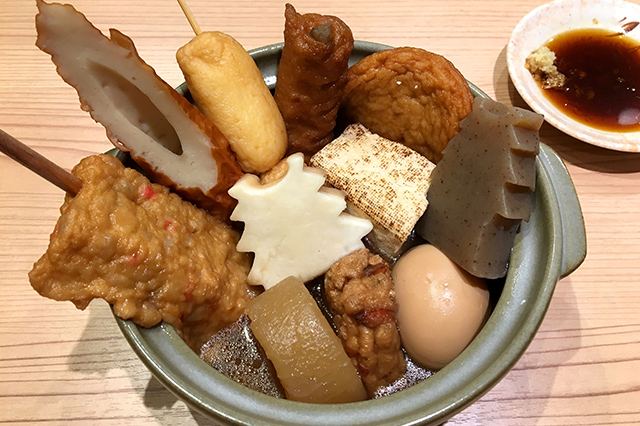
| Prefecture | Hyogo (兵庫県) |
|---|---|
| Region | Kinki |
| Japanese name | 姫路おでん(ひめじおでん) |
| Reading | Himejioden |
| Home area | The princess city and its surroundings. |
| Main ingredients | It's a very simple thing to do. |
History and Origins
You usually eat with peppers, but you eat with raw oil or with it. This is the characteristic of the native dish of the princess's family. There are two kinds of Kanto stew in the princess's path, called Kanto, which is rich and sweet, but if you use raw oil, it is called "Daijidashi." Sequoise oil, which is added to raw oil, was originally a source of raw and soy sauce. It is also thought that the nearby area is one of the main products of soy sauce, and that these may have led to the eating habit of using soy sauce. It was only in 2006 that the volunteers who were active in the princess's diet called her "City of the City." Many tourists are now well known here as a gurney and are coming to see you for the purpose of "The Princess's Road."
When It Is Eaten
They are usually made at home, but they are eaten even on celebration sites such as fall festival and building up. If you're in a family where you're going to carve the leftovers of the pan and put them in a konaki, you might eat them.
How It Is Eaten
Make sure that your utensils are prepared by the family's preference, besides the ox, radish, eggs, garlic, and so on. After the bull's rice is boiled under water, wash it with water, and do it with a large root, then boil it for about an hour with a mixture of juice and soy sauce. When finished, either put raw silica oil on it or mix it in and eat it while doing so.
Recipe — Serves 4
Ingredients
- Mix: 400 g daikon radish
- Mix: 200 g potato
- Mix: 4 ゆでたまご
- Mix: 4 creepy
- Mix: 2 chikuwa (fish cake tube)
- Mix: 4 plain Heaven
- Mix: 4 atsuage (thick fried tofu)
- Mix: 1/2 konnyaku
- Mix: 他にお好みのおでん種 (すじ肉), to taste
- Mix: 800–1000 ml dashi stock
- Mix: 60 ml soy sauce
- Mix: 30 ml mirin
- Mix: 15 ml sake
- Soy sauce: ginger (すりおろす), to taste
- Soy sauce: soy sauce, to taste
Method
- The seed is prepared and the radish is cut into three-centi-twenty-inch slices and boiled in rice lye. - Cut into triangles and boil them down. - The potatoes are peeled and put in water. - Sequoia, plain and thick, put boiling water on them. - I'll cut the dick in half. - I'll make a boiled egg and leave it in the shell.
- Put the sesame oil in the soup, gravy, and wine, and put the radish in the sauce, and boil the potatoes. If you have an eight-minute fire in the potatoes, I'll cook them with a bowl of rice and a bowl of rice.
- I'll put a pan in a bowl and add a pan of sesame oil and a base of earth.
More About Oden
Oden (おでん or 御田) is a type of nabemono (Japanese one-pot dishes) consisting of several ingredients such as boiled eggs, daikon or konjac, and processed fish balls stewed in a light, soy-flavored dashi broth.
Oden was originally what is now commonly called miso dengaku or simply dengaku; konjac or tofu was boiled and eaten with miso. Later, instead of using miso, ingredients were cooked in dashi, and oden became popular. Ingredients vary according to region and between each household. Karashi is often used as a condiment.
Oden is often sold from food carts, though some izakayas and several convenience store chains also serve it, and dedicated oden restaurants exist. Many different varieties are sold, with single-ingredient dishes sometimes as cheap as 100 yen. While it is usually considered a winter food, some carts and restaurants offer oden year-round. Many of these restaurants keep their broth as a master stock, replenishing it as it simmers to let the flavor deepen and develop over many months and years.
Oden is represented in Unicode as an emoji at code point U+1F362: 🍢
Regional variations
Japan
In Nagoya, oden retains its original meaning of a miso-based stew, and Tokyo-style dashi-based oden is referred to as Kantō-ni (関東煮; lit. 'Kantō stew')) instead. Soy sauce is used as a dipping sauce.
Miso oden is simmered in hatchō miso broth, which tastes lightly sweet. Konjac and tofu are common ingredients.
In the Kansai area, this dish is sometimes called Kanto-daki (関東炊き) and tends to be more strongly flavored than the lighter Kantō version.
Shizuoka oden uses a dark-colored broth flavored with beef stock and dark soy sauce, and all ingredients are skewered. Dried and ground fish (sardine, mackerel, or katsuobushi) and aonori powder are sprinkled on top before eating.
Udon restaurants in Kagawa Prefecture in Shikoku almost always offer oden as a side dish, to be eaten with sweet miso while waiting for udon.
Outside Japan
China
In China, 7-Eleven markets oden as hǎodùn (好炖) a word play on 'good pot'.
South Korea
In South Korea, the loanword odeng (오뎅) borrowed from Japanese oden is a synonym of eomuk (fishcakes). The boiled dish consisting of fishcakes is called by the names such as odeng-tang (오뎅탕) or eomuk-jeongol (어묵전골), with the words such as tang ('soup') or jeongol ('hot pot') attached to the ingredient name. The street food version is sold from small carts and is usually served with a spicy soup. It is very common on the streets of South Korea and there are many restaurants that have it on the menu or specialize in it.
Taiwan
Oden was introduced to Taiwanese cuisine during Japanese rule and is referred to in Taiwanese Hokkien as olen (Chinese: 烏輪; Pe̍h-ōe-jī: o͘-lián), which has been further loaned into Taiwanese Mandarin as hēilún (Chinese: 黑輪). Tianbula (Chinese: 甜不辣; pinyin: tiánbùlà; lit. 'sweet, not spicy') is a common ingredient for oden and is a popular snack at night markets. Tianbula is actually Japanese satsuma-age and was introduced to Taiwan by people from Kyushu (where satsuma-age is commonly known as tempura) when Taiwan was under Japanese rule. Besides the more traditional ingredients, the Taiwanese olen also uses many local ingredients, such as pork meatballs and blood puddings. More recently, oden is offered in convenience stores where it is sold as guāndōngzhǔ (關東煮), the Mandarin reading of the Japanese characters for Kantō-ni.
Text adapted from the English Wikipedia article Oden by its contributors, licensed CC BY-SA 4.0.
Dish data: Ministry of Agriculture, Forestry and Fisheries (MAFF), “Uchi no Kyodo Ryori” (Our Regional Cuisines) database, used under the Public Data License (PDL1.0); translated and adapted from the Japanese original.