Zosui クファジューシー
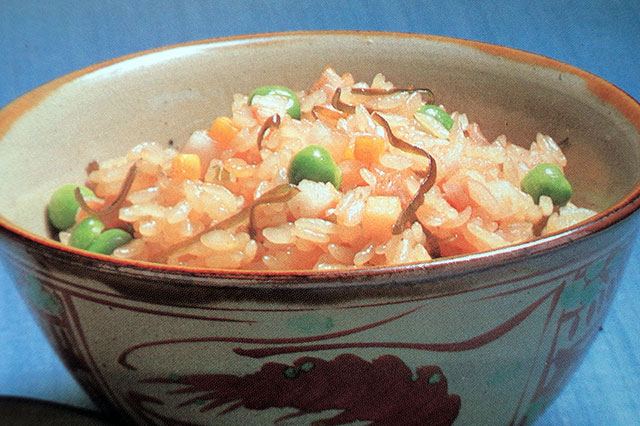
| Prefecture | Okinawa (沖縄県) |
|---|---|
| Region | Kyushu & Okinawa |
| Japanese name | クファジューシー |
| Home area | All within the province. |
| Main ingredients | Three pieces of rice and a pig. |
History and Origins
There's "Jussy" in a formal form called "crazy" and a "jussy" in a formal style. "Cfay" is characterized by a faty, and well - done by the fat that is good enough to boil with pork. It adds vinegar to the little oil that is left in the mouth after eating. Originally, it was a Hale's day dish which was essential for a performance or celebration, but today it is also known as home cooking. The "Cfayce" includes such things as making a bowl spirit "on the entourage" or using a leaf pepper or a rice potato made from rice in wintertime. On the other hand, there are "Yafajsy" and "Yafajsy," which were commonly eaten by people, such as "Yafajawsy" and "Kandaba" and "Jussy" and "Kandaba-msai."
When It Is Eaten
They act as events and celebrations. It starts with the host's welcome 'on July 13 of the old calendar, and it takes place between the three-day send-in-the-wind-in-the-wind-o-cuy. On the evening of Unche's, the jussy, which uses leaves pepper, is eaten. The "Tungsy Jiesy" with either a potato or a lily is a dish that is eaten at wintertime. It's also now eaten as a daily diet.
How It Is Eaten
Wash the rice. Don't have to wash it. I'll cut the water off. I'll boil three pork meat in whole pieces and then cut it into pieces. Carrots, water-rescue dried sea cucumbers and pumpkins cut as well. It's a cold pig in a pot, and it's made of soy sauce, salt, rice, chicken meat, vegetables, and so on. Once you're cooked, add the lard and mix. I sometimes have lunch on the table.
Recipe — Serves 4
Ingredients
- 2 cups rice
- 21/4 cups dashi stock
- 1–1 tsp1/2 salt
- 1–2 tbsp soy sauce
- 150 g pork belly
- 30 g carrot
- 2 dried shiitake mushrooms
- 30 g kamaboko (fish cake)
- 2 tsp lard
Method
- Wash rice 30 minutes before cooking, raise it up to the monkey, and drain the water.
- Three pork meats are boiled whole and cut into five millimeters.
- Carrots, put-backed mushrooms and pumpkins will also be cut.
- It's a pig in a pot just before cooking, so you can add salt, salt, sesame oil and mix it with 1, 2 and 3.
- When you cook, add lard to it, mix it, and steam it.
- It's your favorite and will add a simple utensil.
More About Zosui
Zōsui (雑炊; literally "miscellaneous cooking"), or ojiya (おじや), is a mild and thin Japanese rice soup akin to a rice-based vegetable soup. It is made from pre-cooked rice and dashi or water seasoned with either soy sauce or miso and cooked with other ingredients such as meat, seafood, mushrooms, and vegetables. It is generally served to those who are sick or otherwise feeling unwell, and is usually only served in the winter.
Leftover soup from nabe is often re-used for zosui. Instead of rice, udon and ramen noodles are recent alternatives.
History
In the days when it was difficult to keep cooked rice warm, the only way to reuse cold rice was to combine it with miso soup, so this was widely done in households across Japan. Nowadays, it is more often used to make meals for the sick or those feeling unwell rather than in everyday meals.
Varieties
There are a number of varieties of zōsui, including maru zōsui (まる雑炊) (made with Chinese softshell turtle), fugu zōsui (ふぐ雑炊) (made with pufferfish), tori zōsui (とり雑炊) (made with chicken), kani zōsui (かに雑炊) (made with crab), sukiyaki zōsui (すきやき雑炊), and shabu-shabu zōsui (しゃぶしゃぶ雑炊). For home cooking, leftover broth and rice is combined with whatever ingredients are at hand.
Ojiya
The word ojiya often has the same meaning as zōsui, but was created as part of the nyōbō kotoba, or "court ladies cant". Its origins are unclear, though it has been suggested that it came from the sound made by the rice cooking, or possibly from olla, the Spanish word for ceramic cookware (pronounced oja (オジャ) in Japanese).
Many people use the words ojiya and zosui interchangeably, and usage varies by region and household. However, the following list shows some common differences between them:
- Zōsui is prepared by rinsing the rice first to increase its stickiness. This is not the case with ojiya.
- In zōsui, the broth and rice are brought to a boil together, preserving the shape of the rice. With ojiya, the shape of the rice is not preserved when boiled together with the broth. The rice grains fall apart and distort in shape.
- While being flavored with miso or soy sauce, the broth in ojiya remains light or white in color. In contrast, the broth of zosui is only flavored with soy sauce.
Related tradition
Ryukyu Islands
In Okinawan cuisine, zōsui include jūshī. Jūshī (Okinawan: ジューシー), originally jūshīmē (Okinawan: ジューシーメー)) is considered to be derived from zōsui. However, it is generally made with uncooked rice and far more water is used when making it. This is the origin for the name jūshī. Strictly speaking, these rice dishes are called kufajūshī (Okinawan: クファジューシー or katai jūshī (Japanese: 固いジューシー), literally "firm jūshī"). The zōsui of Japanese cuisine corresponds to yafarā jūshī (Okinawan: ヤファラージューシー or yawarakai jūshī (Japanese: 柔らかいジューシー, lit. 'soft jūshī'), in Ryukyuan cuisine.
There are a huge variety of styles in which this is made, including using large amounts of lard or margarine. Ingredients like ribs, hijiki, carrots, shiitake, and konjac jelly are also commonly used. Yafarā jūshī commonly contains ribs or pork, yomogi leaves (fūchibā,Okinawan: フーチバー), potato leaves (kandabā, Okinawan: カンダバー), and taro (chinnuku, Okinawan: チンヌク).
Text adapted from the English Wikipedia article Zosui by its contributors, licensed CC BY-SA 4.0.
Dish data: Ministry of Agriculture, Forestry and Fisheries (MAFF), “Uchi no Kyodo Ryori” (Our Regional Cuisines) database, used under the Public Data License (PDL1.0); translated and adapted from the Japanese original.