Dangojiru だんご汁
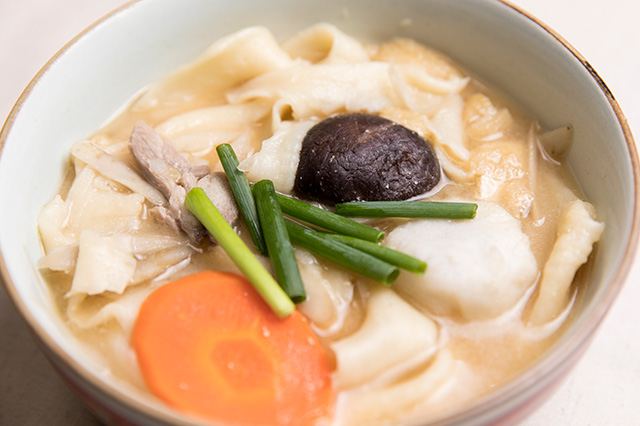
| Prefecture | Oita (大分県) |
|---|---|
| Region | Kyushu & Okinawa |
| Japanese name | だんご汁(だんごじる) |
| Reading | Dangojiru |
| Home area | All within the province. |
| Main ingredients | And it's just wheat and rice. |
History and Origins
Oita Prefecture was developed, many of the lands were not suitable for rice and grain growing from old-fashioned fields. Since most of the grain was ground to powder, eating cultures are rooted in the ground at Oita Prefecture. The "Cypriot" is a representative of it. The flour is folded into thin bands, and the coral is mixed with paint and put in the juice of the flour that is often eaten in the Kyushu region, as well as in the blending and white-champ soup. In times when rice was scarce, we used to eat it daily instead of rice. I imagine a sphere that is usually called a choli, but in large measure, it's pulled by hand and eaten. It's characterized by a stronger cone and a more pleasant tooth. It looks like a knead, but it is said that it has come to be called a sieve because it sleeps in a round state in the process of building a coral. After that, the thin banding is done so that the flavor will be easily soaked in the soup. In Fukuoka Prefecture and Kumamoto Prefecture, it's called "sew."
When It Is Eaten
It was said that in the past, even at home, they had a good "silver" product. It's the way grandmothers, mothers, children, and grandchildren are taught, and it's connected to modern times. During the cold season, my body warms up and my stomach fills up. The "George" used to sit at the table from fall to winter. It's a big soul food.
How It Is Eaten
Although it is a great honor to be able to serve a lot of soup in a pot, there is a difference between the way the juice is extracted and the way the coral is used in each household, and it is rich in barati. These days, it is often made out of carrots, lentils, radishes, cabbages, meats, and other common foods in every household, but among other things, it is a very popular combination of the sea potatoes, which is very much liked by the coral. Unlike pig juice, meat is not basically a simple dish. At one time, it was often made of ground flour, and it was preferred to taste good as a bite, but recently it has been difficult to get it. It's delicious to taste it with sesame base.
Recipe — Serves 6
Ingredients
- 500 g wheat flour
- 13 g salt
- 250 ml water
- as needed dashi stock (dried sardines)
- 10cm daikon radish
- 1 carrot
- 1 burdock root
- 5 taro
- 150 g pork
- as needed small green onion
- 150 g miso
Method
- Mix the flour with salt and add a little water.
- I'm sorry, I'm sorry. Water sees the state of the powder, but adds to it, doesn't let it all in at once.
- If you don't get hold of it, round it up.
- I can wrap it in wet-kin and put it to bed for about an hour.
- It'll be a stick and a thumb-sized break after you've slept.
- With the palm of your hand, you can wet your wet-kin and then sleep on it.
- Hand shakes and boils in the hot water of the pot.
- It's all right.
- I'll take the juice from the cloth.
- Keep the potatoes under your skin, peel them and cut them into easy size to eat with about seven-inch thickness.
- I'll put it in the water.
- We'll peel the carrots and make them bigger.
- I'll peel the radish off and make a big hint of it.
- Cut vegetables and put them in the soup and boil them. It's easy to cut. It's also a pork.
- When the material is cooked, taste it with a sauce and add coral.
- I'll hang it on a vessel and scatter the small cut.
More About Dangojiru
Soy sauce is a native dish of Oita Prefecture. It's eaten all over the province.
Overview
It's made of flour, a flat soy sauce, and put it into the juice of the sauce. In the juices are goobows, carrots, sea horses, pork and so on. It's like pig juice. Tastes are used with flour, and spices are used by daisies.
This coral is a salt water dough that has become as hard as ears, and once it has been laid, the dough has been torn to the size of a thumb and shaped into a single flat-nut-like shape. I'm told that reaching out improves teeth and makes the soup easier to bind. In some areas, it's not soy, but it's literally a stretch of torn fabric that uses coral.
In large areas, the plains were scarce, the old rice didn't grow as much, and the wheat grew better. So, there were many wheat dishes and processed goods made. In it it is common food, and it can be eaten on a dull day, if you like it, and it's a noodle food, but it's a near - to - noodle food.
And if you put a little powder and sugar in this noodle-like "silica," it will produce a Oita Prefecture native dish. The thin sea horse is eaten extensively in the province and is also used as a gift for the Nirvana party, the bonsai and the seven-sevens.
Text adapted and translated from the Japanese Wikipedia article だんご汁 by its contributors, licensed CC BY-SA 4.0.
Dish data: Ministry of Agriculture, Forestry and Fisheries (MAFF), “Uchi no Kyodo Ryori” (Our Regional Cuisines) database, used under the Public Data License (PDL1.0); translated and adapted from the Japanese original.