Hinonazuke 日野菜漬け
| Prefecture | Shiga (滋賀県) |
|---|---|
| Region | Kinki |
| Japanese name | 日野菜漬け(ひのなづけ) |
| Reading | Hinonazuke |
| Home area | All within the province. |
| Main ingredients | I don't know if it's a day-to-day vegetable or salt or rice. |
History and Origins
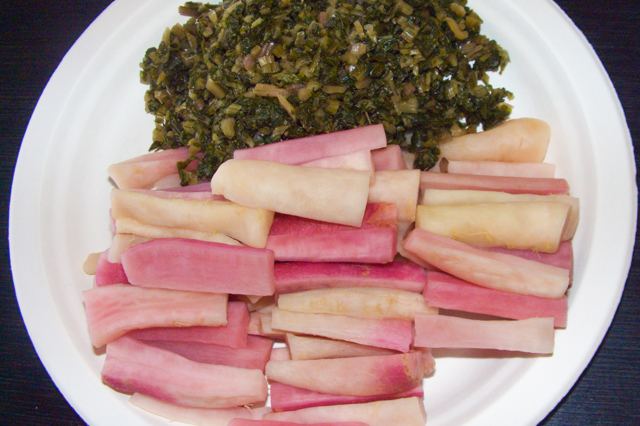
"Saturation" refers to traditional vegetable products from Shiga Prefecture (in 1998), and Shiga Prefecture selection is selected as "Food and Agriculture" in Shiga Prefecture. It is said that Japanese vegetables were introduced to Japan in Shiga Prefecture. Sunbeaks are a type of clothing that features purple on the leaves, white towards the roots, and is 30 centimeters long and narrow. They say that the season is due mainly from October to the end of December. However, it is often used as a delicacy, a bitter taste, a bitter pain, and a thorn. There are many ways to dip leaves, cut leaves, cut short roots, and stuff them in vinegar, with leaves, dip them in with leaves, and "suck" in sweets, and "snack" in garlic. The roots of the daily vegetables contain abrasions, which serve as starch digestive enzymes, as well as a small amount of vitamins, which are rich in the leaves, such as beta caroten, vitamin C, calcium and potassium.
When It Is Eaten
The day-to-day vegetable season is from October to December, but you can eat a year-long meal because it also sells processed foods that are soaked in.
How It Is Eaten
Wash your vegetables daily and dry them. We can put salt in the bottom of the tub and we can make sure that our daily vegetables are flat. Add salt on top and hold tight with your hands. We can repeat this procedure several times, push it down and place a heavy stone on it. After being soaked, I'll check the swelling in about a month.
Recipe
Ingredients
- 5 kg() sunflowers
- 200 g salt
- 2 kg rice bran
Method
- After washing the vegetables, we wash them until they are ready for two days.
- I'll wrap leaves around the stock of the daily vegetables. Mix well with rice and salt, put it in the bottom of the tub, then do the flating of the daily vegetables, add salt and hold tight with your hands.
- Then we can take the vegetables and salts one by one, and when we reach the top, we can press them down, and we can press them tight, we can press them, we can press them, we can press them, and we can double the weight of the heavy stone content.
- If the water doesn't rise even in a few days, use 4% salt water to water them. I'll see how it's going in about a month.
More About Hinonazuke
Sunbeaking is a dish of daily vegetables. It's a special product that's going to be very good at Shiga Prefecture and Mie Prefecture.
Overview
It's a regular diet of daily vegetables and is known as winter taste.
The Birth
The story of the following story comes to pass:
Shinichi Hideo, lord of Sakura, discovers the root plants that grew themselves in the Kamuzucho family. Since it was so delicate in color and taste, Sadie dedicated it to her parents, the Tokyo Public Home. When the parents presented the kimono to Emperor Hirohito, after he liked the flavor and the beauty of his appearance, Emperor Owada ordered the parents to sing a song of Japanese beauty and began to call the root vegetable "Sun's Vegetables" and the vegetable "Same'" from that song. The Japanese song, which was added to the tribute sent by the Shinji, is said to be "The Child's Day of Youth."
The daily vegetables spread across Japan by the conscription of Shinichi and by the hand of Japan traders. They became widely known as Japan's best products.
I've made it. I've made it.
I'm going to do it. The day I wash the water, I salt the vegetables. I'm going to put it on books. It's wrapped in barrels with flavored flavors, such as rice or vinegar.
Although it used to be made of just salt and soy sauce, it has been made with sweets more and more these days.
There are various ways to soak it like this:
I'm dressed up. I'll sweeten the vegetables on a round day. Sakura, leaves, roots are cut short and swallowed together in vinegar and sweets. It's soaked with leaves and soaked in sweet sugar. I'm going to put it on top of it.
Text adapted and translated from the Japanese Wikipedia article 日野菜漬け by its contributors, licensed CC BY-SA 4.0.
Dish data: Ministry of Agriculture, Forestry and Fisheries (MAFF), “Uchi no Kyodo Ryori” (Our Regional Cuisines) database, used under the Public Data License (PDL1.0); translated and adapted from the Japanese original.