Hōrakuyaki 法楽焼
| Prefecture | Ehime (愛媛県) |
|---|---|
| Region | Shikoku |
| Japanese name | 法楽焼(ほうらくやき) |
| Reading | Hōrakuyaki |
| Home area | I'm in the city now. |
| Main ingredients | It's not just fish, it's fish. |
History and Origins
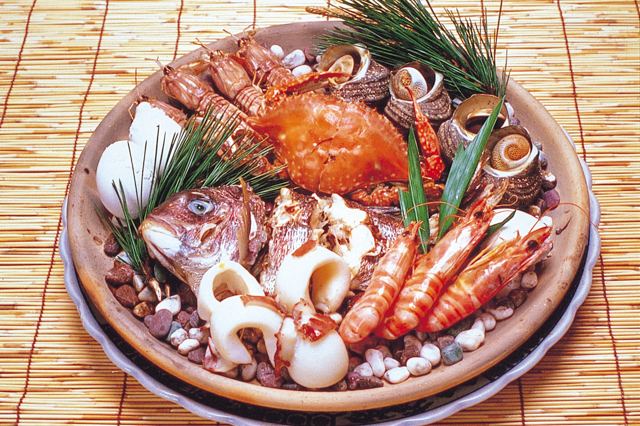
Using the "False Fabulous Cooking" now in the city's best - known dishes, using a flat cooking pot to roast salt, salt, and beans, fresh sea salts, salt, and fresh sea salts, salt, and other fish, such as sea salts, palm, shrimp, and clams, which are known as Japan's main tides. It'll be a bit of a problem to burn the dishes after they're left out. It is said that pirates were eaten during the time of the battle in the city, and it comes from the navy that was built on the island of Isshima, now in the city of Japan. It is also called pirate food. A pirate may have the image of an illegal plunderer of gold, but in peacetime, he has been able to handle sea safety, sea patrols, sea traffic, sea safety, sea travel, sea travel, maneuvers on small boats in war, and he has become good at fighting with fire and fire. It is said that he was also a culturer who liked tea, incense, and sang songs. There is now a facility called the Pirate Museum in the village.
When It Is Eaten
"Falkaki" is a dish that can be eaten year round, and is eaten at banquets because of the splendor of the look.
How It Is Eaten
I'll put pebbles and pine leaves on top of the walnuts, and tie them around a tie, and boil them around with shrimps, clams, saze, and so on. We also make a lid with a sieve and then we boil it. Since the seafood you put in uses the season, it varies according to the season, but the standard is the way you dress your tie around the center. The taste of the fishfish will be condensed without water, so that the taste will be served and the pebbles that are placed under the paint will suck in the excess water, and the whole will be boiled up.
Recipe — Serves 5
Ingredients
- 1 sea bream
- 5 turban shell
- 1 cups squid
- 5 boiled egg
- 5 shrimp
- 1 sweet potato
- ginza, to taste
- salt, to taste
Method
- We then place the pieces of rice in the middle of the tie, and then cover them with fish, vegetables, eggs, and so on.
- The taste is only salt, and the amount of salt is controlled by the amount of material used.
More About Hōrakuyaki
The roasting of roasts is a Japanese dish. I put pine leaves and salt on the broth, then I put in a dish of rice, covered it, and boiled it. I'm sorry.
It is also used with a letter such as Kyokaki or Takaki.
The taste of the fishfish is condensed to make it taste delicious.
Also, it is sometimes used as a cooking name for roasts besides steamed food, and I'll tell you later.
I'll take you to my place.
Akishikiaki is a traditional dish from Akishima and a great dish.
Rupaki
Ichiaki is now the traditional dish of the city.
The fish that are caught in the coming island Channel will be added to the surface and steamed with salt-only flavor.
It comes from the Village Coast Guard, and it is called "Packo Food."
I'll take you there. I'll take you there.
Kanashima's tanned rice is a gift cake, as opposed to the dishes mentioned above.
Two women from Oshima village, who went to Japan's mainland early in Meiji, to train them, learned how to cook rice, and then went back to the island and told the village what was to be born. The roasting on the surface of the walnut has led to the name "salted baked."
The novel "The Black Sea" by Yoshiko Yoshiko has become" in "The Burns."
It's the third-spring burn.
Contrary to the above - mentioned dish, the tannuts of Fukushima Prefecture 3X 3X 3 are cooked with a thick oil and onions. Since it is offered in roasting, it is called tanned or oiled.
It is estimated that the Akita Shiki season, the master of the third spring, was born with the story of the oil - raising story that we ate during the hunter hunt.
Rinjiro
The dish that was cooked by boiling is a small roast called "The Art" with a slice of fish and onions.
It's a dish that has been invented and developed into a cup of tea.
Text adapted and translated from the Japanese Wikipedia article 焙烙焼き by its contributors, licensed CC BY-SA 4.0.
Dish data: Ministry of Agriculture, Forestry and Fisheries (MAFF), “Uchi no Kyodo Ryori” (Our Regional Cuisines) database, used under the Public Data License (PDL1.0); translated and adapted from the Japanese original.