Janbomochi じゃんぼ餅
| Prefecture | Kagoshima (鹿児島県) |
|---|---|
| Region | Kyushu & Okinawa |
| Japanese name | じゃんぼ餅(じゃんぼもち) |
| Reading | Janbomochi |
| Home area | Kagoshima City |
| Main ingredients | It's rice powder. It's freshly ground. |
History and Origins
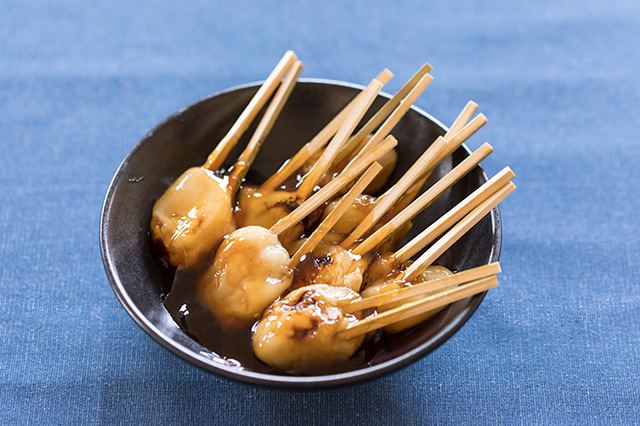
"Soo-seed" is an old dish known for Kagoshima Prefecture. "Then I will write 'two sticks'." The story is that while the father was staying at the castle of the Kagoshima City valley, the father of the castle's castle, the Manjidani of Taniyama, made the pot to comfort his father, and brought out two bowls of rice and black sugar. In the time of Edo, Taniyama from Taniyama was dedicated to Mr. Islando Koji, who is said to have spread "Sooji's" in the area. There are also theories from the name "Sooji". In ancient times, the high warrior wore two swords with his back and similar to his looks, so this name is said to have come to be. It's also said that reading two sticks in Chinese is derived from Chinese and that both words in Chinese are pronounced "sing" and that this word is "sun" and "sai" in Kagoshima Prefecture.
When It Is Eaten
Especially at any time of the year, they are eaten throughout the year. It's also ideal for the simple hospitality of the visiting district.
How It Is Eaten
We add water to the rice flour and we make it as soft as ears. In a flat circle about three centimeters in diameter, it's cool enough to float in a hot water and cool it with water. Cut the water and cut two bamboo plants. Sugar - oiled or taste-dame is liked, and when you have made a little of the sauce, you eat it with a tip.
Recipe
Ingredients
- 130 g glutinous rice flour
- 110–120 ml water
- 24 bamboo skewers
- Mix: 1 tbsp light soy sauce
- Mix: 5 tbsp sugar
- Mix: 1 tbsp mirin
- Mix: 1 tbsp potato starch
- Mix: 50 ml water
Method
- Add water to the rice flour and wipe it with ears and raise it to a flat circle about three centimeters across, boil it in boiling water, cool it for water when it floats, and drain it.
- The lubricant dandel pre-resolves the powder in water and then sets the mixture on fire with other ingredients.
- I'll burn them in a pan, stab them in two pieces each, and put them on a plate with two fingers.
More About Janbomochi
Both sticks are traditionally known for Kagoshima Prefecture.
Overview
From the word Jumbo, many associate with the jambo size, meaning something big, while the bar is a mouth-sized bowl.
The recipes were either to add water to the rice powder or to make a freshly pressed bowl as soft as the ears of ears.
The strong tenacity and elegant sweetness produced by Kyushu alone are characteristic of "gray rice" and by placing water in the corn of potatoes, or just after steaming the rice in the pan, some stores are using the juggets that have increased the volume of water to their limit, while others are providing the fragrance of the peppers.
There are shops in which sweet citrus oils have been served by the sweetest, but tasteless people, and in the center of the garden, there are "two-landers" who use the fine flour and the black sugar from the island island and make it sweet and sweet.
There is a story of how, during the time of the Civil War and the son of Emperor Kagoshima City, King Sung Shizuki, the father of the Emperor Seung Jo, made a pot of rice and poured two bowls of rice and black sugar. In the Edo period, the existence of Koyo was thought to have spread in the Sasayama region since it was dedicated to Mr. Issa.
- It's a shop.
Along the beachside of a nearby bathhouse, there are several old baths that provide food and shelter, as well as shops that bring home food and drink, and in some stores, there are also sales of frozen rice. In Kagoshima Prefecture, they sell sweets as well as supermarkets and grocery stores. Kagoshima Prefecture is an event, such as an event, there are opportunities to experience Japanese cooking, and some schools learn to make them in home school classes.
The photos and signs from Kagoshima, including his wife and children, are displayed inside the shop. The Nakagawa family in the two bar stores next to the Takada shop is also the scene of Kagoshima Prefectureroke's last day of the "Man's in Men's Hands" flower.
Origin of Name
There are various theories about the origin of the term "kiki" There is a theory that since the "two sticks" look like two swords across the side, that means two pairs of objects, meaning "Lin" in Chinese, that this is pronounced "Lin" in Kagoshima Prefecture, and that the name "Sing" has been spread since about 10 years after IX. So there is also the theory that it was once also called the Fukuoka and the Sagitsu.
On the other hand, it is said that when Takashi Taniyama and Taniyama offered to the Kozato, they were asked the name of the dish and said, "Two sticks."
Text adapted and translated from the Japanese Wikipedia article 両棒餅 by its contributors, licensed CC BY-SA 4.0.
Dish data: Ministry of Agriculture, Forestry and Fisheries (MAFF), “Uchi no Kyodo Ryori” (Our Regional Cuisines) database, used under the Public Data License (PDL1.0); translated and adapted from the Japanese original.