Kokutō 黒糖
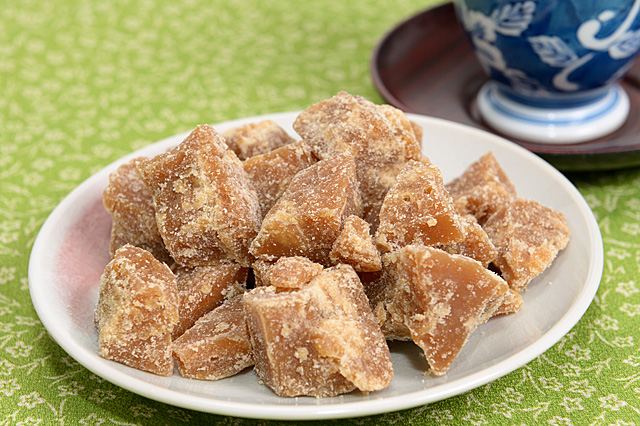
| Prefecture | Kagoshima (鹿児島県) |
|---|---|
| Region | Kyushu & Okinawa |
| Japanese name | 黒糖(こくとう) |
| Reading | Kokutō |
| Home area | I'll be back in a minute. |
| Main ingredients | Dreel. |
History and Origins
Black sugar is the sugar that makes the juice boil out of a fine cut of the starch and then pours it over a pressurized pressurization machine. It's known as the Kumumi and Okinawa Prefecture special product. It is a region of the era that has been subjugated by the Edo and since the war, under the control of America. Since "black sugar" was a very expensive food item, it has been greatly influenced in the course of its history. When I was in Kasai, the year was so expensive from rice that I replaced it with "black sugar," and he monopolized the black sugar. This forced the island people to take priority in producing "black sugar," and created a harsh situation called Black Sugar Hell, which was so busy producing daily food. And after the war, large sugar factories were built to focus on domestic sugar, and the traditional Japanese culture of "black sugar" was threatened. This is how the "black sugar" of the Shikoku region has continued to be manipulated with the times, but it has been strongly rooted as a sweetener that supports the diet of the Shizuzushima and Kagoshima mainland. Since "black sugar" contains a lot of honey, it's easy to make a lump, and many commonly sold are crushed blocks. Because of its deep moss and flavor, like caramel, it's not very general in comparison with white sugar, but the dishes that make up that "black sugar" taste are widely known.
When It Is Eaten
Besides being used in flavoring various dishes, "black sugar" is often eaten in hungry places and on teas and still. Because they are rich in vitamins and minerals, they are sometimes eaten by nutrients.
How It Is Eaten
If you squeeze the juice from a bottle, boil it, and water is steamed, it'll cool it. Black sugar is used in many local foods, representing Kagoshima Prefecture. In particular, in the Kyushu district and Okinawa Prefecture, there are so many "black sugar" flavors that they are loved from a wide range of ages, from adults to children.
More About Kokutō
Black sugar or black sugar is a type of sugar-infected honey sugar. It looks black brown, solid or powdered. (Sustoquii is a slat, and the raw material is the juice of the stem, which is used to remove impurities from the sap by the neutrillas, and then points to the product that is made by cooling down the process without making the condensation of sugar.)
In English, it is a form of sequodo, which is derived from Spanish or Portuguese, and also Brown sagaar. It's different from the Japanese word for brown sugar.
It's not just about how you use it.
From having a lot of honey, it's easy to solidize with white sugar and is usually sold in a state of breaking blocks. Besides being used as a sweetener to crush and grind this, or to boil it, or to make it into food or sweets, or to put it in coffee or tea, or to put it in sweets, we enjoy the flavor directly in our mouth like candy.
Since black sugar contains all the various components, such as corny alkaloids, sugars such as spongy sugar are the lowest in 80 percent and the lowest sugars. Since various minerals, such as calcium, iron, and zinc, which are essentially impurities, are so rich in sugar that they also have a high amount of suffocation, bitter taste, and are as sweet as caramel. So, while taste is deep, because of its unique taste, I choose its flavor and flavor as ingredients for cooking and sweets.
Processing
The sap from the cane stem is heated, the water is evaporated, and the concentrated material is cooled. In order to neutralize acid and to make it easier to sink impurities, he mixs stones in the juice, but he doesn't extract sugars, and he uses "malmic sugar" as a classifier for sugar.
Source
In Japan, it is made as a special product of Okinawa Prefecture and Kagoshima PrefectureXXXIZ.
In Japan, Barbados, the Philippines, Vietnam, and Fiji are famous sources, and in English, they are called Barbados slaggar. Taiwan used to make and export large quantities of it, but these days it's falling apart.
Black sugar safety.
Since the sugar can be turned into black sugar, the bacteria may contain botulism spores, and because the spores survive the boiling process, such as boiling the juice, and so forth, infants under the age of one like honey can cause an addiction to baby botulism. Since the worst cases can be fatal, infants under the age of one should not be allowed to include some of the sweets used.
Cancer Risk Low Effects
Although black sugar has been used to make many minerals, polyphenols, polycosnols, long life foods, there has been little epidemiology study that has judged them to be useful for health. In December of 2023, Kohone research was published in the journal Asia Pasadeal of Clinical Naturality, and it indicated that black sugar intake was associated with a decline in cancer, stomach cancer and breast cancer risk. The survey found that trackings of 5,004 men and women (about 5,004 men and women) from the people of Ch'in's population participated, compared to 13 and 14 years ago, found that black sugar intake was about 40 percent lower than "a lot of people" and that "a lot of people" were at risk, that "a lot of people" were about 40 percent lower than "a lot," that was about 70 percent lower than "a lot," that was about 70 percent lower in the stomach, that was about 70 percent lower in the stomach, that was 30 percent lower in the colon, that was about 60 percent lower in the lung, that was about 50 percent, that was the result of a 70 percent loss of the prostate. The cause is still unknown, but we got some outstanding data. It was also suggested that pure sugar is the same as refined sugar sugar but that, if appropriate, "it can be expected to reduce the rise in blood sugars."
Black sugar in Japan.
Definition
In Japan, the Consumers Agency revised JAS's "Q&A on Food Display" notification in 2010 and clarified its definition of black sugar in the next 2011, 23 years. And that's what we're going to talk about.
- That's what's going on. Consumers Agency has defined the definition of black sugar by stating that black sugar and black sugar are the same, separate, and unknown. Almost a third of the consumers didn't know the difference. Re-processed sugars mixed with processed black sugar and sugar sugar (sold sugar) were sold as "black sugar," which made it impossible to use the expression black sugar to show what was not defined. This definition is also adopted by the Japanese Black Sugar Association.
Also, the Okinawa Prefecture black sugar Union defines black sugar as a product that produces mainly on the islands of Okinawa Prefecture and Kagoshima Prefecture, with only the milk of the sugars of the sugars, without boiling, without making any processing. The Okinawan Black Sugar was a character marked registered by the regional trading coordinates of the patent agency in April 2006. In June of that year, it was approved by the Foundation Food and Agriculture Organization's "The Realm" authentication system and is sold after printing its own marks.
History
In the kingdom of Inobo, in 1623, in 1623, in the 3rd year of Heaven, in the 9th year of the reign of Xhong, Black sugar was produced for the first time by the practice of sending a man to Fukuoka, China, to learn the process of sugar making. From then on, black sugar has spread deeply from Okinawa's life, culture, agriculture, and the economy.
In Toshishima, Japan, which was ruled by the invasion of Tsukigi in 1609, the sugar industry was introduced from Sakura in 1690, and the black sugar became a powerful source of fertilizer. In 1747, it was thought that the year was to be spent in black sugar instead of rice, and because of the priority of the growth of soybeans, the island's daily diet was also lost, and the situation was called " Black Sugar Hell."
Today it is a special product produced and produced on a separate island of Okinawa Prefecture and Kagoshima Prefecture. The domestic output of the Black Sugar sugar sugar in 2017-2018 is 10, 350t, of which Okinawa Prefecture is 9,642t and Kagoshima Prefecture is 708t. The black sugar is produced at Okinawa Prefecture in sugar factories on Iseshima, Iseshima, Iseshima, Tokiichishima, Taichishima, Shobashima, Kiwashima, and Tsukokushima in eight separate islands. On the other hand, Kagoshima Prefecture is produced in small facilities such as workshops on such islands as Ionu, Happy Island, Oshima, Seed Island, and so on.
It's an important source of economic support for the separate islands of the southwest, but it's sometimes a struggle to sell and to pile up reserves through competition with imported goods and processed black sugar.
Spread.
In areas where sugar grow is common, such as Okinawa Prefecture and Kagoshima Prefecture, it is spread as a sweetener, but in other areas it is often treated as a health food because it contains rich minerals, and it is sold mainly in health food stores and native products. In the old country of Kyushu and Okinawa, there are many native sweets and dishes with black sugar.
The relevant product.
Black honey.
It's called black honey. In Japan, we eat on rice, rice, rice, rice, and so on, and so on. In Taiwan we also use it for tofu desserts called ice cream and tofu flowers.
Processed Black Sugar
In Japan, you can mix black sugar or sugar sugar with milk mixed with sugar and sugar and then remove the citrus, and then cool down and make solid or powdered sugar. Also, the black sugar use rate of processed black sugar is more than 5% for product weight, and if you use soy sauce instead of black sugar, you will replace it with the amount of sugar in the milk that is in the milk that is milked with soy. Although it was traditionally sold as black sugar, the only items that could be shown as "black sugar" or "black sugar" on April 1, 2012, were products that were made with soy sauce, and those that were mixed with sugar and sugar in black sugar and sugars were called "mixed black sugar" to avoid misspelling. Since you blend black sugar with sugar sugar and sugar sugar, you can maintain a constant quality, so it is suitable for processed foods.
Tensy sugar
Although it has been difficult to produce black sugar like that of corn, since sugar has to be highly refined for the tencyons, it has been made available and provided for food by manufacturers of Hokkaido grids in 2006. Unlike the black sugar derived from sugarcane, it contains distinctive components, such as Orago sugar. Even now only one company produces it.
The associated food.
Japan
(There are also dark - brown sugars found in all Japan) (There are dark - brown caramels, brown sugars, and white sugars) It's a black sugar casserica, a mixture of black sugar. Black sugar liqueur - base-splititz foam and Okinawan-smrum liqueur with black sugar.
Taiwan
Black sugar cake made from local black sugar in the Lakes.
Korea
Hot rocks.
Latin America
Aguapanella
United States
Brown Sugar.
Text adapted and translated from the Japanese Wikipedia article 黒砂糖 by its contributors, licensed CC BY-SA 4.0.
Dish data: Ministry of Agriculture, Forestry and Fisheries (MAFF), “Uchi no Kyodo Ryori” (Our Regional Cuisines) database, used under the Public Data License (PDL1.0); translated and adapted from the Japanese original.