40 19 にくてん
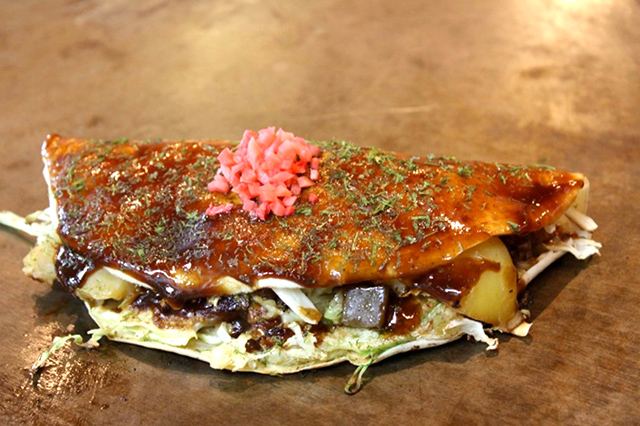
| Prefecture | Hyogo (兵庫県) |
|---|---|
| Region | Kinki |
| Japanese name | にくてん |
| Home area | High Sand City |
| Main ingredients | I'll give you a couple of examples. |
History and Origins
In the high-steel city, you call it "a relief" because you cut half of what you had cooked with thin fabrics, potatoes, garlic, cabbages and so on. They are eaten as home cooking. I don't know how long it's been eaten, but after World War II, wheat flour began to be imported from the United States and was eaten very well. The day after I ate the carrots at home, I heard that I used the rest of the pan's tools to make them. It is said that the origin of the name "grain" is due to the presence of the meat and the "natural" in it.
When It Is Eaten
You can eat at home, at a restaurant.
How It Is Eaten
The thin fabric is baked with sweetly flavored potatoes, chopped potatoes, sweets, cabbages, and abscess. After applying the sauce and burning both sides, fold them in half, then apply the sauce, and then apply the blue and the blue. I also add leftovers from the legumes, such as potatoes and potatoes, and rice and so on. They're eaten by snacks and liquor bowls.
Recipe
Ingredients
- okonomiyaki flour mix, to taste
- potato, to taste
- green onion, to taste
- source, to taste
Method
- I'm going to wash the baked fabric on the iron plate. I'll wear thin wax and stammer.
- I'll cut the potatoes and garlic into the size that I can easily eat. The potatoes are a little big, but they're delicious. The smaller one is more likely to eat it.
- Cut into pieces, cut cabbages and onions.
- We can cut the sweetly boiled meat into size easily eaten.
- Let's make it happen.
- Hang the fabric from above again.
- Turn it over and burn until the fire passes through the back.
- If you burn it, turn it over again, apply a lot of sauce, fold it in the middle, and fold it in half.
- Put the sauce on the side of the fold again.
- I've been able to wave blue and satchels for my taste.
More About 40 19
It's the food that has become the root of a tanned-cut roast in the southern Hyogo Prefecture region. It existed before the name "Kinjiaki" became widely used throughout the country, and at the time, Hyogo Prefecture was the name of the general brand of kanji.
It's the food that is made of soy sauce in the Nagata region of Kobe City.
Overview
Before the war, Kobe City had already been used to have prewar Kobe City, and even before the roasting-sakin cooking season was introduced, there was a snack on thin fabrics and a low-burned squabble style that we called "sour." From the end of the year, there were numerous stores throughout the city.
After the war, when this kind of dish, whether baked or baked, came to be called "Konichi-aki" all the time, the word "Kon-aki" was almost dead. Also, the menus with the prewar main stream of onions were not to be seen except in downtown areas such as Nagata and the Army. However, not a few stores have survived the old-fashioned sukiyaki style since the main tools turned into cabbage and pork.
It has become more known as the masterpiece of the high sand fair than Kobe of the cradle. It has appeared in high sand and in Glumuri as well. The tins in the area around the high-sand city are baked in the same way as those in Kobe, but the ones called "high-sanded" include onions, cabbages, and tinsels, as well as boiling - cornered potatoes and bamboo rings. This is derived from the fact that they were carving and burning the equipment from the Kanto that they left at the store, as requested by the customers.
Outside of Hyogo Prefecture, there are several stores that can spray into the wave island district of Miyazaki City. Although unknown as to the timing and origin of the spread, it is said to have come from Kobe. The tin from Tsushima is baked on cabbage, and it is closer to Kando Yuuki Koyaki. Also, in the Kagawa Prefecture, between the Inland Sea, they are treated as one of the native dishes.
Origin of Name
The origin of the name is not determined. There is also the interpretation of "Feel's Creep," but in an article published by the Kobe City Nagata District Hall, a guide to the future journal Nagata Nanan, which rejects this interpretation and explains that the "C" is natural with sigmite.
There's more than that.
And then we put the meat on top of it, and then we turned over the meat in heaven and earth.
There's all kinds of theories.
It also points to the relationship between the expression "clinical" and "clinical" with Tokyo. However, there is no correlation, including the birth of a baby.
How?
The recipes were similar to the cooking of the Japanese kanji Hiroshima or the cooking of Kyoto City, which was the same as what was called in the rest of the time or the cooking process as in the rest of the world. In addition to meat, the materials used were a variety of vegetables, beans, dry foods, and fresh air, and in many cases they were baked in a candy store similar to a single meal.
In the Nagata region of Kobe City, it was used as meat for materials. Also, Kobe often follows prewar tradition and uses soy sauce and uster sauce as a flavor. The hot, bitter sauce was also in use since about 1936.
I'll put high-Sun-Sun-Sun-Sun-Sun-Bung-Sun-Bung-Bung-Bung-Bung-Bung-Bung-Na-Na-Na-Na-Na-Na-Na-Na-Na-Na-Na-Na. Unlike Kobe, they often use sweet, rich sauces that have come out after the war, and they are served in doubles, such as is often seen on the stand.
Text adapted and translated from the Japanese Wikipedia article にくてん by its contributors, licensed CC BY-SA 4.0.
Dish data: Ministry of Agriculture, Forestry and Fisheries (MAFF), “Uchi no Kyodo Ryori” (Our Regional Cuisines) database, used under the Public Data License (PDL1.0); translated and adapted from the Japanese original.