Burizōni ブリ雑煮
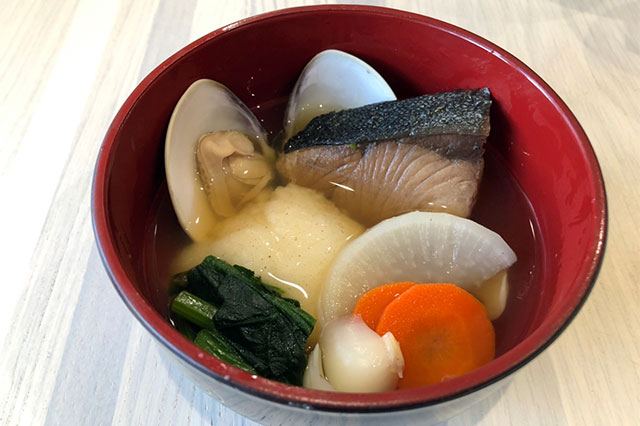
| Prefecture | Okayama (岡山県) |
|---|---|
| Region | Chugoku |
| Japanese name | ブリ雑煮(ぶりぞうに) |
| Reading | Burizōni |
| Home area | Takashi City |
| Main ingredients | And I'm going to show you some of the roots. |
History and Origins
The turquoise, which is an essential dish for New Year's, has various shapes in the area. In the southern area near the Sea of Okayama Prefecture, it is standard to bring in Bligh. Buri is a successful fish that changes name every time she grows up with Yazonada, Hamachi, and Bligh, and it's supposed to be a good idea and is used for a big seat dish. In the southern area, the bares are taken by linoleums and cloths, but in the northern areas, they are also distinctive. Also, there are a lot of other ingredients, such as spinach, radish, carrots, peppers, and so on.
When It Is Eaten
They're eaten at home with their parents on New Year's Eve.
How It Is Eaten
I'll keep vegetables such as radish, carrots, and spinach in a good wash. So add root vegetables to the soup and when it's soft, put a burri. Put in soy sauce, wine, garlic, and soy sauce, and prepare it, and then add a centrosome. Put plenty of water in another pot, boil it, and cook it gently. Put a bowl in the bowl, and place some paint on the brimstones, spinach and root plants. There are ways to boil or burn a burri first.
Recipe — Serves 5
Ingredients
- 10 round mochi
- 5 yellowtail
- 100 g daikon radish
- 50 g carrot
- 100 g spinach
- Broth: dashi kelp, to taste
- Broth: bonito flakes, to taste
- soy sauce, to taste
Method
- I'll boil the burrito.
- The spinach is soy sauce and is cut into about three centimeters.
- The carrots are cut a little bit by a semimonthly cut.
- Take the soup, put the carrots in the main root, put the pepper in the pan, and taste it with oil.
- I'll boil the rice in another pot.
- Put a bowl in the bowl and clean up all the carrots and vegetables in the brim, hay, radish and so on.
More About Burizōni
Chrysanthemum is Japanese native food. It's a bleat made with brine. XNagano Prefecture Matsumoto, Okayama Prefecture, Fukuoka Prefecture, ZXXZQQQ130X, etc., are eaten in western Japan and Northland. Brie was a typical successful fish, a product of age, and a rarely regarded as an old-fashioned high school fish.
Nagano Prefecture
In the Nagano Prefecture Matsumoto area, bludgeon, which is based on brine, is eaten.
The vegetables grown in each household, such as dichon, onions, and honey, are also used in the cooking process.
It is believed that during the Edo period, it began using the brine that was washed up in Tokuyama Bay. Bligh was made into salt mills and carried through Matsumoto and to his husband. If you have a strong economic family with Matsumoto, you have bought a salt bar at the end of the night and eaten a little until New Year's Eve. After cutting off a piece of salt from the walrus, it was used to cook the rest without waste. Ara too is used in cooking and other ways.
The Nagano City region also uses the casserole that comes from the Nui. The border between Bri and Sung will be located around Shizuoka Line.
Okayama Prefecture
In Okayama Prefecture, it is also known that "Bry city" stands, and briri is eaten in the area where the city stands. However, it was after the post-World War reform that the common people were able to buy Bligh in the city, and buying it once a year as a luxury and boiling it was an incentive for luxury, for labor.
In the south of the province, there are boui as well as clams, oysters and shrimps, and clams often in the north. Also, roots are often used.
In addition to adding them because the roots are boiling, the burri may be boiled separately or put in baked burri.
Using or boiling round bowls is common in Okayama Prefecture, but they are divided by the following:
It's Bri while I'm in charge. I'm going to put in a bottle. In the south, there are snails and so on, but as you go north, you get only root vegetables. It's a beautiful sulme. I can't go in with Bry. It's the Sulme in the north. I can't go in with Bry. It's like the south of the country. I can't go in with Bry.
Fukuoka Prefecture
In the north of Kyushu, there is a custom called bride-to-beuth, which brings Bligh from the family of his newly married son-in-law to his wife's home during the first month of the year, with thanks to his wife. It is thought that the custom of this bride Bry's custom influenced besides the reason that it was a product that came to be used for boiling.
Soy sauce.
It's made from raw rice, which is eaten in the Fukuoka PrefectureXQFukuoka City district of Togo. The vegetables are made of essential materials, and the cucumber uses a small bowl.
It's a feature of taking the juice with a jaw-tobing fish. Also, I'll keep Bry's cut in hot water before we do. We boil the rice and the tools in separate pans and then add the sauce and the ingredients to the bowl that we have cooked. Also, when eating, the new ones made from the branches of the plant (and also with the "shoesticks" and the twigs) are used for New Year's use. The chopsticks are so rough and rough that they are hard to use with the ends of them. And they're very good at it.
The recipe for making the dishes is to stick each piece in a bamboo pot and prepare it for distribution by pulling it out of the bowl and putting it in the bowl and putting it in the last place. It is believed that this recipe was designed to make things easier. Since there are so many visitors at the end of the year, and there are so many businesses, and there's so little trouble preparing the stew for the guests, it's estimated that you put one of your old tools in the closet so that you can act quickly.
Snacked boiling
The succulent stew is eaten near the port of Belzaki, Fukuoka Prefecture.
The materials used are the same in a great deal of steam, but they are characterized by the use of other materials in a glue and in a bowl.
Nagasaki Prefecture
It is characterized by the abundance of ingredients in Nagasaki's sauerkraut. Although the materials used vary from home to home, salt burrito and a variety of Chinese cabbages are considered indispensable.
The number of materials is odd, the number of objects is characteristic of the whole of each individual, and because they are so many in equipment, they are provided with by a large bowl.
And there is also a service in the Tangman's Vegetable that says "make a name."
Text adapted and translated from the Japanese Wikipedia article ブリ雑煮 by its contributors, licensed CC BY-SA 4.0.
Dish data: Ministry of Agriculture, Forestry and Fisheries (MAFF), “Uchi no Kyodo Ryori” (Our Regional Cuisines) database, used under the Public Data License (PDL1.0); translated and adapted from the Japanese original.