Home / Hiroshima / Kuwainoamani
Kuwainoamani くわいの甘煮
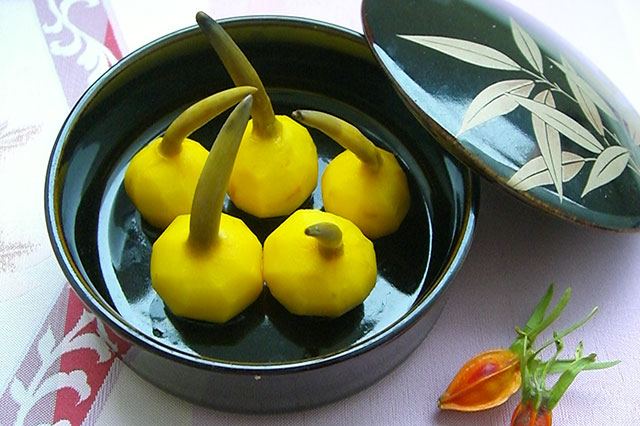
| Prefecture | Hiroshima (広島県) |
|---|---|
| Region | Chugoku |
| Japanese name | くわいの甘煮(くわいのあまに) |
| Reading | Kuwainoamani |
| Home area | Fukuyama City |
| Main ingredients | It's a little bit of a trick, but it's a lot of fun. |
History and Origins
Fukuyama City's "Found Sweet" is characterized by the taste of soup, sugar, and sweet sauce to taste. The root word "choo" comes from a leaf that is shaped like a earth - digging plant and is called a potato-like fruit, and it is turned into a "coo." There are three different types of bowls: green, green, white, and green, and green, and green, and green, and in Japan, mainly. Fukuyama is also produced in Fukuyama City, but Fukuyama is Japan's largest producer. The blue one is characterized by cologne and round round spheres, with a strong, bright blue surface. That beautiful color also calls it "Saida Sapphire." It is rich in protein and potassium, and it is characterized by a thin sense of food and a sweet taste that remains in the bitter taste. Since the seeds grow from the fruit, they are often eaten as stews as a base-stained food or as a celebration. Since Fukuyama's demand for raw food is so high that its shipping season is concentrated on December 11th. Fukuyama had a mild climate in Seto, which was sunny and was originally suitable for growing blue. It is believed that growing plants began about 35 years ago when I brought what I had grown from the swamps of what is now Fukuyama City, Japan, in the fertile moat around Fukuyama Castle. It is also possible that during the Edo, Fukuyama found himself in an environment where he could build an additional network of waterways and secure large quantities of water to send the water to Shinda.
When It Is Eaten
The food is often eaten mainly by cooking. The Edo was the food of warriors in the middle of the city of Miyagi, but during the Meiji period, the generals also made the food of rice. In the '30s, department stores and other heavy-boxed food sold extensively, and the custom of eating fresh New Year' became widespread. Locally, we eat during the season between November and December.
How It Is Eaten
I'll boil the bowl and leave the stem part behind and skin it. I added sugar, lentils and garlic to heat them, but I put a bowl in the soup and cook it. Put it overnight to make it taste good. In other words, we sometimes cook and eat in raw fish, soup, salads, chips and so on.
Recipe — Serves 4
Ingredients
- 200 g arrowhead
- 1–2 gardenia fruit (coloring)
- Seasonings: 1.5 cups dashi stock
- Seasonings: 3 tbsp sugar
- Seasonings: 2 tbsp mirin
- Seasonings: a pinch salt
Method
- (It's a good idea to have a crack in the surface of the boiling surface.)
- Cooling and leaving the sprouts on the skin.
- Add a bowl of citrus sauce (and put it in a bag) and cook it.
- Put two in and cook. (I'll put it all night to taste)
Dish data: Ministry of Agriculture, Forestry and Fisheries (MAFF), “Uchi no Kyodo Ryori” (Our Regional Cuisines) database, used under the Public Data License (PDL1.0); translated and adapted from the Japanese original.