Okinawa soba 沖縄そば
| Prefecture | Okinawa (沖縄県) |
|---|---|
| Region | Kyushu & Okinawa |
| Japanese name | 沖縄そば(おきなわそば) |
| Reading | Okinawasoba |
| Home area | All within the province. |
| Main ingredients | Okinawan (Santazu) |
History and Origins
The "Osakaro Okinawa" is characterized by thick noodles made from soft water, and thick wool made from rich pigbone and slatted rice, using only flour without flavour. The tools placed on the noodles were made by three pigs boiling their meat, onions, onions, and red peppers, but these days there are a lot of different kinds of food: squirm, sultry, and vegetable. There are also local features, such as noodles, tools, and so on, such as Miyagi and Yasaka. The Noodles of Okinawa, a representative of the Okinawa Prefecture ethnic group, did not use florida, so in 1976, the Justice Trade Commission was instructed not to call them "near." There has been a time when the Okinawan Noodle Union, in an effort to protect its traditional name "Santamura" and the Okinawan diet culture, rose and negotiated and won a commercial registration for Okinawa. In memory of this date, October 17th was defined as "The Day of Okinawa." The roots of Okinawa's roots are said to have begun with a Mangan opening his house to him during the middle of the Meiji period.
When It Is Eaten
They are eaten daily at home, at restaurants, and elsewhere.
How It Is Eaten
Three pork meats are all boiled and cut into five-millimeter thickness at a width of six centimeters. I'll boil sugar, soy sauce, foam, and pork meat in a small pot. I will cut sticks in half and ruba juices in a small bite. In the pot, we cook pigs and rice, salt and soy sauce, and make soup. The noodles, boiled in plenty of hot water, will boil the water with a good cut, stir the soup, and cook three roasted pig meat, sticks, brazier, red peppers. If you put a taste of the island pepper on top of a steamed flavor, it will make it tasty. It's not just a pig.
Recipe — Serves 4
Ingredients
- 360 g cake flour
- 180 g bread flour
- Water: 3/4 tsp fertilizer
- Water: 1 tsp1/2 salt
- Water: 300 ml water
- 60–70 g dusting flour (タピオカ)
Method
- Put thin and strong powder in the bowl and mix it well.
- It's called a water plant. It's called a water plant.
- Add the two slowly, and mix them so that they are all tattered.
- 10 minutes for water to soak enough into the dust. It's nice to step on your foot. If you press lightly with your fingers and the part you press comes back with a reaction.
- I can put my twisted fabric in a plastic bag and sleep for two or three hours.
- We ground the powder on both sides of the fabric and press the laid fabric on it by hand to extend it to a rectangle.
- It's thick with a soy sauce bar, and it's a two-millimeter rectangle. I'm going to extend it from the center to the outside so it becomes uniform.
- I'm going to make a lot of powder on both sides of the fabric, and I'm going to cut it with the desired thickness.
- (It shrinks when you look at the hands that grind more on the cut of the noodles.)
- If you boil a lot of water in a pot, melt the noodles, stir with chopsticks, and boil the noodles up in 1020 seconds, you'll have to do it.
- I'll eat with my favorite soup and utensils.
More About Okinawa soba
Okinawa soba (沖縄そば) is a type of noodle produced in Okinawa Prefecture, Japan. Okinawa soba is a regional collective trademark of The Okinawa Noodle Manufacturing Co-op. On Okinawa, it is sometimes simply called soba (or suba in the Okinawan language), although this Japanese term typically refers to buckwheat noodles in mainland Japan. The noodles of Okinawa soba are made from wheat flour, and do not contain any buckwheat.
The thick wheat noodles more closely resemble the texture of udon, and when served in soup, the broth is more similar to that of ramen. The noodles tend to have a circular cross section in the Yaeyama Islands and tend to be slightly flat in the rest of Okinawa Prefecture.
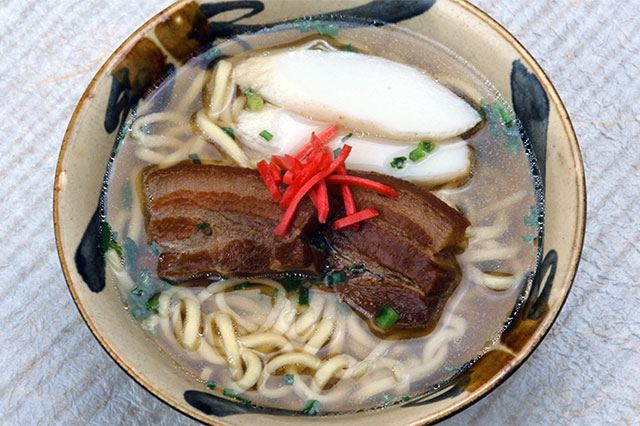
It is served in a broth flavored with konbu (edible seaweed), katsuobushi flakes and pork. Standard toppings are kamaboko (fish cake), sliced scallion and a thick slice of stewed san-mai niku (三枚肉, pork belly; lit. "three-layer meat") or soki (boneless pork ribs) and usually garnished with beni shōga (pickled ginger). For extra spice, diners can add a few drops of kōrēgūsu, which consists of chile peppers soaked in awamori rice liquor.
Varieties include:
- Sōki soba (ソーキそば) – topped with extra ribs, known as sōki in Okinawan.
- Tebichi soba (てびちそば) – topped with stewed pig's trotters.
Name
Today the word soba means buckwheat, in particular buckwheat noodles, in Japanese. This word is in origin an abbreviation of soba-mugi (buckwheat). The word soba refers to the edge in ancient Japanese and soba-mugi meant "edgy wheat". Around the 16th century, buckwheat began to be processed into thin noodles. This method was originally known as soba-kiri (lit. soba cutting) but it was later abbreviated into soba. Soba was mainly consumed in eastern Japan and was not popular in western Japan or on Okinawa. Buckwheat noodles remain rare on Okinawa, where they are known as Nihon soba (Japanese soba) or kuroi soba (black soba).
In modern Japan, the meaning of soba was extended so that it could refer to other types of thin noodles. Yakisoba (stir-fried noodles) contain no buckwheat. Shina soba, commonly known as Chūka soba (Chinese soba), or rāmen today, is also made from wheat flour. Okinawa soba falls into this category and is made entirely from wheat.
Under a fair competition regulation, soba was standardized as "the noodles contain at least 30% of buckwheat." This definition caused a problem when Okinawa was returned to Japanese rule in 1972. In 1976, the Fair Trade Commission tried to make Okinawa Prefecture drop the name "soba" because Okinawa's soba did not conform to the regulation. The Okinawa Noodle Manufacturing Co-op negotiated with the Fair Trade Commission and as a result it was accepted as one of several exceptions under the name of Okinawa soba.
History
Some attempt to trace the origin of Okinawa soba to the Ryūkyū Kingdom period. Chinese delegates possibly brought wheat noodles to the royal court, though no link has been established to the modern Okinawan cuisine.
The first known documented reference to Okinawa soba was in 1902 during the late Meiji period when it was known as Shina soba (Chinese soba) as in mainland Japan. Several soba restaurants are known to have operated in Naha during the Taishō period and to have close links with the red-light district. Soba restaurants were destroyed by U.S. attacks during the Battle of Okinawa. Its revival began in U.S. internment camps, where wheat rations were supplied. In the 1960s, soba was popularized with the introduction of noodle making machines. The popularization was accompanied by the transformation from a restaurant meal to home cooking. The mainland Japanese custom of eating soba on New Year's Eve was introduced to Okinawa in 1968, but buckwheat noodles were replaced by wheat noodles. Today, Okinawa soba is considered as a vital part of traditional Okinawan culture, although folklorist Nishimura Hidemi argued that it was an invented tradition.
In Brazil, a variation of Okinawa soba known as sobá is popular in the city of Campo Grande in the state of Mato Grosso do Sul, due to the influence of Okinawan immigrants. It is eaten all-year long at street markets or in special restaurants called "sobarias". As of 2019, the recipe has deviated from Okinawa style to suit Brazilian local preferences.
Text adapted from the English Wikipedia article Okinawa soba by its contributors, licensed CC BY-SA 4.0.
Dish data: Ministry of Agriculture, Forestry and Fisheries (MAFF), “Uchi no Kyodo Ryori” (Our Regional Cuisines) database, used under the Public Data License (PDL1.0); translated and adapted from the Japanese original.