Acharazuke あちゃら漬け
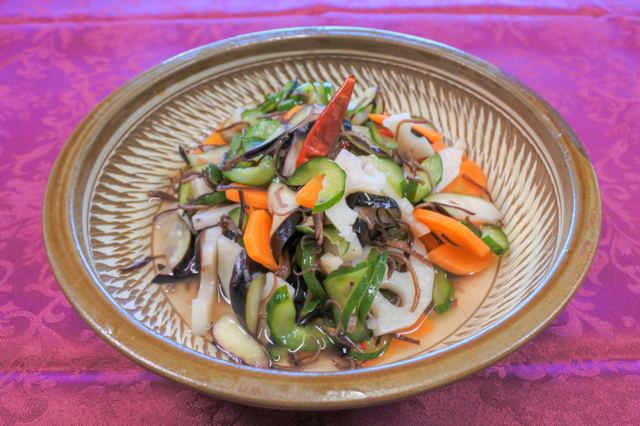
| Prefecture | Fukuoka (福岡県) |
|---|---|
| Region | Kyushu & Okinawa |
| Japanese name | あちゃら漬け(あちゃらづけ) |
| Reading | Acharazuke |
| Home area | Zhou |
| Main ingredients | It's a little bit of a trick. |
History and Origins
It's from vinegar with red pepper added to the season vegetables. It's sweet and sour, and the bitter taste of pepper makes an accent. It has been valued as a dish that comes alive in summer since the days when there was no refrigerator. "Smacked" is written in kanji and is derived from the Portuguese word "acharachazar," meaning a vegetable or fruit dough. There are similar words that refer to a matter with similar pronunciations, such as "chare," "ochool," and so forth. However, there are stories coming from other sources that have been named by the name "the Great Wall," meaning "the Great Wall." Takashi Bay has always been a source of trade. It is said that "sucking" was transmitted by the conquered South Africa trade, which occurred between the Fukuoka mountain and the early Edo. It's also said that red peppers, which are essential to "sucking" were introduced to Japan at the same time.
When It Is Eaten
I've been preparing them for the guests at the time of the trays, as well as the guests at the Kasai. We use the odd number of sour summer vegetables that are supposed to be good luck. At present, food may also come up on a regular table as a vegetable and may vary from home to family.
How It Is Eaten
White peppers are cut into thin pieces and salted. The other tools are cut thin and then boiled down and cool. I'll treat the seasonings and red peppers with sweets white, or add them to the tools. After a while, I'll mix the flavor and then put it on the bowl.
Recipe — Serves 4
Ingredients
- 200 g (2) white-weird (cucumber)
- 100 g(1) eggplant
- 100 g lotus root
- 50 g(1/2) carrot
- 10 g wood ear mushrooms
- 5 g shiso
- 10 g ginger
- 7 g(1) red chili pepper
- Mix: 7 ml vinegar
- Mix: 30 ml dashi stock
- Mix: 3–4 g salt
- Mix: 20 g sugar
Method
- I'll keep vinegar, sugar, salt, soup, red peppers cold together.
- The white lily splits in half the length to produce seeds, cuts them, and salts them. I'll cut it thin and check the salt.
- The carrots are cut down in thin slices, and we'll have to drain them and cool them.
- The salty white lily and the dishes are washed in water and cut off. I'll cut a handful of water-screws.
- And four is packed into one.
More About Acharazuke
A local dish from Fukuoka PrefectureFukuoka City. It's a dish of sweets with pepper and vegetables and so on.
Overview
It's from vinegar with seasonal vegetables and red pepper. In addition to sweet sweets and sours, the bitter taste of pepper has become an accent. Even before the refrigerators were introduced into the home, it was a local dish that has often been eaten in summer and especially during the time of the people's trays.
Besides vegetables, such as rice, kimchi jellyfish, frozen connaks, and other materials that are used by the community and family, the number of tools used is odd.
Origin of Name
The Portuguese word for vegetable or fruit dough is derived from the Portuguese word achar. In Portuguese, there is a word that is derived from a similar pronunciation, such as "chare," "ochool," "achaar," and so forth.
And I'm going to tell you about the story of the Gulf of Totaka, which has been a great trading center for ages, and it's been a great success since the time of the Edo.
It's said that they've passed through. Red peppers, which are vital to duplicating, are also used for the same period.
In addition to the above theory of Portuguese, there are theories that have been named "the sub-soil of the south wind" from the Japanese meaning of "there," which is foreign to Japan, and others that are derived from the Indian language.
Text adapted and translated from the Japanese Wikipedia article あちゃら漬け by its contributors, licensed CC BY-SA 4.0.
Dish data: Ministry of Agriculture, Forestry and Fisheries (MAFF), “Uchi no Kyodo Ryori” (Our Regional Cuisines) database, used under the Public Data License (PDL1.0); translated and adapted from the Japanese original.