Home / Kagoshima / Butahoneyasai
Butahoneyasai 豚骨野菜
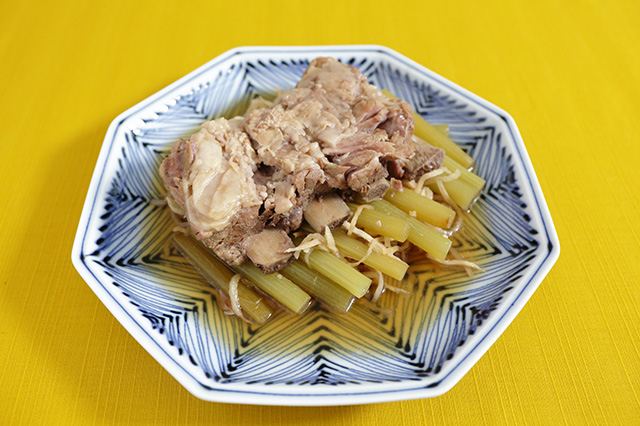
| Prefecture | Kagoshima (鹿児島県) |
|---|---|
| Region | Kyushu & Okinawa |
| Japanese name | 豚骨野菜(ぶたほねやさい) |
| Reading | Butahoneyasai |
| Home area | I'll be back in a minute. |
| Main ingredients | We've got pork, tweasel, fabric, radish, carrots, kosher. |
History and Origins
The pigbone vegetable is cooked in a large pot of pork, twabuki, sauerkraut, yam, carrots, kosher, and so on. It is an essential dish in the silk region from New Year to New Year. It's called "Unfineyace." I don't know what to do with it. In Toshimi, island pigs have been raised from old age with black hair. It was once said that island pigs had one in each household and were eaten as a valuable protein source. In order not to waste all the parts, we made all the dishes available, including the annual dish "pigbone vegetable," as well as the stored "pigs" and salts, baked and baked foods. The island pig is very delicious, but it takes longer to grow, so gradually it has fewer and fewer crops to grow. Today, pork is used as a "pigbone vegetable," and at the end of the year, a salted bone is used to line the supermarkets and meat stores.
When It Is Eaten
On New Year's Eve, it is customary in the Miyagi region to eat a pigbone vegetable, and the next January 1st, with its own custom, to celebrate the new year.
How It Is Eaten
Tswabuki makes sure that he gets a good idea. The porkbones are salted and if you cut off "pig bone vegetables" on the day of the production, you put them in a pot, then they are baked and baked and browned. If you boil the water until it is soft enough for the meat to hide, add the vegetables that are easily eaten, add the vegetables that are cut, and add the seasonings, such as soy sauce. When the whole flavor is added, you put it on a large vessel and eat it apart. Tastes vary from home to home, including the firming of the soy sauce, the simple salt flavor, the additive with black sugar. The island vegetables we use also differ from house to house.
Recipe — Serves 4
Ingredients
- 8 黒豚豚骨
- 300 g tweet (ツバシャ)
- 200 g dried daikon strips
- 30 g niboshi (dried sardines)
- 3 tbsp soy sauce
- 30 g coarse sugar
- as needed salt
- 2 tbsp mirin
Method
- The pig bones are washed in a mild bath two times in a row.
- I'm boiling with water as much as I can with a pigbone in the pot. When you boil it, it will make a pot come out, so once you boil it and wash it clean. Since the pot has a pot on it, it's washed well.
- I'll make a thin salt on the pig bones that I washed. I'll cook it for about an hour again.
- I'll get some juice in another pot with a piece of pig's rice, and I'll put on an island, oil, salt, and garlic, and I'll boil the pig bone.
- I'll keep the soup in a lot of boiling dishes.
- Distorted tweezers and re-cut radish are boiled in another pot and cooked with boiling juice.
Dish data: Ministry of Agriculture, Forestry and Fisheries (MAFF), “Uchi no Kyodo Ryori” (Our Regional Cuisines) database, used under the Public Data License (PDL1.0); translated and adapted from the Japanese original.