Home / Ishikawa / Goshikinamagashi
Goshikinamagashi 五色生菓子
| Prefecture | Ishikawa (石川県) |
|---|---|
| Region | Chubu |
| Japanese name | 五色生菓子(ごしきなまがし) |
| Reading | Goshikinamagashi |
| Home area | Kanazawa City area |
| Main ingredients | Five different sweets. |
History and Origins
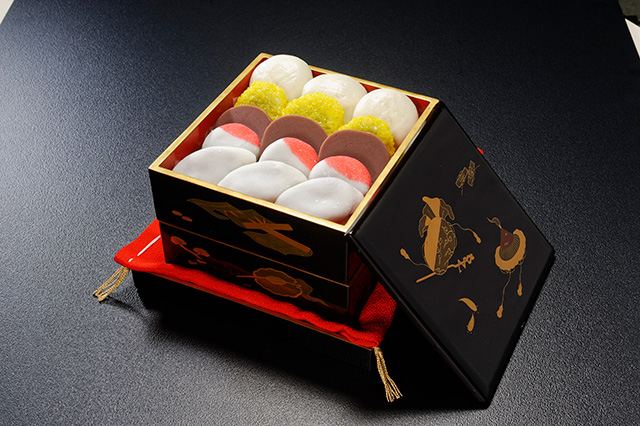
Ishikawa Prefecture is a land based on culture based on the old-fashioned eating of rice. For example, the "C" that comes to you when you go to Togo is "C" "Sit" is a baby and is a native dish that mother, after giving birth, gives birth to good milk. Besides being used in sultry and citrus sauce, they are also eaten as desserts, such as smudges. Also, "Masuke" is said to have been introduced from Hokkaido to the Koki district of Osaka. It is eaten without exception in the last passage or the spring festival. In addition, there are many different dishes eaten in various parts of the province throughout the year. It is eaten at Kanazawa City, which is a historic city in Kajiji's castle. It is said that when the second general and the second daughter of Hideo Tokugawa continued to be taken in by Akita, Akira's Japanese master, Akira Tokushi was offered. It's said that Owada stuck to the container and dedicated it to a five-heavy bowl. There are various theories about the five different sweets stored in the bowl, but each means a million elephants. The white bowl of red rice dust, half of the rice, has "sun," the white and round carpets, the "moon," the "Mount" with yellow rice, the "Mount," the "Sun" with the" with the purple rice, and the "sea" with the spirals, the "Sun," the "Sun," the "Sun," the "E" with the purple" with the purple rice, the "R" with the red. This will complete the natural elements of "Sun-Sun-Sun-Sun-Sun-Sun-Sun-Sun-Sun-Sun-Sun-Sun-Sun-Sun-Ne-Ne-Ne."
When It Is Eaten
There was also the birth of the "Field Fun" that spread as a wedding present. It's said that during the Meiji era, it was established by the common people. I've learned how to pack five different kinds of raw candy and 20 of them in a bowl. It's said that the sponges that put the bowls in five layers were placed in front of the door of the house and were distributed after the ceremony. Now I'm not going to have 20 of them as gifts, but I'm going to tell you that I can get about five dozen candys and eat them.
How It Is Eaten
I take raw candy out of the vessel and eat it as it is. The bowl in the bowl is a pale color, and it is presented as a token of a celebration.
More About Goshikinamagashi
Five-colored sweets are Japanese sweets that are spread from the Ishikawa PrefectureX085X.
Overview
It's a five-kind pack of raw candy.
Five species have the same color and meaning as the following.
A round bowl of red rice on half a bushel of white rice -- sun, white, and round -- a round ball of yellow rice covered with a moon, a conical sieve of mountain and sea goat.
In five ways, it becomes "Sun-Sun-Sun-Sun-Sun-Sun-Sun-Sun-Sun-Sun-Naji" and it is a display of nature's will.
History
When, in the year 6 of the Chief Chief, the daughter of the second general, Hideo Hideo Hideo Hideo, entered the third generation of the Koga Akita family, it was offered to him as a gift shop for Kaji. It is said that Owada stuck to the container and dedicated the candy to the five-heated bowl.
Later, it spread as a wedding treat, and during the Meiji period, customs began to develop which were also given at the wedding of the innocent.
There are fewer cultures from the middle of the Shogun period and fewer opportunities to eat, as there are fewer cultures to line up the sponges in front of the gate. Still, Japanese candy stores at Kanzawa are handled year after year, and it is not unusual to see them at weddings. It's also sold as souvenirs for tourists.
Text adapted and translated from the Japanese Wikipedia article 五色生菓子 by its contributors, licensed CC BY-SA 4.0.
Dish data: Ministry of Agriculture, Forestry and Fisheries (MAFF), “Uchi no Kyodo Ryori” (Our Regional Cuisines) database, used under the Public Data License (PDL1.0); translated and adapted from the Japanese original.