Home / Kumamoto / Ikinari Dango
Ikinari Dango いきなり団子
| Prefecture | Kumamoto (熊本県) |
|---|---|
| Region | Kyushu & Okinawa |
| Japanese name | いきなり団子(いきなりだんご) |
| Reading | Ikinaridango |
| Home area | Ikea |
| Main ingredients | It's not just wheat, it's wheat. |
History and Origins
The "Sunako" is a simple native dish that is steamed with flour wrapped up in a cut-out stick. Because of the growth in the area around Akashi, including the best in the province, and in the surrounding area, where the volcanic ash has caused the growth of the rich vegetation, farmers in the ponds and the bear's plains were well-dressed for eating during the autumn farming work to harvest the tasties. Besides being able to make it easy in a short time by means of the Bear's Vocabulary word, it's a name that can be given immediately in the event of an emergency visitor. The skin fabric is made of flour, coral and salt, but rice was made of flour only when it was precious. A few years ago, some of the meats were used to add beans to the fabric, but when the sweet taste of the mushrooms and the salt taste of the dough were added, they were popular and now they are the main source. More recently, there has been a slight increase in variations in fabrics, such as mixing corn and black sugar with fabrics, adding mushrooms, using purple potatoes on the cloth, and adding lentils to the cloth. Although it was originally a warm cook, there were other types of coagulated dumplings that would eat frozen foods in semi-freeze.
When It Is Eaten
Originally, I made and ate at home during the season of the evening, but it's also sold in shops, candy stores, and stalls, and it's eaten daily. The old-fashioned sweet and sweet taste is also popular with tea cakes and children.
How It Is Eaten
As a snack, I'll take it in the middle of the cook's cooking and cooking. The souvenirs are frozen, heated by a range or a distiller, and eaten.
Recipe
Ingredients
- 1–1.5cm) 20–25 sweet potato
- Mix: 250 g all-purpose flour
- Mix: 100 g dango flour
- Mix: 50 g sugar
- Mix: 1 tbsp salt
- Mix: 1/2 tbsp vegetable oil
- 180–200 ml water
- 250–400 g bean paste
Method
- The skin of the little ones is cut into one inch thick, cut into a face and water for ten minutes.
- We can put seasoning A to bed for over 30 minutes with water.
- The fabric is spread out on a board and cut to the size of a thin piece.
- I round the bowl on top, one at a time, put one ball on top of it, and wrap it up.
- I'll put them in a steamer, and then I'll steam them for about 20 minutes. If you stab bamboo with it and pass it on to the ends of the stick, it will be done.
- If you don't lay down the fabric, it won't wear out, so you can lay down the fabric for at least an hour or more. You can sleep for the night.
More About Ikinari Dango
Ikinari Dango (Japanese: いきなり団子) is a traditional local dish and confectionery from Kumamoto Prefecture, Japan.
In the Kumamoto dialect, it is also known as Ikinari Dago (いきなりだご).
Overview
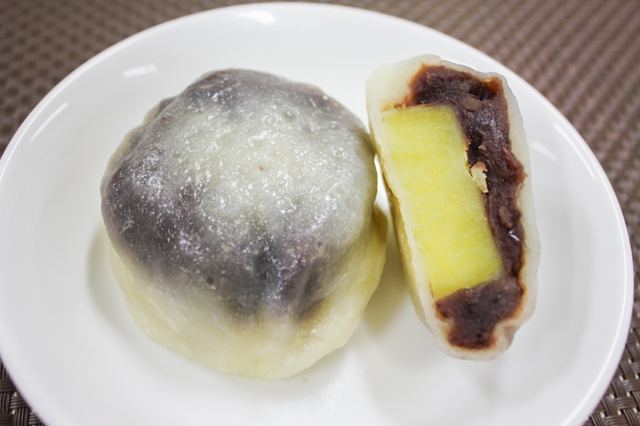
Ikinari Dango is made by wrapping slices of sweet potato in a dough made from wheat flour,Dango rice flour (だんご粉), and salt, and then steaming it. Around the Showa era, it became common to add azuki bean paste (小豆餡) along with the sweet potato, and this version has since become the mainstream form.
In agricultural regions such as Ōzu (大津) in Kumamoto Prefecture, as well as in the Kikuchi Plain (菊池平野) and Kumamoto Plain (熊本平野), it was traditionally eaten as a snack during the sweet potato harvest season. It has been continuously handmade in ordinary households and remains an important confectionery for the people of Kumamoto Prefecture.
Today, Ikinari Dango is sold not only in Kumamoto but throughout Kyushu, and can even be found in supermarkets in places like Fukuoka Prefecture.
In recent years, advancements in preservation technology have led to the availability of vacuum-packed and frozen versions. Although it is traditionally enjoyed fresh, variations such as hiyashi ikinari dango (冷やしいきなり団子), which are eaten semi-frozen, have also become popular.
Name
"Ikinari" (いきなり) in the Kumamoto dialect means "simple," "quick," or "immediate." The name is said to derive from the fact that the confection can be made easily and quickly, making it suitable for serving to unexpected guests. Another interpretation is that the term reflects the simple preparation method of wrapping raw sweet potato (サツマイモ) directly in dough and steaming it, emphasizing its ease of making.
An alternative theory suggests that in some areas of Kumamoto, people who are poor at tidying up are still referred to as "ikinari na hito" (いきなりな人). From this usage, "ikinari" came to mean "rough" or "haphazard," implying that the dango is made in a quick and rough manner.
Text adapted from the English Wikipedia article Ikinari Dango by its contributors, licensed CC BY-SA 4.0.
Dish data: Ministry of Agriculture, Forestry and Fisheries (MAFF), “Uchi no Kyodo Ryori” (Our Regional Cuisines) database, used under the Public Data License (PDL1.0); translated and adapted from the Japanese original.