Home / Kumamoto / Karashirenkon
Karashirenkon からし蓮根
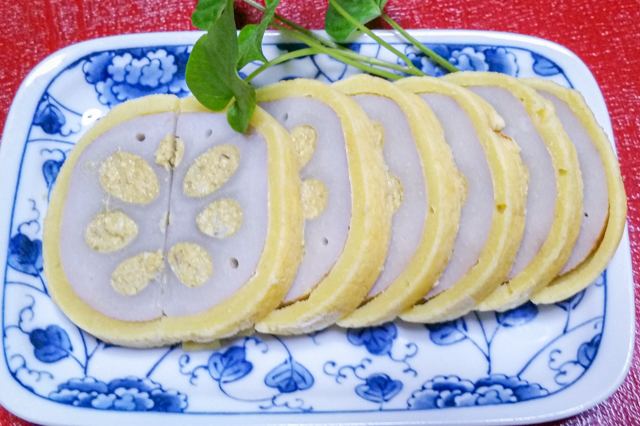
| Prefecture | Kumamoto (熊本県) |
|---|---|
| Region | Kyushu & Okinawa |
| Japanese name | からし蓮根(からしれんこん) |
| Reading | Karashirenkon |
| Home area | Bear Book Area |
| Main ingredients | I'm going to do it for you. |
History and Origins
Kumamoto Prefecture is a country-wide source of high production. The castle that was developed during the Chizu Migawa year is still grown as the main source of life. The dish is known as a dish bordering on Kogawa. Since the time when he was sick and worried, he was searching for "something of nourishment." At that time, Kumamoto Prefecture was known to have many swamps, and it was found that he had an increased blood effect in his writings. There was a root in the outside moat of Bearmoto castle where Kato's purity was planted for a very food use, so he tried to feed it, but the Lord Koto said, "It is unclean that grew up in the mud." I never tried to wear chopsticks as one. So I filled the hollow with a mixture of taste and taste of mustard, and put on flour, air peas and egg yellow clothes and fried them with oil. It is from the root of "the mustard root" that when the bitter pain worked, or was enjoyed and eaten, and the sickly man became more hungry and more able to see. The appearance of the cut-offs was similar to that of the Migawa family's family, and the Chrysanthemum secreted how to make "Schimoto root" and the taste of it has never come out of the house until the next day. This is also the relative to which the "Custo root" can be made only in the country with Kumamoto Prefecture.
When It Is Eaten
You can eat it as a bowl of rice or a bowl of wine. It's also becoming an essential food for sushi on New Year's Eve.
How It Is Eaten
Basically, cut into the thickness of 5 to 10 millimeters so that you can see the 9-day shake. Some families prefer to eat with soy sauce or mayonnaise. These days, you can see a lot of hard work being done on sandwiches, hamburgers and other bread. The mustard is close to mustard, so they say that bread is compatible.
Recipe
Ingredients
- 7–9(1 kg) lotus root
- 500 g barley miso
- 20–23 g Japanese mustard
- 300 g wheat flour
- a pinch turmeric (食用色素)
- 350 ml water
- oil for frying, to taste
Method
- The tin is a metal paste and washs it clean.
- We'll boil a lot of water in the pot, and then put a bowl of boiling water in the bowl and keep it in a ten-percent soup to be kept in the oven. (SCREAMING)
- Mix the bowl with mustard from flour and flour.
- I'm going to put a bowl in the mustard sauce, put it in and turn it, and then pack it in a bowl. (Singing) (Singing)
- The extra taste will be left standing in the background for six hours.
- I mix flour and ukon in water and make a tight coat.
- Clean up the stirrup, put the bamboo plant in its prickly coat a little above the center of the crescendo, and use a 180 degree-grade oil to melt it. (Beatboxing that the oil temperature doesn't exceed 180 degrees Celsius)
More About Karashirenkon
I'm sorry, I'm sorry. (many times called mustard root) is a native dish of Kumamoto Prefecture, which is fried with oil in the root pit with bitter pepper and a yellow coat. Likewise, unlike the mustard, which is crowned with "Schin" and so on, the common use of the sweet pepper is not the pepper.
Overview
It's eaten all over Kumamoto Prefecture, centered at the eighth and XKumamoto City. In addition to being eaten as a snack for rice and wine, regardless of the season, it's also a social event for Hare's Day, such as a tray or a festival. Since the root is a product that "see-through" is a product, it is also a common dish of New Year's dish. Bearbook is a regular dish that we see daily, and it's sold in shops as well as supermarkets and grocery stores, and it's on the menus of Japanese restaurants and pubs as well as in local restaurants.
It is common to eat with a cut of five to ten millimeters thick, but in some homes it is served with soy sauce and mayonnaise. As a modern recipe, there are crinkets, pepper root, sandwich, hamburger and pepper root, which are oiled with oil. Fukuoka Prefecture, the name "Cooking Dad" is used in addition to the sale of a variation called "Akita root," which used lynx instead of pepper.)
History
As to the origin of the root of the taiko root, there is a legend as follows. And it seems that it was actually after Meiji that the clothes began to wear.
Toshio Tokugawa, who was the first person to die of natural illness, was weak. When the Zen priest and the master of the pre-governable Kajijijijiji temple visited, he recommended that there be a blood - building effect and eat roots grown in the outer moat as a hot meal by Kato, but he refused to wear chopsticks as "unclean in the mud." So Koro, who was the cook of the rice plant, packed the root holes with a dough mixed with mustard flour and put on a yellow coat of flour, air, and eggs and made a generous contribution to the vegetable oils. It wasn't easy to get into a restaurant. From this anecdotal story, the image of the mustard root is rooted in the image of a healthy diet in Kumamoto. It's said that Takao was given a reward for his discovery of the pepper root, a stroke, 10 small pieces of sawed steel, and a tie.
The cut section may be similar to that of the Mizugawa family, and the connoisseur used a method of making pepper root. Since Iseshima, it has been allowed to eat among the common folk, and we have become widely known as Kumamoto's native dish.
Now that it is known to Japan as the most famous of the bear, it must be a gift to bear, such as the joint proposal "What do I call a souvenir from Bear Book?"
Processing
The recipe for jiiko root has changed little since the time of Edo. (It was supposed to be a waste of oil to put citrus powder in order to prevent squabbles), but putting in empty beans is meant to prevent them from becoming solid in time.
The succulent sauerkraut is stuck in the hole of the root. In the home, it is the easiest way to place the pepper in a container, such as a bat, and press the root strip several times. When mass production is done by manufacturers and others, the peppers are placed in a heap of about 50 centimeters and the roots are pressed to cut up the top of the stem.
The root with a mixture of bitter rice will be laid for more than five hours. Then we can put together the flour turmeric water, which we made with a sticky mixture, and then we can put it on a full, medium hot oil. Since oil usually uses vegetable oil, it is produced by the combined effect of turmeric on a garment that causes it to glow yellow.
Food poisoning.
In June of 1984 (U.S.) 11 people died of addiction to botulism caused by the vulcanus root, which was made and sold by the trio of the pepper-sharp-sharp manufacturers, and 36 died of addiction. Later investigations showed that the mustards used in the factory were used to detect the toxins from the bacteria, and also that the toxins and bacteria were found in two unopened bags of the same-to-the-one. It is believed that some cause causes the mustard to become micro-contamination of bacteria, and that the pepper root, which used it, has been refrigerated for a considerable time during the vacuum - packing process, has become a favorable environment for the adverbable botulism bacteria and has been contaminated.
Another pepper-root manufacturer, not related to food poisoning, was also affected by a reputation, and almost half of the nearly 50 manufacturers were forced to go out of business.
In December of that year, the Kumamoto Prefecture Chrysalis Union began to start. When formed, 33 companies and 12 companies now join us in 2020. Although unions have independent standards that do not produce vacuum pack products, non-communicators sell vacuum packages.
Text adapted and translated from the Japanese Wikipedia article 辛子蓮根 by its contributors, licensed CC BY-SA 4.0.
Dish data: Ministry of Agriculture, Forestry and Fisheries (MAFF), “Uchi no Kyodo Ryori” (Our Regional Cuisines) database, used under the Public Data License (PDL1.0); translated and adapted from the Japanese original.