Tsubonjiru つぼん汁
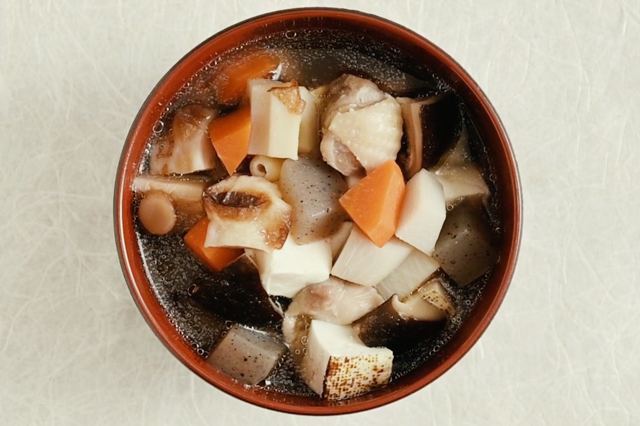
| Prefecture | Kumamoto (熊本県) |
|---|---|
| Region | Kyushu & Okinawa |
| Japanese name | つぼん汁(つぼんじる) |
| Reading | Tsubonjiru |
| Home area | The Man's Chokes |
| Main ingredients | I'm going to have to go to a restaurant to get some chicken and dry, and I'm going to have to eat some potatoes and potatoes and potatoes, and I'm going to have a carrot and I'm going to have to cook some tofu. |
History and Origins
The "Kinji" is a soft taste of chicken, chicken, yams, potatoes, carrots, root roots and other vegetable vegetables cut into small pieces, boiled in soup and finished with soy sauce. It's a sweet taste with the flavor of vegetables melted. It was originally in the Manchuan area, one of the autumn festivals, and is now made up of New Year's and Festivals. It is especially essential for celebration, when the tools meet with odd numbers, such as 7 or 9 kinds of dishes. The name comes from the base of the auditorium, using shallow and deep bowls, but from the fact that the deep - covered bowls were being boiled, it was called "the juice of the pot," and the name "the juice of the pot" changed. In each region and in each household there are differences in the source, ingredients, cutting and so on. (In other words, if it's cooked tofu or baked tofu, you can add oil to the fried tofu.) There are many other sources of gravy, such as gravy, chicken and fried shrimp.
When It Is Eaten
The fall festival has long been held in various places as a festival to thank you for the spring of fruit and to celebrate farming and fishing. The soup that was such an unspoiled dish during the fall festival was ready to be made for New Year's and celebration.
How It Is Eaten
During the celebration, we eat with red rice and stew. For example, at the National Treasure-Auto shrine in Manchui City, the "Mama Festival" occurs on the old calendar September 9th of Akira, the soup is always served with red rice, stew and set. We have cut the pieces of the food into pieces for boiling, so it's not a waste, and we've eaten them with the "Koji" tools. It's also a piece of food prepared from the custom of eating whole meals.
Recipe — Serves 10
Ingredients
- 300 g chicken
- 10 dried shiitake mushrooms
- 8 taro
- 2 chikuwa (fish cake tube)
- 1 konnyaku
- 1 carrot
- 1 blocks grilled tofu
- 10 cups water
- Mix: 1/4 cups light soy sauce
- Mix: 1/4 cups soy sauce
- Mix: a pinch sake
Method
- I'll keep dry and dry.
- The ingredient will be cut into dice about the same size.
- Water is poured into the pan, and add ingredients to remove carrots and baked tofu, and add carrots when the vegetables are cooked a little. When boiling the ingredients, take the pot carefully.
- When you boil, you add a flavor A and then add some baked tofu and taste it.
More About Tsubonjiru
It's a local dish from Yoshiyoshi City County. It's the juice of the rice-soured dish that I finished with chicken and vegetable.
Overview
Originally, it was part of the Fall Festival held in the Manchuan area, where seven or nine types of tools were prepared in odd numbers. It is still an essential food for local celebrations, and is known as a school food, as well as providing school meals.
Materials and soups vary from region to home. For example, in the Manjikichi district, baked tofu and fried tofu in the city of Akiki City are used. In addition to lyko, lye is used in soups, such as dried rice, chicken, and fried shrimp.
Also named after local shrines. In Tokicho City, it is called "Miyagi," which comes from Tokigi Yogigi. In Yuaki, it is called "Arimiya," which is derived from the Hijiyama Miyagi.
Origin of Name
It used to be called Seo-yeon.
At the hall, the bowl was spread out of shallow and deep bowls, while the bowl was stretched over a deep cup with a lid. From this it is called "the juice of the pot," and it becomes an accent, meaning "the juice of the pot." The deep pot used varies from baked to wood and from home to home.
Text adapted and translated from the Japanese Wikipedia article つぼん汁 by its contributors, licensed CC BY-SA 4.0.
Dish data: Ministry of Agriculture, Forestry and Fisheries (MAFF), “Uchi no Kyodo Ryori” (Our Regional Cuisines) database, used under the Public Data License (PDL1.0); translated and adapted from the Japanese original.