Kashiwa mochi 柏餅
| Prefecture | Fukui (福井県) |
|---|---|
| Region | Chubu |
| Japanese name | 柏餅(かしわもち) |
| Reading | Kashiwamochi |
| Home area | Obashima City, young town. |
| Main ingredients | And I'm going to show you some of the things that I've been doing. |
History and Origins
The children celebrating the success of the country's rice plant are celebrating the main festival called Tata's Festival. If you live in a 15-acre area from Obashima City to Tokyo, you will be able to go to a 15-day holiday with the names, "I'm going to be late in May" and "I'm going to stay at work." It's a national festival that is rare to travel through the home and the rice fields with its distinctive words. From mid- May to early July, every house at the time of the festival will be prepared for the Koda god. Even in villages where children don't go around, there are many names like "Six-Santa Life" and "Six-Santa Life" and "Sun-Santa" and "Sun-Santa" and "Silly" and "Silly" and "Burden" and their parents and daughters' wives and so on, and so on. It was thought that the tree god protected the leaves from the anti-bacterial effects of the leaves, which were designed for preservation and not to fall from the trees without difficulty. This has made us a happy, prosperous food.
When It Is Eaten
From mid May to early July, they are eaten at festivals that are celebrated in each gathering.
How It Is Eaten
The rice flour and the silica flour are stirred in boiling water to make it soft enough to make ears to pick up. Then we fold it with a saw, then we fold it into a small mold, wrap it in two, fold it in two, and wrap it around a spiny leaf.
Recipe
Ingredients
- 4 × 180 ml(400 g) glutinous rice flour
- 1 × 180 ml(100 g) rice flour
- 140 g azuki beans
- 130 g sugar
- a pinch salt
- 30 かしわの葉
Method
- Put plenty of water in the pan, boil it in the middle, boil it, boil it for about five minutes, and not stop the fire, and drain it with running water. In the pot, you put a broom in a fire, and when it is boiling, you make a fire, cover it, and boil it until it is soft for about 40 minutes.
- When the ball is soft enough, it filters out the wax that has become soft, removes the skin, adds plenty of water, and sinks, and discards the top every five minutes until it sinks. Repeat this twice, put it over and dry the water firmly, put the sugar and water in the pot and mix the water with the water, and add the salt until it is heated and water is gone.
- Wash the palm leaves cleanly and steam them with a steamer. (Feel is boiling)
- Mix rice flour with gravy flour at a 4 to 1 rate and add hot water to it. It's a very simple process. It's a process.
- When it becomes soft enough, it will rip to the right size with its hands and steam it for up to 15 minutes.
- We often saw steamed cucumbers with saws and thinn them to a small test.
- round the decks into twenty-five pieces, thin them on a small scale, wrap them in two pieces, hold them around the circle and wrap them in a seam of leaves.
More About Kashiwa mochi
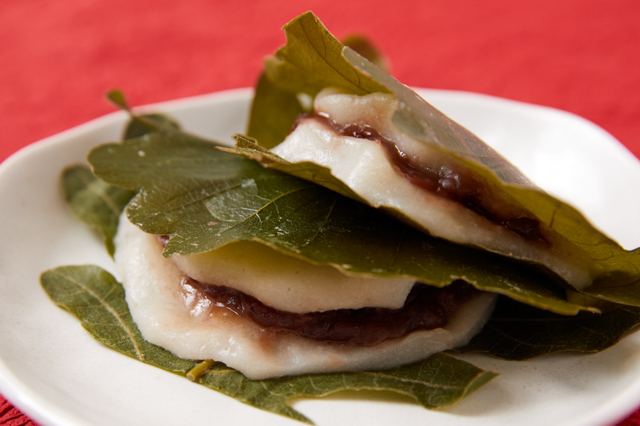
Kashiwa mochi (Japanese: かしわ餅, 柏餅) is a wagashi (Japanese confection) of white mochi surrounding a sweet anko (red bean paste) filling with a kashiwa (oak) leaf wrapped around it. Unlike the cherry blossom leaf used in sakura mochi, the oak (kashiwa) leaf used in kashiwa mochi is not eaten and used only to symbolize the prosperity of one's descendants.
Children's Day
Tango no sekku (Children's Day) is celebrated in Japan on May 5. On this day, the Japanese promote the happiness and well-being of children. Kashiwa-mochi and chimaki are made especially for this celebration.
Text adapted from the English Wikipedia article Kashiwa mochi by its contributors, licensed CC BY-SA 4.0.
Dish data: Ministry of Agriculture, Forestry and Fisheries (MAFF), “Uchi no Kyodo Ryori” (Our Regional Cuisines) database, used under the Public Data License (PDL1.0); translated and adapted from the Japanese original.