Matsuyamazushi 松山鮓
| Prefecture | Ehime (愛媛県) |
|---|---|
| Region | Shikoku |
| Japanese name | 松山鮓(まつやまずし) |
| Reading | Matsuyamazushi |
| Home area | Matsuyama Area |
| Main ingredients | We're going to have a lot of fun with that. |
History and Origins
(Iseshima) When I first visited Matsuyama, and when I stopped at his house, his mother Yasaka was welcomed by "Mama Yamayama." I'm telling you that at that time, I was very happy to eat one grain without pouring it out. And to Koji, "Namayama was a proud people, and he has the phrase "my dear, I love you" And when I'm back in the spring of Iseshima, as a teacher at Matsuyama's junior high school, I can imagine that the first thing I wanted to do was to say, "It was Matsuyama, and it was my favorite dish." Matsuyama is sometimes referred to as "sing" but is derived from what the Matsuyama dialect calls "shoe" or "buo" in its language.
When It Is Eaten
In Matsuyama, it is customary to have sushi in celebration and with guests, and it is believed that "sama Matsuyama" was born when the food in the Seto was lavishly distributed. We eat when we celebrate, when we come, when people gather.
How It Is Eaten
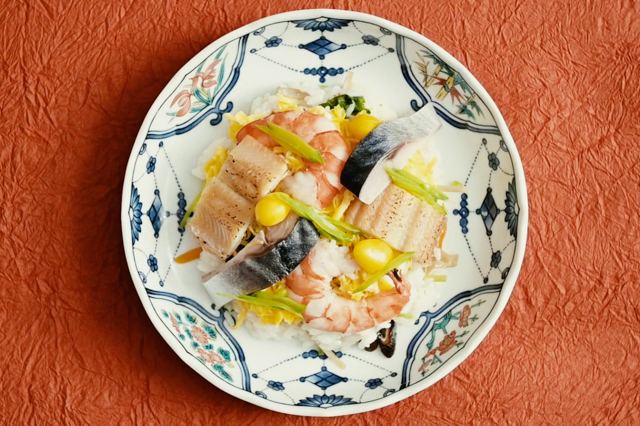
It's characteristic of the frequent use of fish from the Inland Sea. The tools change from season to season, but the basic thing is that they contain anago. Using the juice and sweet vinegar from small fish, such as eso and tra-haze, we stir in the anago and seasonal vegetables that we have carved out of rice. On the sushi, they decorate their rich silk eggs and fish.
Recipe — Serves 8
Ingredients
- 3.5 cups(560 g) rice
- 150 g egg
- 80 g burdock root
- 80 g carrot
- 20 g dried shiitake mushrooms
- 25 g mitsuba
- 60 g ginkgo nuts
- 40 g snow peas
- 160 g burning Anagos
- 160 g cured mackerel
- 160 g shrimp
- 40 g eso (すり身)
- 1/2 tbsp vegetable oil
- Mix: 3 tbsp sake
- Mix: 730 ml water
- Mix: 1 dashi kelp
- Mix: 5 tbsp1/2 vinegar
- Mix: 65 g sugar
- Mix: 2 tsp salt
- Mix: 300 ml dashi stock
- Mix: 2 tbsp1/2 light soy sauce
- Mix: 1 tbsp1/2 sugar
- Mix: 2 tsp sake
- Mix: 1 g( a pinch ) salt
- Mix: 1 tbsp sugar
- Mix: 1 g( a pinch ) salt
Method
- I cook with rice and seasoning A.
- I'll make vinegar. Put in seasoning B and stir slowly to make sure that the eso wear doesn't become solid.
- When you cook the rice, you add two vinegars to it, and you cook the rice.
- When you dry, you can boil water, rice, and carrots and boil them in seasoning C. Shake three leaves.
- The eggs are melted, seasoning D combined, and made into silk eggs.
- I'll cut the baked antelope lightly and to the right size. I'll cut the sabbatical to the right size.
- The shrimps, the lentils, are boiled and cut to the right size.
- I'd like to dry the rice, cook it, mix carrots and three leaves. I'll put some other tools on the plate.
More About Matsuyamazushi
Matsuyama is a local dish spread from the Matsuyama region of Ehime Prefecture. It is made up of celebrations and visitors, and is characterized by sweet bowls of rice that have been caught by small fish in Seto. It is a sushi with native fish in it.
My relationship with the Sakushi and Masako Kooka.
It seems that Koko loved Matsuyama as her home's taste, and ate it with every opportunity she had, and later in her life her pride in native cooking has become a famous story.
In August of 1892, I was a university elementary student, and I was the first person to visit Matsuyama when I stopped at the house of Koji Okaoka, and my mother was very happy with him.
I hear that the stone, which had been very modest in its appearance in Japanese clothes and in front of the boy who takes chopsticks, sat right on his knees and ate properly, without spilling a grain of juniper, while the bastions that were present were thought to be in the book, and they were being passed on.
Also, for Koji Guangumi, her mother's favorite dish, her mother's favorite dish, and her dear Matsuyama's precious memory, seems to have been the favorite memory, and we can understand this by the fact that she has left a lot of passages about Matsuyama.
And yet, in the spring of 1895, when I was back as a teacher at Matsuyama Middle School, I can imagine that this experience was the model of the novel "Sun-Sung" that I wanted first, and that it was my favorite dish for the stone.
By the way, it is written in its own book that I also ate Seung Jo.
It's a feature of Matsuyama.
The most characteristic is to make sushi from the sweets of the daisies in "the little fish of the Seto" and like "the fish of the Seto" and "the little fish of the sea" and to make sushi with the sweets of the rice and to make them a mixture of an elephant and seasonal vegetables carved in it. And on top of that, they will be lopped with rich silk eggs and then, at the end of the season, they will be served by your favorite dish of fish in Seto.
In a serious restaurant, you can make a variety of colorful menus, such as sea cucumbers and car shrimps, and the winehouses, with the center of the wine, and the dining room, with the lily - green food, such as the sky, the sea horses, and so forth.
(Singing) Using the mixture of food.
Matsuyama is sometimes called "sama" This is derived from what Matsuyama's dialect calls mixing "bullet" or "shoe" in its language.
In rare cases, there is a mix of this "snap meal" with "snap meal," which is not a "snap meal," but it means a simple meal that is eaten by mixing rice with rice, such as "snack" or "snack" or "snack" or "snap" and it is quite different from the dish that was served as a welcome dish.
Text adapted and translated from the Japanese Wikipedia article 松山鮓 by its contributors, licensed CC BY-SA 4.0.
Dish data: Ministry of Agriculture, Forestry and Fisheries (MAFF), “Uchi no Kyodo Ryori” (Our Regional Cuisines) database, used under the Public Data License (PDL1.0); translated and adapted from the Japanese original.