Nishinzuke ニシン漬け
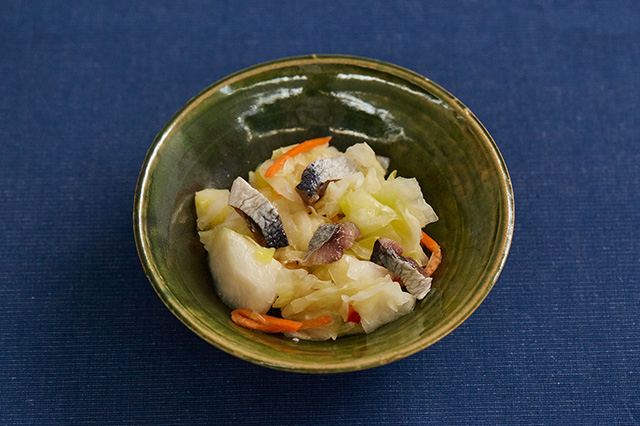
| Prefecture | Hokkaido (北海道) |
|---|---|
| Region | Hokkaido |
| Japanese name | ニシン漬け(にしんづけ) |
| Reading | Nishinzuke |
| Home area | I'll be right back. |
| Main ingredients | It's called the Nisin, the root, the cabbage, the carrots, the red pepper. |
History and Origins
"Nicining" is a local dish that tells the history of the herring industry in Hokkaido. In spring, when a large herd of herring came to the coast for eggs, the sea would become white, and you could see "a swarm of them." The catch of herring peaked during the Mexical era, and at one time it had nearly a million tons of water. At present, we often take the lake swamps and other nearby herrings, such as the Sakura Lake, which are located in and around them, but the catch is hardly caught at its best. Nisin-sucking is a local dish made from home since the days of herring fishing. Since it was important at that time to store food for the cold winters, the material was used as a means of saving it. It is said that the mixture of a dry dish with a mixture of a protein and a vegetable has been formed as "Nicin" established before winter. Although herring's catch has been reduced, it is still based on a winter home dish of Hokkaido.
When It Is Eaten
She kept her spring herring as dry-sized herring, and she was eating it in the winter with a "Nicin" that she swallowed with vegetables in late autumn. When herring was fishing, it was common in every household.
How It Is Eaten
I'll keep the absent herring in a day or two, or in a melted water of ash or in a rice yuzu. After that, you wash well enough water, drop the scales, cut them to about four inches long, and then dip them in cavets, root, carrots, and so on. The salt isn't so strong, and it's a long-term duplicating of the citrus, which increases the fermentation and makes the flavor and flavor of the herring grow. Using dried items until the large roots become soft, cabbages are cut into pieces, and carrots are cut into pieces. Some families cut the pepper into pieces. In a container, it is a container of citrus and salt, a little salt, a little ninin, a vegetable that is piled in alternately, and then a heavy stone is applied. You can mix the materials together from the beginning and stuff them. Since it's fast changing tastes when put in a warm place, we used to store it outside the store. The cold winters and the freezing of vegetable water make it possible to enjoy a refreshing sense of food. Many homes are now saved in refrigerators and so on.
Recipe
Ingredients
- 2.5 kg daikon radish
- 2.5 kg cabbage
- 0.2 kg koji
- 0.25 kg dried herring
- 0.2 kg carrot
- 40–50 g ginger
- 2–3 red chili pepper
- 3% 塩 重量の
- weight (for pressing)
Method
- The dried radish will be cut, the cabbage will be cut, the carrots will be cut. Red peppers pick seeds and cut them into little pieces.
- A hungry herring is packed overnight in rice yuzu, and a scales are cut to the size of a four-inch cube.
- I'll keep the citrus in warm water.
- Put all the ingredients into the container, place salt in it, mix it together. The surface is flat and heavy.
More About Nishinzuke
The Japanese condiment that used to fertilize the wearer's chicken and vegetables.
Overview
I'm going to pack the absent herring in with the root and the cabbage with the short print. The maturity period is about 20 days.
The goods sold at Hokkaido are about 2.5% salt, 50 percent salt, 35 percent cabbage, 10 percent nimb, and 5% citrus.
The HokkaidoZXZX0x027X is a stored food for the weather through severe winters. Since the salt concentration is not too high and is used in citrus, it will increase in the release after a long time and will be characterized by a unique taste of acidity and niacin.
Local Colors
Hokkaido
It's the winter diet of Hokkaido, and many homes are soaked in late fall. (Dinishness, cabbage tag) The ones that you wear are popular: dacon, cabbage, carrots.
There are local colors, and often they are easily fertilized in the river, but in the barn they often use only the dicon, which is difficult to produce without making acid.
Aomori Prefecture
Aomori Prefecture is simple enough to be worn out by the seams, the dacon, and the hawk claws.
Akita Prefecture
In Akita Prefecture, it's just a handful of vagaries, dicons, and carrots. There's also a kiosk with a local name.
Fukushima Prefecture
In the Fukushima Prefecture Club, there are mountains of tin cans to be packed with in the sunshaws. Both are soaked in dehydrated herrings.
Fukui Prefecture
In the city of Zheng He, use the nailnails of the hungry, the dicon, the carrots and the hawk. It's called Nisin Sushi.
Kyoto Prefecture
In the town of Miyama, Kyoto Prefecture, the only thing that's missing is carrots and carrots.
Text adapted and translated from the Japanese Wikipedia article 鰊漬け by its contributors, licensed CC BY-SA 4.0.
Dish data: Ministry of Agriculture, Forestry and Fisheries (MAFF), “Uchi no Kyodo Ryori” (Our Regional Cuisines) database, used under the Public Data License (PDL1.0); translated and adapted from the Japanese original.