Oshizushi 押しずし
| Prefecture | Ishikawa (石川県) |
|---|---|
| Region | Chubu |
| Japanese name | 押しずし(おしずし) |
| Reading | Oshizushi |
| Home area | Kanazawa City, around and around Koga. |
| Main ingredients | (Music) |
History and Origins
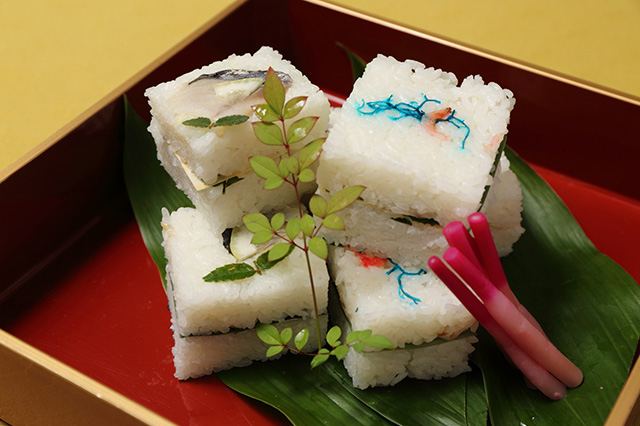
In Ishikawa Prefecture, you can eat a "slip" on a festival or celebration day. In Kanazawa City, vinegar-like fish, rice, and green pepper are placed in wooden frames and pressed overnight to sleep. I've heard that by taking a night's weight, fish and rice blend in with each other's flavor. The more acidic it is, the better it is. In spring, the fish that use them in seasons and events, such as Thailand, Eagles, Aji, and in fall, as well as the fish that use them in seasons and events, can also be colored with tree sprouts and crabs. In Kaga, some types of push-ups are eaten, such as the "swinging" and the "leaf leaves" of the plant. The "silence" used to be a night's sleep with rice and fish wrapped in a bowl. The rice bowl will grow to about 50 people. Once upon a time, it was said that we could get dozens of people out of a nearby mountain and have all of them come from the family. The food at home is made in a simple way and said that it was eaten in a "no food" way. In areas where fish were hard to get, they used oil and salt lotteryes. "The leaves of the broom" was also a dish of rice and fish. "The leaves of the broom" was pressed. It is said that the leaves of the plant are thickly scented with green, while those that grow from July to August. Some families freeze large amounts of harvest during this time and save a year's worth. It's supposed to be the original way to make fish under the rice and on top of them a blue rose and a cherry shrimp.
When It Is Eaten
In addition to New Year's Day and the Memorial Day, they are eaten during spring and fall festival. Once upon a time, it was customary for families to build a large sum of money in front of an event and to have a house in the neighborhood for the day. It's said that each step, such as laying rice, catching fish, doubles, and restraining children, was shared by adults and carried on with the flow.
How It Is Eaten
After I went to bed for about a day, I ate as I did. When it comes to the celebration, they are placed on a bowl of Kunji-kun. They are placed on a luxury plate and they add color to the feast.
Recipe — Serves 4
Ingredients
- 3 cups white rice
- 1/4 cups glutinous rice
- 3 1/2 cups water
- 5cm) 1 kelp (konbu)
- (A) 5 cups) vinegar
- (A) 1/2 cups vinegar
- (A) 16 g salt
- (A) 60 g sugar
- Mix: sardine, to taste
- Mix: mackerel (刺身用), to taste
- salt, to taste
- julienned ginger, to taste
- lemon, to taste
Method
- White rice, rice rice, wash it for one hour or two without being soaked in water for 30 minutes.
- A is cooked on fire and heated enough to melt salt and sugar. (You can use vinegar.)
- Put a cloth in the rice, boil it up, place it in the tub, mix it with two vinegar, mix it, and put it in a wet cloth and cool it.
- The fish are placed in three pieces, salted with strength, salted with salt for two or three hours, washed and wiped with water, soaked in a container of garlic for about 30 minutes, covered in a jar, peeled, and cut.
- I can cut a piece of ginger and dip it in the water. The lemon is cut into slices and poured into the water. I'll put the blue stain on the water and bring it back. The leaves of a tree or a tree are cut to fit the pattern.
- Keep the slats wet in water, spread the wood, spread the lemons and fish, spread the rice and spread the rice on top of them, and then added blue shrimps and needles and then put them together again and press them one night.
- I'll put the plate on a slice-up plate.
Dish data: Ministry of Agriculture, Forestry and Fisheries (MAFF), “Uchi no Kyodo Ryori” (Our Regional Cuisines) database, used under the Public Data License (PDL1.0); translated and adapted from the Japanese original.