Sabasōmen 鯖そうめん
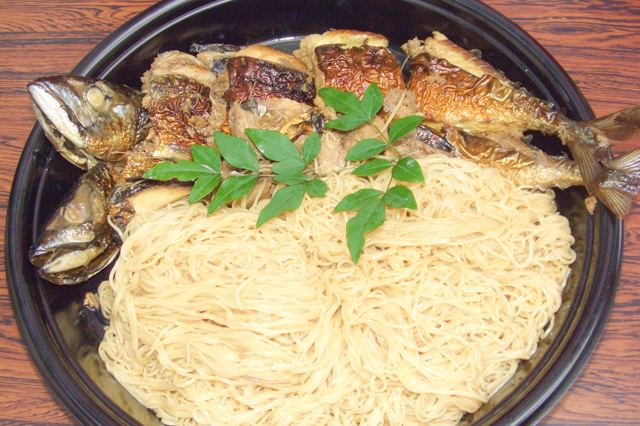
| Prefecture | Shiga (滋賀県) |
|---|---|
| Region | Kinki |
| Japanese name | 鯖そうめん(さばそうめん) |
| Reading | Sabasōmen |
| Home area | Lake North |
| Main ingredients | I'm going to start with a couple of things. |
History and Origins
"Squash" is a local dish that is eaten in the interior of the province, centered around the northern part of the lake of Shiga Prefecture, which boils down to the cooking saber and is carefully enjoyed. From ancient times, there have been many ways to carry supplies, such as "to the edge of the country," from small to sea products, to Kyoto. The fact that the typical supplies were Saba makes it called the "Safe Road." Although roads are well known from the beach and through the deforested regions of the lake west, there were routes from the northern part of the lake. So, in the northern part of the Shiga Prefecture, the lake region was well available in the west. In the northern part of the lake, there is a custom of "visiting" in the spring when she is married to a farmer, and of giving her a rich food to a well-fed mauve, a meat-salt meal, to be given first. The baked Sabas that were presented were passed on to acquaintances and relatives in the neighborhood. When I was busy with farming, it was valued as a dish that could be easily cooked. In the case of visiting plants and other plants, they can be baked lightly and eaten with soy sauce.
When It Is Eaten
Each year, in April, as a celebration of the Haseji Highbayi, there is a festival served as a feast for Kosaka. It is eaten on Hare's day. Also, during springtime, they were eaten as visits in May.
How It Is Eaten
Put in a pot with a low-frequency soup and seasoning, boil it, cook it in a baked saba, and cook it until half the sauce is served. It's the point where the soup is poured on a sabbatical when boiling it. When it is cooked, put the sabbatical on a plate, and apply the soup so that it doesn't fit. I will boil the blue thread in the soup and heat it lightly and put it on the plate. If you boil it, add a hard-boiled bowl and season it. It's a good place to cook.
Recipe — Serves 5
Ingredients
- 1 grilled mackerel
- 4 bunches somen noodles
- 2 L() water
- 5 green onion
- Dashi: 1000 ml dashi stock
- Dashi: 25 g sugar
- Dashi: 100 ml soy sauce
- Dashi: 50 ml sake
- Dashi: 20 ml mirin
- Broth: 400 ml water
- Broth: 20 g sugar
- Broth: 30 ml sake
- Broth: 20 ml mirin
- Broth: 1 bamboo sheath
Method
- We boil 2L water into the pot and then boil the cucumbers tightly. If it is cooked, we will have to cool it with a stream, then remove the stain.
- I boil it by adding a dish with a raw raw sauce and seasoning.
- I'll remove the baked sabbatical, put it in a pot and boil it. Sometimes I pour the soup on the sabbatical. I'll cook it for about 15 minutes until half the soup. I'll be careful not to blow it up.
- I'll take the hippo from the pot and put it in the middle of the plate. The soup in the pot will fold and keep the bones out.
- Cut the blue strip into three-inch slices, and stir with three soups, then place it around the four- plate sabbers.
- Add water, sugar, wine, and garlic to the soup.
- I'll put the bowl around the three sabers. When you divide by five, you divide five of them into five classes, put them in a bowl, and then pour some noodles and soup around them, and then cut them into pieces.
More About Sabasōmen
The dish is native to the northern lake area around Shiga Prefecture Coast City. It's also called a haiku.
Characteristics
In May, when it's a season of farming, parents who have a busy daughter are drawn from the custom of "murdering" in the Lake North, where they take her from home to burn the ground. They've been eaten as dishes that are easily cooked and eaten during the season of agriculture, as well as as as those that are served with guests and as hale dishes, such as a wedding feast. The northern part of the lake is inland, but it is closer to the young cove, where it comes from, so the cooking of the rice, the rice, the rice, and the like were familiar. Even in the Kajishima area, which runs through the Hijishima Road, the Japanese rice rice is eaten as an essential dish for the festival.
History
Although the fire and the noodles themselves have been eaten from old times, it is taken since the '40s to combine them. It's originally home food, but since about 1990, it has been served as a fine, long beach dish for tourists as well. It was (in 1990, when the Wings Building, which had put the baked noodles on the menu, opened at the early age of 2) and the local tourist community took note of the tourist resources since about the year 2005. In the year 2020, it's provided at nine stores in the heart of Long Beach City, as well as at local supermarkets, such as local supermarkets and fantasies. In the year 2020, the development of the instant rice pot was the topic of the development of the Japanese noodles from the experience of local elementary school students.
How?
There's a fine difference in flavoring and making at home.
Cook the broth with a sweet soup until it is tender. I'll boil the noodles with one soup. I put the broth on top of the noodles.
It's a thick flavor, so it's often eaten not as a staple food but as a bowl of rice and wine.
Text adapted and translated from the Japanese Wikipedia article 焼鯖そうめん by its contributors, licensed CC BY-SA 4.0.
Dish data: Ministry of Agriculture, Forestry and Fisheries (MAFF), “Uchi no Kyodo Ryori” (Our Regional Cuisines) database, used under the Public Data License (PDL1.0); translated and adapted from the Japanese original.