Sangon 三献
| Prefecture | Kagoshima (鹿児島県) |
|---|---|
| Region | Kyushu & Okinawa |
| Japanese name | 三献(さんごん) |
| Reading | Sangon |
| Home area | I'll be back in a minute. |
| Main ingredients | (Customer, chicken, pork) |
History and Origins
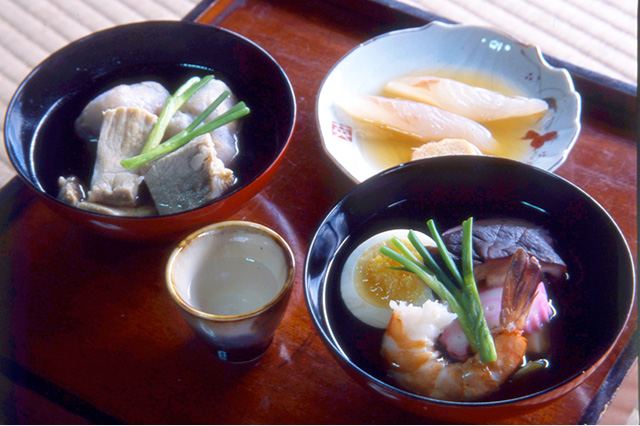
New Year's cooking is soy sauce and stew, but it eats "Treaji" in the Miyumi region. Its name came from the offering of red soup, chicken, or three dishes of pork-soured meat, or meat with a knife. It is a series of rituals to eat in the order of red, knife, and black. When Shizushi Shikoku, who was caught up in a peace-making prison by the Shogun, found himself in Isumi Island, he married Oshima's daughter, the daughter of Oshima's most distinguished family, and was said to be celebrating in "three-do-do- more." Originally, "three" is a Japanese dish, established in the city, developed in the Edo age, but now it is only a special place for weddings and other special occasions, and it is not familiar with the younger generation. However, in Toshimi, the practice of New Year's Day is still rooted.
When It Is Eaten
Many families make "three contributions" on New Year's Eve. It's also possible that the wedding and graduations will happen on the occasion of the celebration.
How It Is Eaten
Once again, the three-volume ceremony begins with the voice of the chief. First of all, it's the best place to get into the red bowl. There is a bowl and I eat other things that I eat that I eat with mushrooms, fish, shrimp and so on. The next time you eat a white fish sting in two bowls, you usually eat a white fish, but many families get an octopus sting. Three sets at the end. We eat chicken or pork in black. Every bite I eat, I drink the broth. There are also families who eat the "skull salt" and dry dishes made of salt, carp, and cloth during the three-volume ceremony.
Recipe — Serves 4
Ingredients
- [a stage]
- 4 mochi
- 4 slices fish
- 4 kamaboko (fish cake)
- 2 egg
- 4 dried shiitake mushrooms
- 4 shrimp
- as needed green onion
- 1 dashi kelp
- 30 g bonito flakes
- 800 ml dashi stock (shiitake mushrooms)
- 1 tsp salt
- 1/2 tsp light soy sauce
- 1 tsp local sake (mirin)
- [two moves]
- 4 slices fish (刺身用)
- as needed salt
- 8 ginger
- as needed vinegar
- as needed soy sauce
- [three sets of rules]
- 1 chicken (なるべく親鶏)
- 400 g daikon radish
- 150 g carrot
- 1 green onion
- 1/2 tsp salt
- 1 tsp dark soy sauce
Method
- If you want to dry it, put it back in the dry water. If I put it back, I'll remove the stone and cut the cross.
- I'll put a piece of cloth on the pot with a cut in 800 cc of water. When I get back, I light the fire and take out the cloth just before the boiling. I'll have it divided into four categories. Put a pot of casserole in the pot and boil it, and you stop the fire. I'll quietly pour it in and put it in with the juice from the sauce. It'll be 800cc. Add the paste and boil it, and then add 1 teaspoon of salt, a small-steel oil, and a little glue.
- I'll cook the fish with a thin salt.
- I'll take the shrimp from the bamboo and boil it with boiling water with a little salt.
- The eggs are boiled and cut in half or turn into flowers. I'll have four.
- I'll burn the rice.
- I'll cut the cucumber.
- I either cut the rice or boil it and tie it in a knot.
- I put in the soup and put the shrimp in the "one cook" pot and cook it a little. Put it in just before the convex and heat it.
- I'll put a cloth on the bowl. It's hot after you put fish, eggs, eggs, eggs, eggs, eggs, etc., and then you pour the juice gently and finally wear blue.
- Fresh fish used for stinging will keep thin salt.
- I'll cut it for stinging.
- I'll put two slices of knife in a plate and make one thin piece of pepper. I'd like to put soy sauce there.
- The chicken is divided into four pieces, and the chicken is cooked out of water for an hour, and then the chicken is boiled, and the chicken is boiled, and the soup is cooked, and then it is cooked.
- I'll cut the radish and carrots in a little bit.
- Cut out the bowl.
- I'll put 1,000ccs of chicken in a pot, cut into a bowl, cut chicken, root and carrots in a bowl.
- When the carrots are soft, make them taste.
- You can taste it by chewing salt, citrus oil, and wine.
Dish data: Ministry of Agriculture, Forestry and Fisheries (MAFF), “Uchi no Kyodo Ryori” (Our Regional Cuisines) database, used under the Public Data License (PDL1.0); translated and adapted from the Japanese original.