Home / Kochi / Sawachi Sahachiryōri
Sawachi Sahachiryōri 皿鉢料理
| Prefecture | Kochi (高知県) |
|---|---|
| Region | Shikoku |
| Japanese name | 皿鉢料理(さわち・さはちりょうり) |
| Reading | Sawachi Sahachiryōri |
| Home area | All within the province. |
| Main ingredients | I'm not going to be able to do that. |
History and Origins
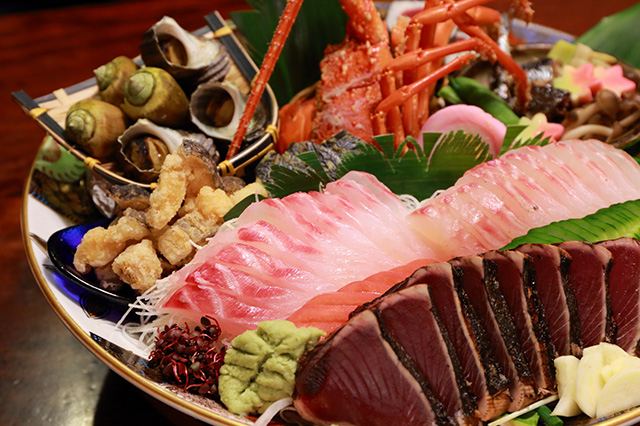
A typical food culture for Kochi Prefecture is "Singing dishes." Not the name of a particular dish, but the style of cooking. On a plate of 36 to 39cm, a Kochi Prefecture native mountain and ocean success are placed on luxury. The variety of dishes on the bowls is varied. There are bowls of raw dishes, such as sashimi and "and chicken" and such raw dishes, such as "behind" and "go wild" and "go wild" and "goo-go-go-go-round" and "go-to-go-round" dishes, bowls of stew and soft dishes, bowls of fried and sweets, fruit and so forth, and other dishes with "shoes" and other dishes. Kochi Prefecture calls the hosting of a party a "no-threshold" and still the "no-threshold" culture is rooted. The dish is served with that dish. The dish is made with a volume of about three people a plate and supplemented when the dishes are reduced. The number of bowls shows the scale of the bowl. "The dish" dates back to the time of the Emperor. It is said that at the end of the warrior's feast, a large dish was served, and soon after Meiji's reign, it was spread throughout the country as a dish. "Singing dishes" was also a symbol of a social status. In wealthy families, they also had items in their collection, such as expensive dishes such as Iwaji, Kyusaka, and Narita.
When It Is Eaten
It's offered not for everyday living but for the hosting of various hare events and guests, such as wedding feasts, birthday celebrations, holiday holidays, holiday holidays, re-dates, phrases, and New Year's celebrations. Cooking is done by men, and women by women. They say sometimes it takes two days to make it, so it takes time to prepare it. In ancient times, a farming village had a group called "stirring" that was formed together. The tie was broken into a small group called the "Live Group" and if there was a "noodle," we would have helped them cook, distribute, and clean. Some of them were amateurs, but some of them were familiar with what they called "the good cook." The locals said that the arm was being judged by them.
How It Is Eaten
I'm going to put a lot of food on a large plate around it, and I'm going to divide it into small dishes and eat them. It's an essential dish for "Knock" because it allows you to eat whatever food you like.
More About Sawachi Sahachiryōri
A dish dish is a native dish of Kochi Prefecture. And in recent years, there are times when people say, "Supultaneous dish" by pointing to a banquet with a big plate with a knife and stuff like that.
The origin of cooking.
In the festival of the Festival of Booths, which was held as a agricultural ritual, thanks to the five-fold offerings and the harvest, there were various ingredients before God. After the gods, he put down those food supplies, cooked them, and went on as a god. Not only was the cooked food served to God, but those who participated in the shrine shared it and ate it. They said that the feast that was eaten with this god was a formal feast, one of the gods with whom God was associated, and was considered an important ritual. The dishes that inherit these traditions were also known as rice and rice until the middle of Meiji's reign, and remained in Japan all over the country.
It's from the dish.
A bowl refers to the middle form of a dish and a bowl. Besides the bowls, they're also said to be "feeding," but they're also said to be "sniff," "sach," "sach," "sach," "sach," "sach." A vessel that is the source of the modern bowl was built from the time of the apartment town. In those days, the vessels were relatively deep, high, and they were named after them, such as the sakura, deep bowls, bowls, and bowls. It is thought that those vessels began to be called bowls during the Edo. The ban on Kochi Prefecture is listed as "sand bowls" and other documents written "sun bowls" and "sun bowls."
Type of vessel
Not only is the shape circular, but it is used in a variety of different ways for cooking, such as small and rectangles. Some of them are as small as nine inches. But today, in a bowl other than a well-made one, it's almost standard. It's not saying that a bowl is too small, but there's no clear section.
The plate is so expensive that it is not used for cooking.
Also, a bowl often arranged after the table has become popular, but once each bowl was laid out on a table table with a plate that was painted for the bowl.
The history of the bowl.
The dish dish prepared by the Shinto ritual was not a daily meal, but a regular meal and was a fine meal. In the diary and notes of the old house, you can see a plate that was written as a contribution to the food program of the Edo. It seems that at that time it was served before or after the formal ritual meal, or for the banquet or for the informal feast.
However, the Edo period was under the control of the Tassahs, with its "surgical" as it was, 2 years long, 5 years long, 1748). It is also pointed out that the dish on record at that time was a banquet for some classes of people, including warriors and merchants and farmers.
During the Meiji era, with the freedom to sell dishes and with the abolishing of a sealed status system, the bowls were passed over to the common folk and developed greatly. It is said that this era began with the use of a variety of food products, such as "stuffs" and "Seven or Five or Three" with an odd number of foods, such as those found in modern dishes. Also, by the middle of Meiji's reign, a shop was set up to be used as a gravy cook. A shop that was originally served from Akii was like taking the fish that you brought and making dishes from house to house. But since the time of Akii, there has been an increase in production of pre-existent dishes. In the mid-30s, bowls were specialized in all parts of Kochi Prefecture, and the eating of food was eaten by the sea, and today there are dishes that are made mainly as Chinese banquets, different from traditional native food, and different from rice.
From the time of Meiji's reign on, the bowl dishes were carefully fixed into the natives as the master's native dish. The reason why dishes have been passed on to each other is that they have been served together to show mutual effort, and that sharing and eating a dish can stimulate community and community consciousness, and that they were "sunning" very useful in the community and community life.
It's the basics of the bowl.
The plate with the bowl and the bowl with the bowl with the bowl and the bowl with the bowl with the bowl with the bowl with the knife in it. In the event that the feast is a feast, it will include "the making of the bowl" and so on. Also, as a seasonal dishwasher, there may be bowls of rice bowls, bowls of rice bowls, bowls of rice bowls, and so on in the summer. On top of that, there may be two or three bowls, or two bowls with a bowl with a small banquet, or a bowl with a bowl with a bowl with a bowl with a bowl with raw, or a bowl with a bowl with a bowl with a bowl with a bowl with a bowl with a bowl with a "sip" in it.
(Sniffles)
The basics were to wrap the stabs of a live fish on a plate. In spring, the red-sharp stings of the "kiddnose tuna" and the "doo" stings of the "doo" in the summer. In the season there will be a drought, and other uses are used as well as walrus, walnuts and curry.
And (increasing of the celebration) did not use a live fish's knife, but was used by tofu stings.
A Tribute
It was basic to cook dishes of a kind until the Meiji period, as you can see on a plate. In the so-called Edo-Creation, the term "competitive" appears in 1835, and it is thought to have been used to mix cooking together and to describe it as "competitive" if the ingredients were added together instead of cooking.
Also, the name "pigs" varies from region to region. It is also said to be built-in, dishwashing or bowling or something else.
The "Scrupulous" will be served with the "Halan" and the "Halan" and the "Feels" and the "Feels" and the "B" and the "B" and the "B" and the "B" and the "B" and the "B." The "Halan" with its color on the bowl has been used since the Meiji period, since the flavor and aroma of the dish were not changed, and it has been set by changing the color not just as a decoration but also as a good effect, such as chewing "haran" and controlling the symptoms in the stomach, as an essential part of "stuff." It is thought that since today artificial Haran is the main source of the existence of artificial Haran, but it's been important to show the cook's skill.
Sweeney.
The white rice and sugar "shoe" are essential to the "soon meal" and is one of the things that will always be added to the dishes. There were many kinds of fish, such as the shape of a mango, the shape of a mango, the shape of a mango, the shape of a fish, the shape of a fish, the shape of a fish, the shape of a mango, the shape of a mango, the shape of a mango, the shape of a mango, the shape of a mango, the shape of a mango, the shape of a mango, the shape of a mango, the shape of a mango, the shape of a mango, the shape of a mango, the shape of a woman's body, the shape of a woman's body, the shape of a fish, the shape of a fish, the shape of a fish, the shape of a woman's body, the shape of a woman, the shape of a woman, the shape of a woman, the shape of a woman, the shape of a woman, the shape of a woman, the shape of a woman, the shape of a woman, the shape of a woman, the shape of a woman's, the shape of a woman, the shape of a woman, the shape of a woman, the shape of a woman,
A bowl as a local dish.
It was said that the banquet was to be celebrated by the number of dishes served, including the number of dishes served, such as the celebration of the birth name, the funeral, the festivals, and the celebration of the festival of the birth name, or the celebration of the New Year, or the celebration of the new year.
Prior to the main operation of the shop, the master of each house served and cooked each house, such as a small festival or a colleague's drinking table.
And there were two or three people in every area who had their real job, but who were deep cooks, good cooks, and who were good cooks, and who were hired to perform weddings and lectures as guests, and who were also very good cooks. Until early in the day, when traffic was still in progress, there were bowls with the characteristics of produce available to each person, and the "microtics" cooks valued the rules and consequences of the local custom, and the "competitives" followed the custom of making dishes with a low content in the case of a celebration, such as cutting food into plates or making dishes.
As the times changed and the growth of transportation networks caused the distribution of food to become more active, the local features of the dish were thinned. Since the mid-'30s, the "skilling" cooks have gradually disappeared, and most of the dishes are now made by the manufacturers, cooks, and so forth.
The "saurus bowl" and the "song bowl" that were once an essential dish for the bowl were the ones used to be the dishes that are now the dishes that are now the most common.
The local diet.
In the mountain area, only salted sea fish could be eaten because of their long relationship to traffic. It is said that what was used for the "best meal" with salted peppers became the prototype of the "feet of the Yugoslav" that is represented by the most intelligent of them.
In other words, the dishes were made from casmas and bida, and the dishes were made from local food, such as the "sing" and the "sing" in the 40-year-old river area.
It's a modern dish.
A professional shop is busy playing a banquet table and providing cheap dishes, and a free-form "containment" has become the main source of the dish dishes, not to mention the traditional custom of having a good day. In addition, the spread of food, such as sea breezes and Chinese, into family life has made a big difference in dishes. There's a bowl of fried and meated food, and a bowl of hot dishes, such as pepper pigs and green vegetables.
Also, the "live-and-life" bowls that were served at the feasts, such as wedding ceremonies and holidays, have become more elaborate, and not only do they have to be used but also are also used for food, such as cucumbers and shrimps.
The local cooking.
The dishes that were rooted in the Buddha like the dishes were still in all parts of the country. Some have been pointed out to the Commander's cooking system for geographical factors and variety.
There are other localities who introduce the dishes of the feast based on traditional traditional native dishes as bowls.
Yuzushima's bowl is delicious.
The Yuzushima traditional dish, "Soo-yaki," which is a "soon meal" for hospitality, is called "soon meal." The cooking itself is a everyday thing, but it displays the luxury of the dish with materials, fractions and plating. In connection with weddings and other events, such as wedding feasts, where the number of visitors is not fixed, the fact that the main dish served to each person is too much rice and thus the "Found's Cook" has set up as a welcome dish. A person who tells the whole story from food to preparation is called a "Spesman" and each dish is divided into pieces by the best in the community. The "School-Pull" also runs the sorting service and makes sure that the food doesn't run out as much as it likes for visitors.
It is thought that the "boo soup" is closer to the "boo soup" prior to Meiji's time than it was to Meek's. While a large dish provides a variety of specific dishes such as "This round of rice" and "this round of rice" and "Santa" and "Santa" and "Santa" which are used to make the story of Kyushu, "Sun-Sun-Singing" and "Sun-Sun-Singing" are served, it is possible that they were combined as an indispensable mixture of the dishes that is spread throughout the entire area of the kitchen.
Also, in autumn harvest festivals included a local dish called "Sai" There are rules such as putting several kinds of food on a flat plate or making the number of dishes odd, and it is thought that the dish is a dish of cooking.
Text adapted and translated from the Japanese Wikipedia article 皿鉢料理 by its contributors, licensed CC BY-SA 4.0.
Dish data: Ministry of Agriculture, Forestry and Fisheries (MAFF), “Uchi no Kyodo Ryori” (Our Regional Cuisines) database, used under the Public Data License (PDL1.0); translated and adapted from the Japanese original.