Senmaizuke 千枚漬け
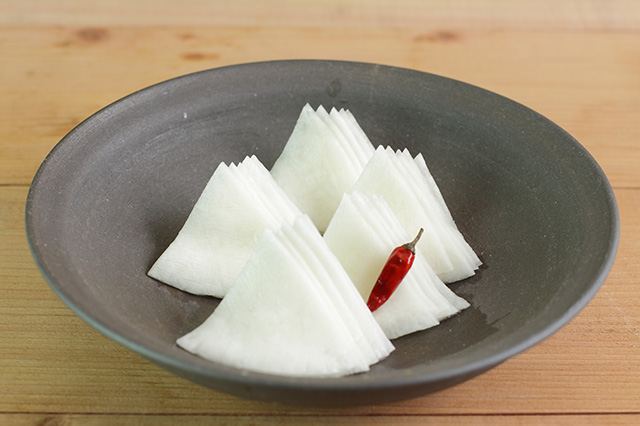
| Prefecture | Kyoto (京都府) |
|---|---|
| Region | Kinki |
| Japanese name | 千枚漬け(せんまいづけ) |
| Reading | Senmaizuke |
| Home area | Kyoto City |
| Main ingredients | The Holy House. |
History and Origins
The "1,000-sucking" is a stew made of salt on a thinly cut sanctum. One of the "sucked" and "mucked" is ZKyoto3X3K. Unlike traditional condiments, they don't have long-term preservation purposes, but they absorb delicately. It's believed to be invented by your cook, Fujito Sanroro, during the Edo. In contrast, Fujito Sano changed his shape into a merchant and sold a thousand pieces. At a national exhibition held in Kyoto in 1890, it was quickly won. It's a Japanese traditional vegetable that I use. It is believed that farmers from the Abbes took seeds from the Habu Abbey and began growing them. It's big, it's between four and five kilograms, and it's the largest suit in the country, and taste soft and elegant. When "a thousand pieces" became common knowledge, growing grew. In Akasaka-sama, a famous center in the Holy House, production began shortly after the war. Most of the "sucking" produced at Kyoto is a coat that is worn in this area. It's also identified as the traditional vegetable that has been eaten from old times at Kyoto. Kyoto Prefecture specifies traditional foods, such as traditional raw materials and technology, as "Konji traditional foods," and contains "1,000 pieces of food."
When It Is Eaten
It's made from about November, the time of the shipment on the sacristan. During this time, the old tailors who publish their work are made of large barrels, made of large quantities, and the scene is a sort of poem of winter's Kyoto. The harvest season on the sacristan is also built by the family.
How It Is Eaten
I cut the sacristan thinly, soak it with silk and pepper. Unlike traditional condiments, they do not save long, nor do they cause urtate. They say it was, in fact, salted and digested. Besides eating it as it is, there are also local recipes with smokescans and so on.
Recipe — Serves 4
Ingredients
- 10–15cm) 1 kg turnip
- 20 g salt
- 45 g kelp (konbu)
- dried red chili, to taste
- Mix: 200 ml vinegar
- Mix: 90 g sugar
- Mix: 40 ml mirin
Method
- The skin on the sacrilege coat is thick and cut to about two millimeters thick.
- Shake the salt and place it on a heavy stone, and then wrap it all up all day and all night before you break out of the water.
- Cut the cloth fine, and leave the hawk's claws out of the seeds.
- I'll boil A together and keep it cool.
- Place the cloth in the container alternately, place the hawk claws in the container, and pour four with a light stone. If you keep it day and night, it will grow.
More About Senmaizuke
It's one of Japan's Kyotos and it's made Kyoto three-dimensional. A yellowishish - white paste that was originally thinly cut (sniffed sieve) fermented. In modern times, it refers to a dough that has been ground with a thinnted mold.
Overview
A thousand-piece is a silica that has been digested by lyses and has been wrapped with a sieve and a small amount of glue that has been wrapped in it. However, since this process has problems with white tins and citrus odors, white sieves using the citrus method have become the main source. It's a thin cut of the rice, and it's soaked with silk and pepper. So it's not very safe as a cucumber, it's refrigerated, and it's relatively short.
Especially is a thousand pieces of rice famous for using the teapots of Kyongyeon. The number of sheets that are cut thin and stuck in barrels is more than 1,000. Or it's said that it's the origin of the name to cut the cucumber thin enough to be called a thousand. It is estimated that Saekoro Black-doro, a cook from your area, originally salted and lysicated and lyses were invented in 1865.
In harmony with the production of the sanctuary (in November - by March the following year) "A thousand pieces of citrus" are packed, and the season for sale is the season for which it is limited. It represents the winters of Kyoto, and besides the "1,000-pieces" it has become one of the zXQQ148X's souvenirs.
A thousand-kids and citrus.
There are a thousand plants and a thousand plants with a roll of rice and a bowl of rice, and there are a thousand plants and a set of goods.
Consider.
The first edition of the first edition of The Salty Letter, which was published in Tokyo, offers a taste of cyo leaves added to the leaves as a "1,000-snap."
Text adapted and translated from the Japanese Wikipedia article 千枚漬け by its contributors, licensed CC BY-SA 4.0.
Dish data: Ministry of Agriculture, Forestry and Fisheries (MAFF), “Uchi no Kyodo Ryori” (Our Regional Cuisines) database, used under the Public Data License (PDL1.0); translated and adapted from the Japanese original.