Shibazuke しば漬け
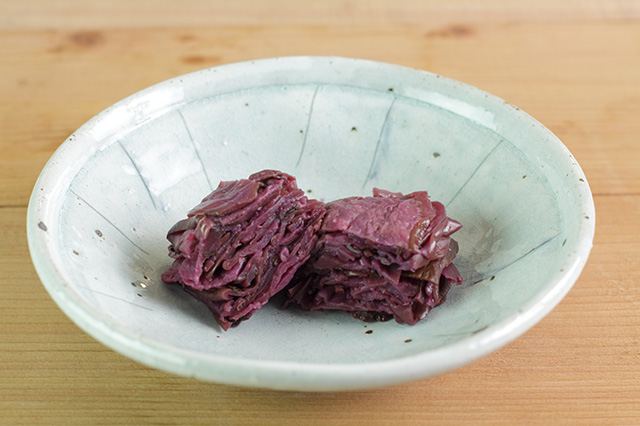
| Prefecture | Kyoto (京都府) |
|---|---|
| Region | Kinki |
| Japanese name | しば漬け(しばづけ) |
| Reading | Shibazuke |
| Home area | Kyoto City |
| Main ingredients | I don't know what to do, what to do. |
History and Origins
In Kyoto, where underground water flows, vegetable growth has been growing in many places since old times. It is said that this has led to the development of a culture of raw materials using vegetables. "Sniffed" is one of the products that represents Kyoto City, which is called "sucking" and "boiled in 1,000" and "ZXKyoto" and "sucking in 1,000." "Snuffed" is a salted dish with leaves, such as walnuts, walrus and so forth. It's characterized by its pale purple and acidity. There is a high rate of color and smell and there is a high demand from outside the government. It is said that the red - greens in the Ota region are the closest to the original species for reasons such as over 800 times grown, and there are no pollen from outside the region for the basin. It is believed that "sucking" was invented by a monk from Ohara's name, Sakura Chi's monastery, and a monk from the Sunoji House. The name comes from the Queen of the High Emperor and the Abbey. They said they were delighted when the local people presented them with a gift from the palm of their hands at the monastery, where they stayed at the Chrysanthemum in Ohara. And he named it "Shings of purple" after a pale purple color. From such a background, "muffed" is the order of the regular vegetable in families in the Ota district.
When It Is Eaten
You can enjoy the year by the year for preservation. Besides being able to buy easily at retail stores and supermarkets, it's becoming an indispensable commodity for a pawn. It's also well known all over the country as well as for the food. In the Oahara district, we hold "Red Open" from July 1 to 31st, during the harvest season. In addition to having "red - and - white law," the opening day of the event will include "magnified" experiences.
How It Is Eaten
We cut them into easy-to-eat sizes, and then we add leaves and salt. If you put the water down for a while, you can move it to a container and stay in bed for days. When the fermentation continues, we eat as a snack for rice and wine.
Recipe
Ingredients
- 10 kg eggplant
- 1 kg shiso buds
- a pinch myoga ginger
- 2 kg cucumber
- 500 g green chili pepper
- 550 g salt
Method
- Take away the pot and wash it and cut it to five-millimeter thickness.
- I'll cut the blue pepper in half.
- I'll keep the cucumbers on an angle.
- They wash branches and pick leaves and mix them in rough carvings.
- I'll cut the walnuts into slices.
- The mixture of the leaves in a container is packed in about 10 centimeters thick, and the salt is shaken, while the peppers, peppers, and peppers are mixed.
- Put the leaves at the top and put the leaves on the top.
- We'll make the same amount of heavy stones as the material.
- If you dip it all day and night, and the black juice comes out, you throw it away and save it in a state of being 3-inch thicker than the lid.
More About Shibazuke
It's a kind of condiment. I'll explain it in the main terms. The method of plating is how to bind the cucumbers together and sink them into the water and catch the fish that have entered it. A kind of execution method. They wrap the sinner in a fist, tie him up, place him on a weight and sink him in the water.
The stamen are classified as silica by lubric acid by lubricants in the body, bluish peppers, peppers, purples, and so on. It's made of Kyoto-three. It's thought to be the idea of a monk of the age of peace.
In modern times, there are more salt - rich cucumbers as the main body, and there are also more salt - pressurized and processed in the taste of vinegar.
The first word is "sleep" and "sleep" is a red purple resuscitation. Ohara, outside Tokyo, was famous for its red purple rise. I liked what the foster people had brought in when they hid in the Nintendo house. There is a tradition from it that he named it "the purple leaf's splattered with purple leaves."
Text adapted and translated from the Japanese Wikipedia article 柴漬 by its contributors, licensed CC BY-SA 4.0.
Dish data: Ministry of Agriculture, Forestry and Fisheries (MAFF), “Uchi no Kyodo Ryori” (Our Regional Cuisines) database, used under the Public Data License (PDL1.0); translated and adapted from the Japanese original.