Shijimijiru しじみ汁
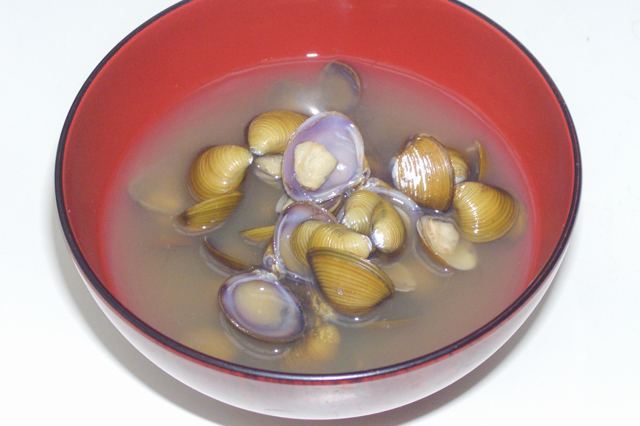
| Prefecture | Shiga (滋賀県) |
|---|---|
| Region | Kinki |
| Japanese name | しじみ汁(しじみじる) |
| Reading | Shijimijiru |
| Home area | All within the province. |
| Main ingredients | It's called "sidmic." |
History and Origins
"Sympathy" is a native dish of Shiga Prefecture using sesididid. In Japan there are three species of common warthog. One is called "State-Sided" and "State-Smid" and the last is "State-Sided" and most of the snails that are now in circulation are called "State-Sided." The sea horses used in Shiga Prefecture's "Symphony" are unique species that live only in Lake Sakura. The shells are thick and thick with meat and moss. The Setassiji live at a depth of less than ten meters from the shallows of Lake Sakura, but it is said that environmental degradation, such as the loss of sand, has caused changes in the location of the snail to occur. However, the Setasimi lived in Lake Sakura until about 40 years of age, and its "Syumi" was eaten regularly. But with the change in the environment, the harvest is falling sharply. The sea horses, which reach the beginning of December and April, are also called the "cold sea horses" because they become so thin and delicious. Local fishermen say that spring is especially delicious when it's not laid during the egg season.
When It Is Eaten
March to April is the time for fishing, and it is possible to eat well in the early spring for the season. However, wintertimes can also be eaten annually using the annual catch of sea horses without using sea horses.
How It Is Eaten
Szimmis will be sanded overnight and leave the sand to vomit. I got it from a cloth, but I put a sieve in the soup and heat it up and remove the shell. I'll melt the taste buds and make them boil. The last thing you can do is to brush your teeth.
Recipe — Serves 4
Ingredients
- 250 g szizimi (殻つき)
- 700 ml water
- 10cm 1 kelp (konbu)
- 40 g miso
- 1–2 green onion
Method
- Szimmis will be sanded overnight and leave the sand to vomit.
- Put a cloth in the amount of water and remove it before it boils.
- It's like putting a sieve inside, heating it up, and pulling out the shell of the shell.
- I'll melt the taste buds and boil them to a boil and then make them light.
- I'm going to put a bow in the air.
More About Shijimijiru
Cyrendiae is classified as the bivalvenous protozoae. It's a small clam that lives in freshwater and train areas. There is a theory that since the two oysters we normally see are small, the "completion" has been rotated and named.
The traditional scientific name Correctidae is Cyrendae Gray, 1847 Cinnochim.
Type
As a traditional species of Japanese mainland, there are three water-sharp, freshwater, water-sharp, sea-sharp, and sea-sharp scales, each of which is about two to three centimeters in size. And on the island of Chongbo, there is also the presence of such things as the Manglovedjii, which is the size of 10 cm by sea. However, since the end of the 20th century, some of the Thai sea creatures that live in the fresh waters of East Asia, which are central to China and Taiwan, have come out and reproduce, and there have also been problems, such as living in great concentrations and threatening the survival of the native pygmy.
The inside of the shell is white purple. It's also distributed to the Russian Far East and the Korean Peninsula.
The inside of the shell is purple. It reproduces at an average temperature of about 19 degrees Celsius or more, and it reproduces at a rate from April to October. It's also common in Korea.
It's the typical lake of the Setacidami Corusula Sannai. It lives in sand and sand bottoms up to ten meters deep, and life expectancy is estimated to be between seven and eight years. Male and female, eggs. The inside of the shell is rich purple. The limited length by the fishing control rules is 15mm. Shiga Prefecture is planning and trying to recover a plan to restore the planet's resources, mainly Lake Setasimi, which is the main source of the long-growing and seed-staining flow of capture.
It spreads widely (a few millimeters of mammidium, which is related to cydimy, or a few millimeters, which is not related to the family, but which are similar to the appearance of Dobbsidmi) but is small, so it is not visible, so it is not used.
Classifications
I'll give you an example of the bivalve branch map between Cijimí and the two oysters.
The two bivalves of the trichromatic line have moved into the fresh water at least twice, and the dovedimics have first classified. The medieval Japanese islands that began to separate them from Eurasia were warm and inhabited by the mangrove swampic Shirenjijijiina (Groina). Then, after the Japanese islands separated from the continent in the re - re - sea, the Japanese islands separated from the mainland, the freshwater seeds were left behind in the lakes and rivers, and the Majimie Corrica Lrena was spread on both sides of Japan and the Korean Peninsula, and the water area was populated by the Sandia Matozimi.
A History of Life
The life history of the sea snail is almost like that of the sea snail, which is water-free, and after conception begins to sink through the stages of the trocofoir, the baby, the baby, the shell, and the perversion. But don't swim during the trocofoa and the D childhood. It's difficult to identify the seeds in floating larvae, but you can distinguish them from them in the later larvae. On the other hand, in the pyrethrum of fresh water, when summer comes to over 19°C, it emits tens of thousands of fertilized eggs, and within two days it will become a baby D, and does not swim. Also, thousands of eggs stay in the shells and spend nearly a month on them, gradually excreting their young. Inhale from the water pipe on the side of the abdomen, filter through the algae with the condensation, eat, and drain from the water in the back. Life expectancy depends on species and environment, but it is from seven to ten years.
Outer Species
Since the 1980's, there has been a lot of tyrannism imported from the People's Republic of China, the Republic of Korea and Russia, and a lot of cormula fluminea, which is sold at relatively low prices, compared with native Japanese. Also, these are difficult to identify from Japanese domestic origin and have difficulty identifying species, so there are a lot of local disguises.
Whether imported Thailand is out of the wild or whether foreign snails have appeared in Japan since the 1990s, and are also concerned about mixing with native species. Also, it has been reported that in the waters into which Tywan Szidi entered, the pygmy is rapidly decreasing.
In the Southwest of the United States, a large number of Thailand's sea horses are growing in trouble that the Chinese are said to have brought in for food by 1944. In the 1980's, Tywanshizii was reintroduced to the Rhine River and also to the Donau through the Rhine Main Dornau Canal. By 1998, the Elbe river has been established.
Use
Cooking
The two oysters used for yuzu sauce are the most familiar to the Japanese in line with the Asari. It's made of rice, when it rains. The sea horses are considered the best taste in the food, and then the sea-sharp fish and the pygmies are considered the best. However, due to the rapid growth of unknown exotic species such as the above, these edible snails are also on the decline.
The white mud of the szilli is due to the troopomycin.
Health Food
It's not confirmed that Ornitine affects the liver, which is commonly said, "Cydmi taste is good for hangovers." The iron is too high for the poor blood and is rich in cochlear acid, a form of flair, and is made a better food for the liver than it was in the days of Edo. It's also sold as health food, such as "sidmimeskis."
Harmful.
There are reports that excessive iron deposits in the liver can be harmful if you are suffering from chronic liver disease, NAH, or alcoholic liver problems, and you may need to limit your diet.
Source
But since the 1980s, the environmental degradation of domestic fisheries and the rise in prices have caused domestic snails to decrease, increasing the percentage of the market for imported snails native to China, Korea, North and Russia. There are multiple varieties of imported sea horses, but there are also manufacturers who sell foreign snails as national products to look the same at first sight. Also caught in Russia and the Korean Peninsula, it is difficult to identify the mountain horses from Japan on the surface.
Reference Image
Text adapted and translated from the Japanese Wikipedia article シジミ by its contributors, licensed CC BY-SA 4.0.
Dish data: Ministry of Agriculture, Forestry and Fisheries (MAFF), “Uchi no Kyodo Ryori” (Our Regional Cuisines) database, used under the Public Data License (PDL1.0); translated and adapted from the Japanese original.