Home / Yamagata / Shiobikisushi
Shiobikisushi 塩引きずし
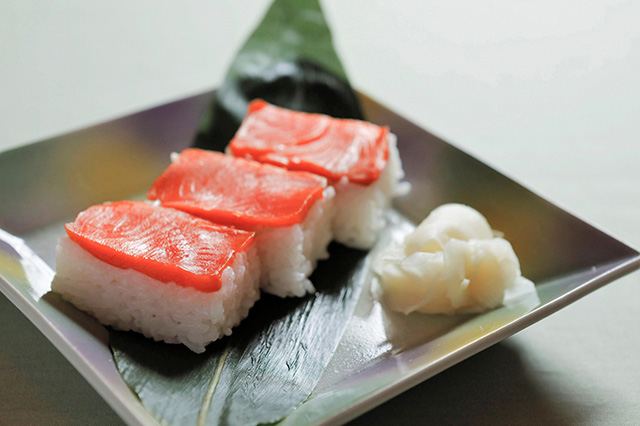
| Prefecture | Yamagata (山形県) |
|---|---|
| Region | Tohoku |
| Japanese name | 塩引きずし(しおびきすし) |
| Reading | Shiobikisushi |
| Home area | I'm sorry, I'm sorry. |
| Main ingredients | salmon, sushi. |
History and Origins
The "salt-treak" that has been celebrated as the native dish of Hale's day is the birth of the American City of Japan. Using the salmon salted material, we were able to make a strain that used to prevent fresh fish from being available in the interior of Japan. The fact that salmon red and rice white becomes red and white makes it a dish that is served in celebration, such as weddings. The area around the U.S. Speaking of fish, fresh water fish such as fish and river fish, sticks, crabs, chicken and salt-sniffers were mostly processed, but they didn't change the food. Generally speaking, salt-salted fish are salted, but in Osama City, salt reduction is the salt-salting of the cabbage. Salting palm is a traditional food item, and at the end of the year, the fish shop has a number of "salts" in front of it, but it's been lost. In early Japan, I used this beautiful "The Book" and the colorful "The Book of Man" to skimp, but since it was so expensive, I generally used "The Book." In recent years, nationally developed "single red" with oil and salt has become more difficult to obtain, and it has also been used by foreign sources with high oil content. In the past, I used to use wooden frames to push one by one, but now I sometimes cut them using large molds. They say that the old wooden frame has little left in the local area.
When It Is Eaten
"Salt dragged" is a dish always prepared for the celebration, because it has a nice red color. It is often served at the Hare even now. There are places where you can order a sushi shop or a local restaurant, and you can always eat it.
How It Is Eaten
The salt-salted palm is so salty that I will cut it thin to about two millimeters, cut it into wooden frame and press it to finish. Since the salmon has salt in them, they eat it as it does without citrus oil. It's a good match with Japanese wine. Since it's difficult to cut salt pomegranates when making them at home, it's best to freeze them once and then cut them when they're in a semi-freeze state.
Recipe — Serves 6
Ingredients
- 2 × 180 ml rice
- 400 ml water
- 5 g dashi kelp
- 2mm(3cm×4cm)20※ red Zake
- Vinegar: 3 tbsp vinegar
- Vinegar: 1 tbsp sugar
- Vinegar: 1/2 tsp salt
Method
- Wash rice without having to open it, cut the water, and then pour some gravy in half an hour.
- When you cook it, you can take it out on the rice table, and put the vinegar in the warm place while it's warm, and make it taste good. We mix it together while we sit down to serve rice. I'll be careful not to be too cold so I can keep warm.
- For easy cutting, freeze once, and cut to about two millimeters in half-freeze. (Laughter)
- Put the rice in the pusher, press it, place the 3 and then push it out again. If you want to use a large mold, turn the pusher upside down and place salt-saped saxkes at the bottom. Fill the rice on top, put the other mold on, and cut it out for a while until it settles down, then cut it out of the mold and size it easily. (Sniffs are easy to pick with)
Dish data: Ministry of Agriculture, Forestry and Fisheries (MAFF), “Uchi no Kyodo Ryori” (Our Regional Cuisines) database, used under the Public Data License (PDL1.0); translated and adapted from the Japanese original.