Tōfudengaku 豆腐田楽
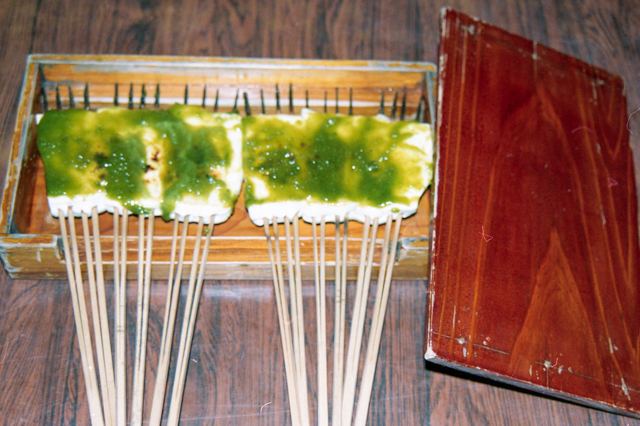
| Prefecture | Shiga (滋賀県) |
|---|---|
| Region | Kinki |
| Japanese name | 豆腐田楽(とうふでんがく) |
| Reading | Tōfudengaku |
| Home area | All within the province. |
| Main ingredients | I've got cotton tofu. I've got onions and taste. |
History and Origins
Shiga Prefecture has a large population of temples, religious soils, and a good menu with tofu. The Tofu Tofu Tofu's delight will be served by boiling the water tofu and baking it. When it gets a little burned, add a bud or a twist in the tree and cook it one more time. There is a custom of making and eating "tofu-ta" at the festival and at the winter solstice. The Hajitsu and Tozuzu Toshigawa in the south of the lake are in Tokiichi's muscle and "Tofu Tofu Togo" is a masterpiece. In an old farming village, there was a tradition of singing and dancing to the drumming of a rice plant. This custom led to dancing, and soon became a craft, and a career actor named Takeshi Tanaka was born. The appearance of a gravy cook who wore a colored coat on a white bowl and played with the appearance of a dish with a paste and a paste on it caused him to call it "Tata" and he came to refer to the cooking of tofu as "tofu" and "tofu" as "tofu" and " tofu" and " tofu" as "tata." And the food was spread not only tofu but also to fish such as vegetables and herring.
When It Is Eaten
In the northern part of the lake, it is a dish prepared at the time of the winter solstice, as well as the benefits of the (Gentile) and festival performed by the people.
How It Is Eaten
A small slice of rice is often used in a bowl, and then add a bowl and sugar, and make a paste. I'll put a paste into the tofu that I cut before it was cut and heat it on the stove. When it's brown, the back side will be baked, and the stylus will be placed on both sides of the tofu.
Recipe — Serves 4
Ingredients
- 1 blocks() firm tofu
- Miso: 5 green onion
- Miso: 100 g miso
- Miso: 80 g sugar
- 8 skewers
Method
- Cut the bowl into small pieces, and thoroughly rub it in a bowl, add the taste buds and sugar, and then fold it together.
- I'll keep the tapura in water for about half a day.
- We divide the tofu into 24 sections, we pick up the moisture with a frickin' stick, and we stick it into the bowl. The tofu sold at the Tofu store on beach, Shiga Prefecture, can be divided by 24 cubed tofu. The tofu sold at the current supermarket is smaller than this, so cut tofu to the eighth grade.
- The tofu is heated on the stove, and when the brown is made, the sides are baked. If you make it with a frying pan or a hot plate, bake it and then stab the prick.
- It's made from a dish of tofu, with a thick layer of rice on both sides.
More About Tōfudengaku
Ichida is a dish that has flavored with tofu, as well as tofu, or lima, rice, rice, and garlic. It is a dish that is cooked with sugar and flavored and flavored and flavored with sprouts and seeds.
Overview
Since the shape of the food that was stabbed with a knife is identified by the platypus, he calls it "Tata fun," it is still the basis of the practice. Since the original food was tofu, it is still basic, but it also can be used in other ways as well as in the case of Sathomo Nass and so on. It may be that after applying the sauce on a dish that has been baked in a sauce, you will be tempted again to enhance the flavor. Also, in the Edo era, the impatient Edo children showed up with nothing but time to burn, but this is subsidy.
Fish can cook as well, and it can be called "Fota" as well. "Tata" stands for Tanaka.
History
During the end of the peaceful period, more tofu was introduced to China than tofu, and there was a dish that was made with a sashimi cut into the sapwood. Then, in the days of the apartment town, taste technology will be advanced, and the bowl will be used as a flavoring agent. By the end of the year 1558 - 1570, cooking with roasted tofu will be popular, and in the beginning it will be delicious. They say that the shape of the dish's white tofu is similar to that of a rice plant, because it resembles a rice-snap cook who prays for the God of the Tata when he plants rice. There is a theory that the "Single Days" of the Chonami shrine of Long Life, which is the first to be viewed as the record of the Chonichi shrine, and the monks of the Tohoku Temple, and there has been a saying that, in the diary of a late - city preacher's choir, "The Long Book of the Book" (The Song of the Book of the Book of the Great Book, 1526) in December, "The Tada" And you can also see in "Sweeting" the laugh book of the early Edo, that it resembles the shape of a white tofu and the shape of a tofu. And in the Edo era, the following willows were boiled and served with tofu and served with a taste for tofu.
Take a look at the past, now eat.
In Kyoto, a tree will be known for its growth and for its growth of trees and for its spring's visit. The Edo tap is one tap, but the top one is a double-sharp, and the top one is a Japanese song like this.
I'll give you two.
The Japanese rice paddies of the Shiga PrefectureXXIO (now ZX098XXK) were fond of the travelers traveling through the Tongo. In Edo, by the time the Fukuoka Year was 1741 - 1743, there were a number of stores in the area of Tokuta, Japan, where rice paddies are sold. By the end of the 7th century, there were eight Japanese tea houses in the area of the Chiba Peninsula and eight Japanese tea houses. Also, in Edo, food is developing that is easy to eat outside, and the sale of Osama Osama went on the market, calling it "Sao-san." Ichida Ichida was also a popular food during the sights.
I can sell short books of tofu. A pile of flowers.
During the Edo, tofu is popular, and in the 2nd year, 1782, "Tofu Racist" was published and became the best seller. Taji made up nearly 30 percent of the dish that was prepared, and originally it was tofu, but then after a year of culture and writing, it was made into a dish made of vegetable sauce made of raw root, rice, rice, and so on. In many parts of the country, such as in the mountains, there is a gravy of rice paddies, which are near the roasting of the potatoes and river fish.
I'm glad you're here.
Today, Fukuda's music has become a popular dish, eaten throughout Japan, along with a bowl of citrus sauce and boiled in soup. Also, the taste-driven Japanese food called native food and masterpieces is passed on to all parts.
In the Tohoku region, a region in the north of Iwate Prefecture has long since enjoyed the taste-driven sweets on Hale's Day, hand-made tofu is short-rolled, stuck tofu is stuck in a bush, and placed on a fire in the lining, and eaten hot. The taste buds may include garlic, rice and raw fruit, and they are also useful in cities such as Kuichishima on the tri-land coast and in Hajimura and Ishio. In Fukushima Prefecture, there is one of the best dishes of the Young Matsu Matsu, which is grown in rice with its own taste in the tin, and also eaten by the white-treamen and the newly-scared mud-year-olds, and many people who have enjoyed the teahouses around the bush.
In particular, Aichi PrefectureWWWWI, for the year 1818 - 1830, there is a creation of a "sect" that is said to have been one of the finest dishes in Tohoku, Toshida's 503th and 11th Manuji, which is used to set up the green tofu rice and vegetable dishes, and is now out in the open as a local masterpiece.
The same Aichi Prefecture city has a red - colored jidaki, or shishima City, which is also a masterpiece of the south and south of Citadel.
In the city of Kyoto, 1,000 years old, the Japanese teahouse in the west of the Japanese teahouse in the Yasaka temple was destroyed during the Meiji period.
Among other things, Resuscit's rice is a unique local field of food, including tofu, as well as a local potato called the crane's young potato, as well as a local rice plant, which uses the sauerkran, yam, and so on.
I'm glad you're here.
During the Edo, boiling rice fields came into play, and when the materials were heated in the soup, they began to taste sweet and eat.
It's the birth of a mother.
In Edo, the condiments of soy sauce are in bloom in nearby rice paddies and fields, and they're boiled with soy sauce, sugar, and soy sauce, and so forth.
The Edo children were short-minded, so they couldn't wait to be ordered on the table and then cooked, and the Gen in "Tofu" was bad, so they spread out in great fashion and were sold on the stand.
Text adapted and translated from the Japanese Wikipedia article 味噌田楽 by its contributors, licensed CC BY-SA 4.0.
Dish data: Ministry of Agriculture, Forestry and Fisheries (MAFF), “Uchi no Kyodo Ryori” (Our Regional Cuisines) database, used under the Public Data License (PDL1.0); translated and adapted from the Japanese original.