Tōheinabe とうへい鍋
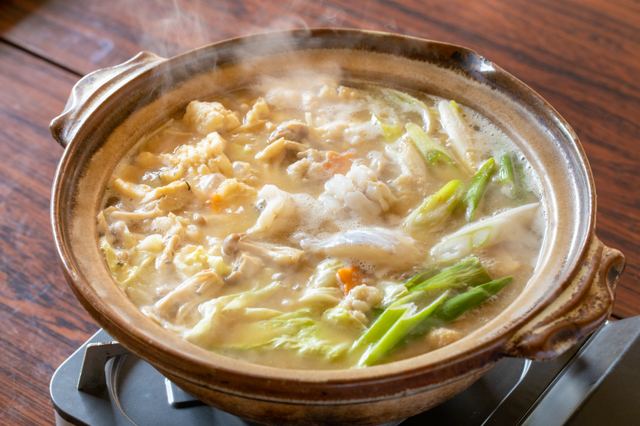
| Prefecture | Fukuoka (福岡県) |
|---|---|
| Region | Kyushu & Okinawa |
| Japanese name | とうへい鍋(とうへいなべ) |
| Reading | Tōheinabe |
| Home area | Iseshima District |
| Main ingredients | (SCREAMING) |
History and Origins
"Stowheim" is a fish that resembles the giant eel that lives in the southern regions of Honshu and is officially called the "Croargo" by the eel. Some are larger than others and may grow to about two meters. Since the body has so many skeletons, it's difficult to process them down, so the fishermen' cooking begins with a pot of corn that has been abandoned for money. Since corn has become fat and delicious from fall to winter, the diet of corn has gradually become popular and can be eaten in the hotels and in the homes of the public. Although we are familiar with Hale's daily food, though at any time of the festival and at any given time of the year, the "Kohea" has become a traditional dish that has been passed down only on the island of Oshima, since it's only available to the poor and difficult to get it.
When It Is Eaten
The season of corn is from autumn to winter, and the family can eat it as a Hale day dish.
How It Is Eaten
I take soup from the bones and cook it with cabbage and other vegetables.
Recipe — Serves 4
Ingredients
- 650 g トウヘイ (黒アナゴ)
- キャベツ 半玉
- 1 long green onion
- 100 g shiitake mushrooms
- 100 g shimeji mushrooms
- 100 g enoki mushrooms
- 1 blocks tofu
- Mix: 200–250 g miso
- Mix: sugar, to taste
- Mix: mirin, to taste
- Mix: kelp (konbu), to taste
- Mix: pepper, to taste
Method
- (I poured hot water on the Kronago, soaked it in cold water, and covered with skin).
- Put it down, cut it into sheets, fat, bone, and internal organs. Also, since the body has a lot of small bones, it's going to cut.
- After boiling the bones and cloth for over an hour, after taking the juice, I clean it up and take a look at it.
- The juice you have brought is a taste-smelled sauce and can be tasted with sugar.
- Put the black elephant in, boil it up, put the cabbage in, fold it in, fold it in, stick it in, stick it in long hair, put it in tofu.
- You can boil slowly and add the rest of the fat at the end. You may put some rice in after you eat.
More About Tōheinabe
The delicious pot is the native dish of Fukuoka Prefecture, Oshima. It's a delicious dish made from a fish called cornhee.
Overview
"Too-he" is the nickname given by the Fukuoka Prefecture of the Krogo.
When fishing in Cue Oshima, the corn-heavy can also be caught. Although the corn is large in size and may grow to about two meters, it has a lot of skeletons and is difficult to process, so it is often abandoned without money. A fisherman's dish that has been cut out of such a corn-heated pot is born. This taste made it possible to eat in the hotels and homes. It is known as the Hale Day, which is eaten at festivals and at any given time of the day, but because of its low catch of corn, and its large, hard fish, and its lower body surface, it is a traditional dish that has been passed down only on the Isle of worship.
Text adapted and translated from the Japanese Wikipedia article とうへい鍋 by its contributors, licensed CC BY-SA 4.0.
Dish data: Ministry of Agriculture, Forestry and Fisheries (MAFF), “Uchi no Kyodo Ryori” (Our Regional Cuisines) database, used under the Public Data License (PDL1.0); translated and adapted from the Japanese original.