Home / Tokyo / Yanagawanabedojōjiru
Yanagawanabedojōjiru 柳川鍋
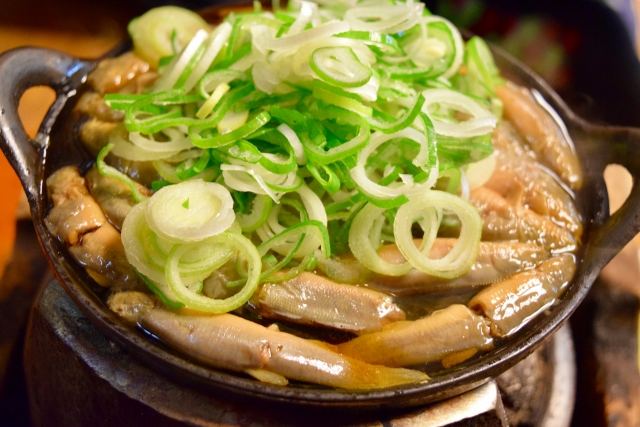
| Prefecture | Tokyo (東京都) |
|---|---|
| Region | Kanto |
| Japanese name | 柳川鍋/どじょう汁(やながわなべ/どじょうじる) |
| Reading | Yanagawanabedojōjiru |
| Home area | I'm going to show you some of the things you've learned. |
| Main ingredients | It's like, you know, doo-doo, goo-boo, eggs, soy-o. |
History and Origins
There are two kinds of "Symb" and the "C" pot drunks a live dojoo in a whole bottle of boiling wine. The "Kango Cauldron" is a dish that is cooked with a boneless dojou that has been boiled on the back. The dojou is a river fish with a soft surface that is characterized by a river fish that has a strong life force. During the Edo, when it was prohibited from eating meat, Dojou was a familiar food with the same strength as the dandelion and the camel. Dojoe writes "murder," and in the old book he writes, "I'm sorry," or "I'm sorry." The oldest shop in the world was named "Scratching" in 1891, but the original name was "Stuff." However, in 1806, at the fire of culture, Mr. Yaji and Seung Jo said they had a bad start in the four letters, and now I'm telling them three letters are "sing." The taste of a white dojoo is a taste of Edo. On the other hand, the Tokugawa pot has boiled the open dojou under the divider and has been turned into an egg with the lounging bowl. It is believed that it was used by a small cook shop in Edo Japan or Hakoku. Since the eggs come in, the taste is delicious when compared to the juice.
When It Is Eaten
Since in the Edo era, the Dojou and the gobow were considered sophisticated food, they were eating mainly in summer. Now, since there are so many stores that provide Dojou, we can eat the year-old food.
How It Is Eaten
We're going to have a mud-sniffed Dojou swim in the wine and smell it off, wash it, wash it with salt, and remove the stain. Cooked with a bowl of round, sashimi, and a pot of yugawa, and a bowl of rice, or onions or three leaves, and eaten with a bowl of rice that you like.
Recipe — Serves 4
Ingredients
- 20 loach (生きたまま)
- cooking sake, to taste
- Mix: 600 ml dashi stock
- Mix: 50 g miso (甘めのもの)
- Mix: 50 ml soy sauce
- Mix: 50 ml mirin
- Mix: 1 tbsp sugar
- 長ネギ お好みの量
- shichimi seven-spice chili
Method
- I'll put my life in a bowl and drink for about an hour. I always make a lid to keep my strength from coming out.
- Add a mixture of citrus A, add a bowl of citrus, add 1.1 bowl of rice, boil it in a medium fire for about five minutes, then cook it into a low heat for about 25 minutes. When you're done cooking, I'll give it to you in a bowl or something.
- I make down-downs in all the flavors of B's.
- We'll set up a pot the size of a square and then pile it up.
- I'll pour down the bottom of my product to the point where it's all soaked. I'll put on a small slice of onions and boil it in a weak fire. When the onions are soft, it's done. Before eating, I'd like to put on the peppers and peppers.
More About Yanagawanabedojōjiru
The Yaugawa pot is a Edo-born dish with a dojou. (See the history of the bowl of Dojou, which is similar to that of the pot in which it is made, but often distinguished from the pot in that open dojou is lynched under the boiling egg.)
Overview
Opened dojou and a bowl of goobows, boiled in the sauce and broth, and poured with chicken eggs. Sometimes they use onions and swallows together as a variation. The meat and other meats that are closed with a sweet, boiled egg, along with the kou, are often referred to as "choo" or "gayaki" in the same way.
During the Edo, the dojoo and the gobau were supposed to eat during the heat. In the world of haiku, "murmur" is a summer language. Since Dojou is not less fertile than an eel and is cheaper than a eel, the people of Edo were fond of him.
In recent years the population of the Dojo has declined, and the Tokugawa pot itself has become an expensive food.
History
Dojou's pot was first invented in the cultural year 1804 by the latest century, when the latest man, in his shallow form, did not open a dojou.
At the beginning of the Edo period, the book Sequoia was published by a company called Edo, which was located in the third and third largest city. But this year's cooking season is simply a dish prepared with Gobau, a pot that turned its back on its head.
There are other theories about the origin of the Tokugawa pot.
The idea of the Yau River is that it is a pot of earth used for this dish. The idea of the Kyushuusu who learned how to cook in Korea in the days of Hideki, a champion. A myth that says that it's a Japanese bridge shop, a Japanese haiku town, a Japanese restaurant, a Japanese restaurant, a small restaurant in Asakumura, a local restaurant.
There are also theories as to the origin of the name "Augawa Cauldron."
The theory that the store that originated was named Tokugawa because of the fact that the pot used was burned in Fukuoka, and that the dojoe was made in the river's leaves.
Ogawa.
Some dishes have been cooked with a bowl of rice, and made into a bowl, and others have been prepared with a dish called Tokugawa. There is also the theory that the drocodjou's nickname comes from (because it's the way that the drocodjou is known as drooster's nickname) and that it comes from the dance, as well as from the use of the dojo, a native of the Kokokoko.
Text adapted and translated from the Japanese Wikipedia article 柳川鍋 by its contributors, licensed CC BY-SA 4.0.
Dish data: Ministry of Agriculture, Forestry and Fisheries (MAFF), “Uchi no Kyodo Ryori” (Our Regional Cuisines) database, used under the Public Data License (PDL1.0); translated and adapted from the Japanese original.