Karasumi からすみ
| Prefecture | Gifu (岐阜県) |
|---|---|
| Region | Chubu |
| Japanese name | からすみ |
| Home area | East Dwelling Area |
| Main ingredients | And it's not just rice, it's sugar. |
History and Origins
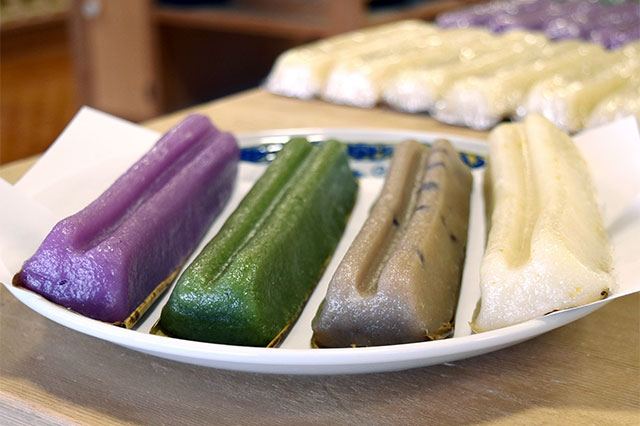
It is reported that about the end of Edo, it has been made in the eastern region in the pink. Speaking of "from time to time," it is famous for the rare taste of salting eggs such as Bora and drying, but this is the Japanese sweets that steamed rice flour. The character is in the shape of a cut cut into a mountain-shaped shape. It is common to have two tops of the mountain, but three are rare. The shape of the mountain is said to have become the shape of Mt. Fuji after the wish that my child would be the happiest in Japan. There is a theory that the name comes from a variety of sources, that it was precious in this area far from the sea, that it was replaced by similar sweets, and that the shape of the ink tools, combined with the writing of the Chinese Tang, was similar in style to that of the Chinese Chinese Chinese Chinese Chinese Chinese Chinese Chinese period.
When It Is Eaten
In the Eastern dense region, we are known as the present of the peach and the everyday sweets. It's a rare event where children would say, "Let's see how you do it," and then they would go all over the countryside looking at her and get some candy. In the past, this "somebody" and "somebody" were behaved by children. Today, you can buy it through a year in a farm shop in the dense East or in a roadside station, the Internet.
How It Is Eaten
I put sugar in rice flour, stick it in a stick, and then remove the mold and water it for about 15 minutes. The white one is standard, but there are many variations, such as using black sugar instead of sugar, or simply inserting busy, squirming, squirming and so forth into fabric.
Recipe
Ingredients
- 330 g rice flour (荒びき)
- 300 ml boiling water
- Mugwort: 130 g mugwort
- Mugwort: 100 g sugar
- Mugwort: a pinch salt
- Mix: 100 g sugar
- Mix: a pinch salt
- Brown sugar: 100 g brown sugar
- Brown sugar: a pinch salt
Method
- Put boiling water into the rice flour, mix it up to make sure it doesn't have a quick snack, and soak it in a steamer for half an hour.
- . . . divided into three classes, divide each material into four pieces, and then stick it out until it's too far out of reach.
- Each has three sections. If there's no mold, put the stick around the bamboo and press it down with chopsticks from above to shape. )
- I'll steam it up for five minutes with a steamer. It's cold. Cut and eat.
More About Karasumi
Karasumi (Japanese: からすみ (唐墨、鰡子、鱲子) or wūyú zǐ (Chinese: 烏魚子) is a food item made by salting mullet roe pouch and drying it in sunlight. It is a softer analog of Mediterranean bottarga.
Japan
Karasumi is a high priced delicacy in Japan and it is eaten while drinking sake. A theory suggests that it got its name from its resemblance to the blocks of sumi (inkstick) imported from China (Kara) for use in Japanese calligraphy.
It is a specialty of Nagasaki and along with salt-pickled sea urchin roe and konowata one of the "three chinmi of Japan".
Taiwan
The wūyú zǐ is almost always the roe pouch of the flathead grey mullet (Mugil cephalus). Mullet fishing in Taiwan can be traced back to when the island was under Dutch colonial rule. Early historical accounts, from the Taiwan Prefectural Gazetteer to the General History of Taiwan mention this delicacy.
Wūyú zǐ was traditionally only consumed seasonally—from December to January—when spawning mullet arrived at the island's southeastern coast. The delicacy came to be associated with the Lunar New Year that falls in January or February.
The town of Donggang in Pingtung County specializes in the delicacy.
Text adapted from the English Wikipedia article Karasumi by its contributors, licensed CC BY-SA 4.0.
Dish data: Ministry of Agriculture, Forestry and Fisheries (MAFF), “Uchi no Kyodo Ryori” (Our Regional Cuisines) database, used under the Public Data License (PDL1.0); translated and adapted from the Japanese original.