40 27 たこめし
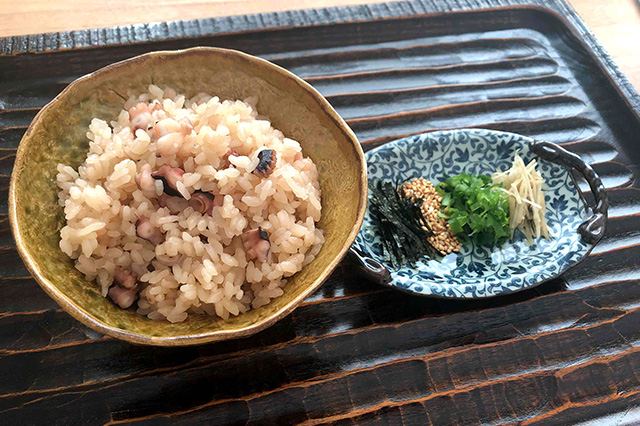
| Prefecture | Hyogo (兵庫県) |
|---|---|
| Region | Kinki |
| Japanese name | たこめし |
| Home area | Akishima, Tohoku. |
| Main ingredients | A kite. |
History and Origins
Hyogo Prefecture octopuses are caught in second place throughout the country and the best in Magako. The sea cucumbers, which are washed from Akirashima and Kobe to Ako, reach their peak from June to August. At this time of year, the tide of the Akira Strait has troubled me, and I try to store up nutrients for my eggs. I have more elasticity, and I have more sugar and sugar. It was recorded that during the Edo, the machin fish in the Inland Sea was known, and the "Big" was made as a meal that would not be difficult to prepare for after fishing. Today it's popular as home cooking, and it's also made from raw, boiled, dried and dried rice. It's also sold as a famous prefecture station valve.
When It Is Eaten
You can eat a full year, but since June is the best season in Madagascar, you can eat it better by summer.
How It Is Eaten
I'm going to cut rice and make it a regular water flow, mix the juice with the flavor, add an octopus and cook it. An octopus can be put in different areas, using raw, boiled, dried, or dried octopuses.
Recipe — Serves 3
Ingredients
- 2 × 180 ml 300 g rice
- 2 cups 400 ml dashi stock
- 2 tbsp 30 ml sake
- 2 tbsp 30 ml mirin
- 2 tbsp 30 ml soy sauce
- 2 (。160 g) dried feet
- to taste ) a pinch ginger
- to taste ) a pinch mitsuba
- to taste ) a pinch green onion
- to taste ) a pinch sesame seeds
- to taste ) a pinch shredded nori
Method
- Rice is washed.
- The dryer is light and cut with a scissors about five millimeter wide.
- Cooked rice, mixed with rice, and cooked with flavored and dried rice.
- I'll make a cup of cooked rice, and then use the medicine as my favorite style. If the dry season is hard, I'll put it in a half-hour of quantity and in the soup if it is possible.
More About 40 27
The rice is rice from an octopus and is one of the local dishes. There's something to cook with an octopus, something to put or mix boiling octopus on rice, or something to combine both.
Also made from the Pacific octopus, at Ibaraki Prefecture.
The pine cone.
It's a cook-in-the-box. Although the origin is unknown, it is believed that fishermen on the fishing boat cut up the octopus and put it into their food. In the beginning, I was born in the sand, where there are many shrimps, crabs, oysters, and octopus growths. The 200-pound daco, or "tree sprout," which appears first in spring, is pressed and delicious. Also, since nutrients - containing water enters the ocean during the rainy season, it is thought that octopus growth and this season also have a unique flavor.
An example of materials and construction.
(Singing)
1 / 2 cup [1.4 L] of raw rice, 3 cups [1.3 L] of citrus oil, 4 oz [45 oz] of wine...
How?
I can't get rid of the dirty dishes just because they're simple and light. First, salting the leg of a live daco, hand-to-hand, and remove the surface slip. And I'll clean up the stains in the inhaler using my fingers. The octopus is cut to the right size and lightly beat with the knife's back. Next, wash the rice, put it on a monkey for about 15 minutes, and cut the water well.
Put the rice in the rice cooker and pour all the flavors and flavors gently together. Finally, put the octopus in and switch it on and cook it up.
If you use raw silk, it will be painted with a pretty color, like red rice. You can use your taste to pick up the sprouts and the blues.
Station valve
What is sold at the following station is famous.
Toshihara Station, Fukuyama Station, Fukuyama Station, Hawa Station, Shinji Station. The "single" is the Long Island Station valve that began to be released in 1953. - "I'll eat you." Using a canister of citrus. - "The Akira-sama-sama soup plate." I'll have rice later. - "three beach lunches." I'm carrying a slice of rice on the rice bowl.
Annotations, Sources
Text adapted and translated from the Japanese Wikipedia article たこめし by its contributors, licensed CC BY-SA 4.0.
Dish data: Ministry of Agriculture, Forestry and Fisheries (MAFF), “Uchi no Kyodo Ryori” (Our Regional Cuisines) database, used under the Public Data License (PDL1.0); translated and adapted from the Japanese original.