Champon ちゃんぽん
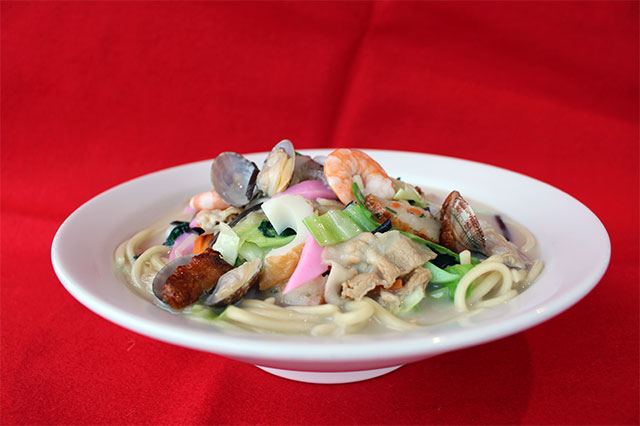
| Prefecture | Nagasaki (長崎県) |
|---|---|
| Region | Kyushu & Okinawa |
| Japanese name | ちゃんぽん |
| Home area | Nagasaki Prefecture |
| Main ingredients | (Customer) |
History and Origins
It's a nationally known Nagasaki soo dish. In 1899, the Chinese restaurant's owner, Mr. Kojiji Kojiji, started making a large bowl of cooked dishes that were cooked with thick soup to feed Chinese students what was cheap and nutritious. The name "symbol" comes from the word "snap" which means simple Chinese food, and the word "snap" comes from the word "sniff" which means "mixed" in Portuguese.
When It Is Eaten
Since the birth of China, the delicious and rich noodles that can be made from a Chinese pot have become a household dish that is regularly eaten at Nagasaki Prefecture. It has been provided at the same time with many restaurants and has become widely known and available in other districts, as well as in other restaurants.
How It Is Eaten
It is said that the soups of soups containing the staples of the staples of the fried chicken, mushrooms, rice and so forth are made from raw rice, made of stronger soup, more rich tools, and their own rice, and made Japanese dishes like "coo" in Japanese. While the equipment is free, it usually contains such seafood as cabbage, onions, potatoes and other vegetables as crabs, shrimp, shrimps, and caki winters. Sometimes raw eggs are topped according to taste. The difference between the other noodles dish and the fact that you can cook them in a Chinese pot to boil them in soup. At present, the heavy, pig-cutter soup, Nagasaki, and the small beach of the chicken-gari soup are said to be the biggest of the states.
Recipe — Serves 2
Ingredients
- 80 g pork
- 80 g peeled shrimp
- 80 g squid
- 80 g asari clams
- 30 g carrot
- 100 g cabbage
- 30 g kamaboko (fish cake)
- 100 g bean sprouts
- 2–3 shiitake mushrooms
- 2 packets(2) 市販の長崎ちゃんぽんの麺
- vegetable oil, to taste
- Stock: 2 tsp oyster sauce
- Stock: 1 tbsp chicken stock powder
- Stock: 1 tbsp sake
- Stock: 1/2 tbsp sugar
- Stock: 1/2 tsp salt
- Stock: 400 ml water
Method
- Cut the ingredients to size easily eaten. I'll mix the ingredients for the soup.
- I boil (more than enough water) and boil the noodles. When you get up in the bowl, you take it to the monkey.
- I put salad oil in a Chinese pot and heat it with a heavy fire, roast pork, sea cucumber, squid and auricle. When the color changes, I put the rest of the vegetables in and cook them lightly.
- I'll boil the mixed soup in three.
- Put the noodles in the pot and boil them.
More About Champon
Champon (ちゃんぽん, Chanpon), also known as Chanpon, is a noodle dish that is a regional cuisine of Nagasaki, Japan. There are different versions in Japan, Korea and China.
Champon is made by frying pork, seafood and vegetables with lard; a soup made with chicken and pig bones is then added. Ramen noodles made especially for champon are added and then boiled. Unlike other ramen dishes, only one pan is needed as the noodles are boiled in the soup. Depending on the season and the situation, the ingredients differ. Hence the taste and style may depend on the location and time of year.
Although Nagasaki Champon is the best-known rendition, there are other variations found in Japan. Ankake no Champon is a soy-sauce based variant found in Tottori, Shimane Prefectures, as well as the city of Amagasaki in Hyōgo Prefecture. In the city of Akita, a version with miso broth is served, with the soup filling the bowl almost to the point of overflowing.
In Okinawa, Champon is a rice dish where assorted vegetables, thinly sliced meat (pork, luncheon meat or corned beef hash) and scrambled egg are fried and served on top of rice. The Korean Jjamppong is a similar noodle dish with a spicy seafood broth, with similar origins as part of Korean Chinese cuisine.
History
Champon was created in the late nineteenth century by Chikusa Shokai (also rendered Tanaka Chikusa). It was first served by Shikairō (四海楼, Four Seas House), a Chinese restaurant founded in Nagasaki in 1899. According to the restaurant's website, this was based on a dish in Fujian cuisine, "tang rousi mian" (湯肉絲麵), more commonly known as rousi tangmian (肉丝汤面). However, some have cast doubt on this claim as the rousi tangmian originates not from Fujian but from Jiangnan. Furthermore, the champon bears far greater resemblance to Gangtou menmian (港頭燜麵), a dish native to Fuqing, than it does to rousi tangmian.
The majority of the Chinese population in Nagasaki Chinatown is from Fujian. In the middle of the Meiji era (late 19th century – early 20th century), the owner saw a need for a cheap, filling meal that suited the palates of hundreds of Chinese students who came to Japan for school. Nowadays, champon is a popular specialty food (or meibutsu) of Nagasaki.
Etymology
There are several theories as to the origin of the word champon. One theory is that it was derived from the Hokkien word chia̍h-pn̄g (食飯), which means "to eat a meal", which might fit the sense of "a hearty noodle dish made of mixed ingredients". Another theory is that the word was derived from the word campur from Indonesian, meaning "mixed" (see Nasi campur, a Javanese dish), which would fit the term's older sense of "mixed together".
The original sense of "mixed together" appears in texts from the mid-1700s. Some Japanese dictionaries trace this to Chinese term 攙和 ("to mix"), pronounced as chham-hô in modern Min-Nan and as chānhuò in modern Mandarin.
Usage to refer to the food item appears from the late 19th century to early 20th century, apparently originating from the Shikairō Chinese restaurant in Nagasaki.
Text adapted from the English Wikipedia article Champon by its contributors, licensed CC BY-SA 4.0.
Dish data: Ministry of Agriculture, Forestry and Fisheries (MAFF), “Uchi no Kyodo Ryori” (Our Regional Cuisines) database, used under the Public Data License (PDL1.0); translated and adapted from the Japanese original.