Hakozushi 箱ずし
| Prefecture | Aichi (愛知県) |
|---|---|
| Region | Chubu |
| Japanese name | 箱ずし(はこずし) |
| Reading | Hakozushi |
| Home area | All in the county, center of the tributary and the tributary. |
| Main ingredients | And I'm going to show you how to do that. |
History and Origins
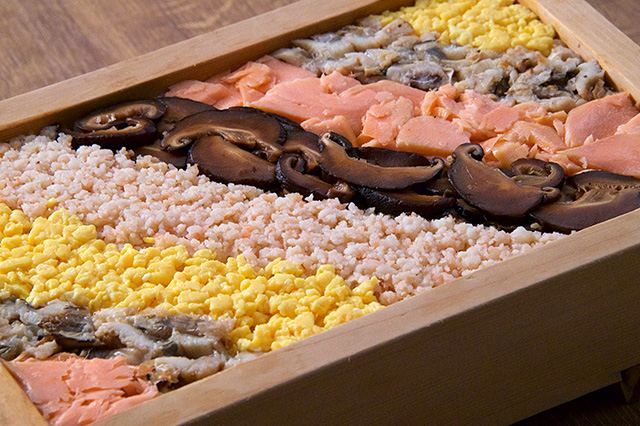
The "boxing" that you make from above, with your rice in a square wooden frame, on top of it, and on top of it, is in the country. The history of Boxing is older than that of a fist. It is said that from the long-term duplicating of fish, rice, and salt, the first "unusable" appeared, and that the "half" that matures in a relatively short period of time rather than in the city age. Compared to "treasure," the fish and rice are also eating food, so they like to eat the sour food itself. From this stream comes the root of a fish with salt on the tubs and wooden frame, covered with lids, and heavy stones on top, and fertilized for several days, and eaten with a "boxy" diet. When (and later on) is invented, "boxing" with various foods will be produced. In times when rice wasn't good enough, "boxing" was a very luxury when we needed to prepare a lot of rice. The "boxing" eaten in the center of the tail and the west tributaries is characterized by the fact that they are placed on diagonals such as shrimps, Anago, dried eggs, and silky silk eggs. This is thought from the consideration that everyone should enjoy different tastes equally. The wooden frame to use is made up of specially designed crates with five to six rows. We put together wooden frame with rice and tools, and put together a crossbar and press pressure. Many families used to have wooden frames, but fewer and fewer families are now.
When It Is Eaten
It was created when a large group of people gathered, such as celebrations and festivals. Now, since many families do not have wooden frame, and there are so many difficulties, family opportunities have been reduced.
How It Is Eaten
While the ingredients and flavors you put on rice are different from those of your family, you often use seafood, mountain vegetables, vegetables, and rice. The ingredients are tightly cut out of the water, placed on top of the rice rice in a center order, pressed, and applied pressure from the top for half a day. When it is ready, take it out of the box and cut it into easy-to-eat size. When I made the box, I often made the "rolls" and the "shoes" together and ate them. Over the course of advanced economic growth, "boxing" was gradually less likely to be made in the home.
Recipe — Serves 4
Ingredients
- 500 g sushi rice
- 100 g shrimp
- Mix: 50 ml dashi stock
- Mix: 1 tsp soy sauce
- Mix: 1 tsp sugar
- 1 burning Anago
- Mix: 100 ml dashi stock
- Mix: 1 tbsp soy sauce
- Mix: 1 tsp sugar
- 1 slices salt Zeke
- 2 dried shiitake mushrooms
- Mix: 1 tbsp soy sauce
- Mix: 1 tbsp sugar
- 1 egg
- Mix: 1/3 tsp sugar
- Mix: a pinch salt
- as needed ハランの葉
Method
- The shrimps are ground with a knife and ground and cooked in A. The roasting Anago is cooked in B. The salt Zake is baked and loosened. The dried grain is rehydrated, chopped, and boiled with C. The eggs are mixed with D and turned into powdered eggs.
- Put the leaves of Haralan in a well-soured box, and put the rice in a bowl, and hold it lightly and keep the surface smooth. The leaves of Haran are like a large leaf of a leaf that is used as a handle for the killing process and as a handle for the wrapping and wrapping of a broom.
- Place the materials on top of the rice, spread them diagonally, put the harman leaves on, and hold the lid tight for a while.
- If you take it out of the box, you cut it into size that you can eat and then place it on a bowl.
Dish data: Ministry of Agriculture, Forestry and Fisheries (MAFF), “Uchi no Kyodo Ryori” (Our Regional Cuisines) database, used under the Public Data License (PDL1.0); translated and adapted from the Japanese original.