Hoshi-imo 干しいも
| Prefecture | Ibaraki (茨城県) |
|---|---|
| Region | Kanto |
| Japanese name | 干しいも(ほしいも) |
| Reading | Hoshīmo |
| Home area | All within the province. |
| Main ingredients | And a snack. |
History and Origins
"It's too dry," a small piece that is used to get acquainted with by young and old, men and women. Ibaraki Prefecture has a dry share which is the top of the country. The majority of them are produced by Yoichi, Tokimura, and Seoji. While Shizuoka Prefecture is a growing plant, a man named Manchuria has come up with a method of boiling the rice with boiling and cutting the rice with a knife, and this is said to be the beginning of "heavy." It is said that the benefits of being eaten at any time and being preserved have spread to Kanto at once. It is said that the Yuasa and Kokichi Guard who owned a well-dressed shop in Tokyo were able to increase their production at once by starting to produce and sell the dry. The Akimashi (Akigagaro) tunneling shrine has a statue of the Kichi Guard as a person who spread the "heavy" Since the war had changed the diet, production of "heavy" for a time stopped, but after the war, the recommendation of pre-war states and "heavy" has been revived.
When It Is Eaten
Since the wind blowing from the sea causes the work of drying, the main shipment period between November and mid- March is usually between November and mid-day. However, because it's stored food, it's eaten throughout the year. The simple process, which is made well at home and with the floor dry, was a winter wind poem. Until now, when I'm hungry, I'm familiar with food and children and other things.
How It Is Eaten
If you steam the rice and cut it thin, you dry it out and dry it. When the water runs out and drys off, it's time to eat. Children like simple sweets and a smooth sense of food. You can get satisfaction by eating it as you like, but there are plenty of ovens, such as scraping it and putting it in pandoons and spong cakes.
Recipe
Ingredients
- to taste (3:750 g) sweet potato
Method
- Keep the tassels in the air until they are soft.
- The skin of your small skin is laid while it is warm. The leather is thick enough to remove some part of the pot. Cut it in half so it will leave something heavy up and down.
- Cut the pads one centimeter wide. You can clean it by using piano lines or fishing silk thread along the fibers while the hooks are soft.
- I'll arrange them so they don't have to be heavy. It's a nice place to wind, and it's been dry for a week. If you can't get rid of it, turn around and dry both sides.
More About Hoshi-imo
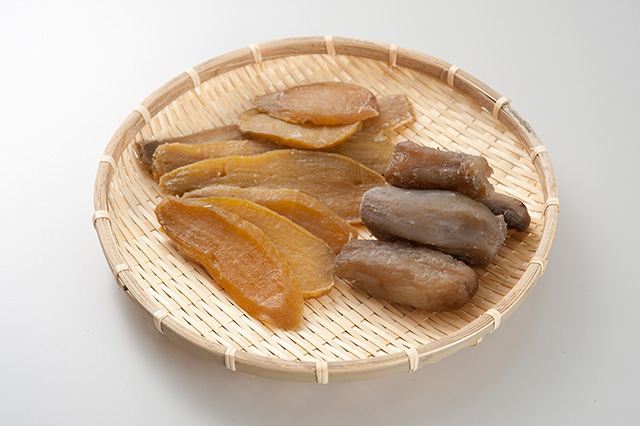
Hoshiimo (干し芋 "dried sweet potato") is a Japanese snack made of dried sweet potatoes and a specialty of Ibaraki Prefecture. The sweet potatoes are generally steamed first before peeling, slicing, and drying, with no artificial sweeteners added. In some cases, the sweet potatoes may be roasted rather than steamed. The surface may be covered with a white powder. Not to be mistaken for mold, this is a form of crystallized sugar that emerges as the sweet potatoes dry. With a chewy texture, it can be eaten raw or roasted.
Names
Hoshi-imo goes by other names in Japan such as, kanso-imo (乾燥芋), mushi-kirihoshi (蒸切干), and kiriboshi kansho (切干甘藷).
Varieties in Japan
In Japan, hoshi-imo is available in many shapes, ranging from French fry-like rods to broad, flat chunks roughly 10–15 cm in length and 5 cm in width. Sometimes oblong, unsliced varieties, known as maru-boshi (丸干し) are also marketed.
Many types of sweet potato (Ipomoea batatas) are used to make this product. Common varieties include Beniharu (紅はる), Tamayutaka (玉豊), Silk Sweet (シルクスイート), and Anno-Mitsuki (安納蜜嬉) sweet potatoes. Since China produces more sweet potatoes than Japan, and the price of sweet potatoes in China is generally lower than in Japan, much of the hoshi-imo sold in Japan today is, in fact, produced in China.
History
The snack supposedly originated in Omaezaki City in what today is Shizuoka Prefecture. Around 1824 a merchant named Shozo Kuribayashi began in manufacturing this dish on a small scale. In 1892, Rinzo Ohniwa and Jinhichi Inagaki of modified the manufacturing process to facilitate industrial production. Soon this product spread throughout Japan as a popular type of preserved food. It was also used during the Russo-Japanese War, briefly gaining the sobriquet as "soldier's potatoes." In 1908 large scale production began in Ibaraki prefecture. Two theories exist about how this product was introduced to Ibaraki prefecture. One theory holds that a rice cracker maker named Toshichi Yuasa hired a technician who modified his dried seafood processing facility to produce this agricultural product. Another theory holds that Seiji Koike and Jizan Ouchi got the backing of the governor of Ibaraki Prefecture, Masataka Mori, to start up local production with the aid of two technicians from Shizuoka.
Both public and private sectors in Ibaraki Prefecture have promoted steamed dried sweet potatoes extensively. In 2019 the Hitachinaka Chamber of Commerce and Industry was selected by the Japan Chamber of Commerce and Industry as the winner of a commerce prize for its "Dried Sweet Potato Attraction Project" that included the development of hoshiimo cakes and a book outlining the history of dried sweet potatoes. Today over 80% of the steamed dried sweet potatoes sold in Japan are from Ibaraki prefecture.
Nutrition
Hoshi-imo is particularly rich in vitamins A, B1, C, and E and contains much potassium and calcium as well as dietary fiber.
Similar dishes
It is similar to two Korean dishes: "goguma-malaengi" (고구마말랭이) and "mallingoguma" (말린고구마). The latter is cut into thinner slices and has a crisper texture than the former. In China, a snack very similar to hoshi-imo known as "dìguā gàn" (地瓜干) is popular and in Vietnam a product known as "khoai lang sấy dẻo" is common.
Text adapted from the English Wikipedia article Hoshi-imo by its contributors, licensed CC BY-SA 4.0.
Dish data: Ministry of Agriculture, Forestry and Fisheries (MAFF), “Uchi no Kyodo Ryori” (Our Regional Cuisines) database, used under the Public Data License (PDL1.0); translated and adapted from the Japanese original.