Inakazushi 田舎ずし
| Prefecture | Kochi (高知県) |
|---|---|
| Region | Shikoku |
| Japanese name | 田舎ずし(いなかずし) |
| Reading | Inakazushi |
| Home area | All within the province. |
| Main ingredients | I'm going to have to take care of it. |
History and Origins
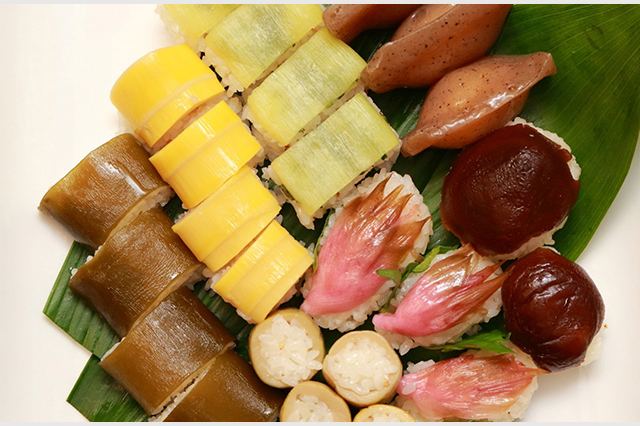
"The country's nostalgia" has been used in a nationally unusual way. In the intercontinental food area of Kochi Prefecture, the success of the mountain within the province is used frequently. When I refer to the feast by the mainland, I am acted upon and is part of the "Supreme Cook," the standard part of the cultural dish. When the cloth and glue were not available, it was established that the food from the mountains was made. Foods vary from region to region, but it's very wide. Colorful colors adorn the table, such as the "sniffs" on board and the" bite of four bamboos with rice in the hollows of the four bamboos.
When It Is Eaten
It's a celebration of the wedding and the festival feast and the dinner and dinner lunches, and it's a large generation of people from children to old. It is characterized by a pale look, and tastes like red, red or black with red or black with a colorful look.
How It Is Eaten
It's just as much as conventional rice to make vinegar rice narrow. The rice is delicious and elegant. The goods on top can be put on sweets and sweets, but you can enjoy the success of the mountains in various flavors. It is common to place vegetables at the top of the rice table like a fist, but the "screws" are eaten by putting a cut inside the pot and then being eaten like a rice load.
Recipe — Serves 5
Ingredients
- 5 × 180 ml(750 g) rice
- Sushi rice: 70–80 ml vinegar
- Sushi rice: 20–30 ml yuzu vinegar
- Sushi rice: 70–100 g sugar
- Sushi rice: 15 g salt
- Sushi rice: 30–40 g ginger
- Sushi rice: 2 tbsp toasted sesame seeds
- Mix: 200 g bamboo shoot
- Mix: 300 g dashi stock
- Mix: 3 tbsp sugar
- Mix: 2 tbsp soy sauce
- Mix: a pinch salt
- Mix: 1 tbsp mirin
- Mix: 20cm ryukyu (marinated fish)
- Mix: as needed salt
- Mix: 3 tbsp vinegar
- Mix: 2 tbsp sugar
- Mix: 2 tsp mirin
- Mix: a pinch salt
- Mix: 5 myoga ginger
- Mix: salt, to taste
- Mix: 2 tbsp sugar
- Mix: 2 tbsp yuzu vinegar
- Mix: 1 blocks konnyaku block
- Mix: 100 ml dashi stock
- Mix: 2 tbsp sugar
- Mix: 2 tbsp soy sauce
- Mix: 1 tbsp mirin
- Mix: 10 shiitake mushrooms
- Mix: 10 ml dashi stock
- Mix: 1 tbsp sugar
- Mix: 2 tsp soy sauce
Method
- Rice boils a little water. (2) I'll make vinegar with a fine slice of ginger, mixed with a flavor. (3) Put the cooked rice into a large bowl, mix the vinegar with it quickly, mix the rice with it. It'll cool quickly to the wind. - If there's a large percentage of the vinegar per cup or per cup, add more sugar. - When the hot rice cools, it absorbs vinegar, and when the wind is turned, the rice grains become soft.
- (1) I'll boil the rice-stained rice with a freshly boiled sauce and let it soak overnight. (2) Pack your rice. (3) Cut to the right size. - It's okay if you're working on an eight-ton bamboo or a four-sized bamboo. - We'll boil salted mushrooms, put them in water, and use salt all the year round.
- (1) The palm is peeled, cut to match the length of the spool, and cut to two at the root. Put a one-blong cut inside, and let the salt boil out. (2) Press the saws, roll the water, remove the salt with water, and then soak it in sweet vinegar. (3) I'll press a rectangle with a spiral. Smudges can be used year round if they are frozen. - Hold the push and cut until it's cold.
- (1) Cut in two sections, cut in the base, and let the hot water pass slowly through, with salt. (2) When it gets rough, fold it tight and soak it in sweet vinegar. (3) Put it on a rice table and hold it. - You can save the sweets of walnuts. - If it's a big fish, it will be thin by removing the inside.
- Cut three times six centimeters in thin pieces and then cut them out of the water. It's easier to deal with the warm. (2) Cook lightly with the soup. (3) Pack the rice with a rice pack. - It's easier to eat thin, but careful when cutting.
- (1) Take the strip and put a cross on the surface. If you cut the shape firmly from the base of the umbrella, sushi will look better. (2) Cook lightly, put it on rice, hold it round. - You can use dryers. When you boil the raw meat, add the boiling juice of the dish, it tastes good.
More About Inakazushi
Country or country sushi is Kochi Prefecture native food. It's not fish, it's a sushi. It's not fish. It's a sushi.
It's also called Sasuke Hara.
Overview
On the coast of Kochi Prefecture there are fish and fish sushi, and in the mountain regions there are salt sabers. At Kochi Prefecture, where there is little plains, rice was a delicacy, and it was an essential food and seasoning in the hot, humid climate to preserve food, to make taste and to make appetite. At Kochi Prefecture, a banquet called "Again" was popular and sushi was made on something. A dish that is served in the country or at such banquets, a dish that is served in a bowl, and a dish that reaches the mountain range of Kochi Prefecture.
It is believed that it was the beginning of the country's country to make sushi out of mountain foods during a time when sponges and seaweeds were not available.
In sushi rice, we have rice rice, such as rice rice.
The combination with the biomimicry is good, and the government has been able to move out of Japan. In the soup of boiling material, there are other foods from fish and other fish, such as casso, and also a cook who takes them from beans and flavored vegetables.
Soy sauce.
The vegetables used are different from the sweetly soaked lye, the lye, the garlic, and the sweetly boiled citrus, and other large foods, such as conch, squawk, and squawk.
A vegetable that serves as a sushi on a sushi table as usual, but there are other things that can be used to fill the hollows of the cinders with rice, or to make them look like a sushi by filling the hollows of the conch.
It's red, it's green, it's black, it's yellow, it's colorful.
It's a chance to eat.
It was once built by each home, but because it's too difficult to prepare it properly, it's less available in each home, and many Kochi Prefecture people buy it and eat it.
Packings are being sold in Sunday city and in the resales and so on. In Kochi Prefecture, it's easy to buy in a supermarket. It's more cheap than a general sushi using fish, and the people of Kochi Prefecture are known as everyday food.
History and name.
It is clear from the origin of the name "native country" is known.
Once, when it was common for a celebration, a legal or a Shinto festival to be held in the homes, at a gathering of 200 to 300 men, between Kochi Prefecture and the mountain range of about 200, a male cook called "skilly" interceded, and a neighbor helped him to prepare a dinner and then held a banquet. The men in the district were drinking from their homes, and the children in the district were looking forward to sushi for their souvenirs.
As the advanced economic growth progressed, crops in the villages were diverse and more people were out working. Women's improvement groups will be added to the production of products such as sanitation, taste-smelling and fokkin' rice. Since about the year 40 of Showa, local food has gradually become from men to women.
In 1986, for the purpose of expanding the consumption of rice, the Food and Agriculture Organization will host "Approximately 100 selections." I was also heard by the Kunichi River's improved group to apply for this. Except for the "Smushi" that I usually made at this time, I would apply for "somi" in the mountains, but I tried to make the appearance taste good, and I tried to make it red from the pontoon moth, and I added something to it that I had used for sea cucumbers, which I used for sea cucumbers, and then I added something sweetly to it. Green was refreshing to my eyes, and when it was mentioned, there was a gurgling tooth, and my reputation was good. I arranged them up in a specially made hinoki pan, and I added a rose to show off four seasons of flowers and peppers. I finished my application, but I needed a name when I applied, and I came up with a name for sushi made from mountain foods. "The country's noodles" has been chosen for "a quarterly selection."
In the Kunichi River's improved group, they had distributed and distributed recipes for "Sunning the Country," and in the following year, country after country came up one after country in all Kochi Prefecture. "Sumi" by the old Yamanaka was hidden under the cover because of its plainness, but it was so widely introduced as "The Country Noodle" that it became a very famous object in a short time.
Then, in 1990 at the Kochi Prefecture Special Product Fair held in Los Angeles, U.S.A., it became widely recognized by the press as a reputation for being a "spoken country across the sea."
When the local reception was reduced due to a gradual infarction and fewer hands to carry out the task, the caterer would take over. But in the 2000's, the tailors, too, had small-scale wedding feasts, had an extra-governable diet, and had fewer assignments. About 2010, when a supplier ordered to "I want to cook a great deal of food," he noticed a plate of relatives from Kochi Prefecture outside. Thinking about making a country-like blend with a new sushi, I took advice from a woman from the mountain range and made it a point to reproduce the "country Noodle" and add to the roast sushi. And we added together natural things, such as blue mops, red leaves, to match the name "country." It wasn't long before I received my old memories and my freshness, and "Susaki the country" became the menu for the tailor.
In March 2017, Kochi Prefecture devised a vision of cultural art and began to support cultural art. This includes the succession of eating cultures, such as XKochi Prefecture sushi, which starts in the country.
Other
In 2021, the frozen rice bush was developed. I appeared in the "NHK" series on the twenty-three-year-old-year-old airline.
Text adapted and translated from the Japanese Wikipedia article 田舎ずし by its contributors, licensed CC BY-SA 4.0.
Dish data: Ministry of Agriculture, Forestry and Fisheries (MAFF), “Uchi no Kyodo Ryori” (Our Regional Cuisines) database, used under the Public Data License (PDL1.0); translated and adapted from the Japanese original.