Jingisukan ジンギスカン
| Prefecture | Hokkaido (北海道) |
|---|---|
| Region | Hokkaido |
| Japanese name | ジンギスカン/成吉思汗(じんぎすかん) |
| Reading | Jingisukan |
| Home area | All over the country. |
| Main ingredients | We're going to have to do something about it. |
History and Origins
When the Great War broke out in World War I, cotton raising was encouraged as a national strategy and as a strategy. It is said that at that time, even Hokkaido would be able to raise cotton and feed sheep from this time on. After World War II, a shortage of clothing supplies increased the demand for wool throughout Japan, but gradually, after imported wool and chemical fibers were introduced into national wool, it was transformed from cotton to meat-feeding in Hokkaido. "Gingiscan" is said to be rooted in a dish that was then used to increase meat consumption. Although the birth of the Genghiscan has been debated, it has been said that it was designed to refer to the Chinese dish "coo-coo-coo-coo" for the Japanese, which at the beginning of the Shoichi season had no custom of eating meat. It was widely known, and it was chosen by the Chinese as "The Stone hunt pot" and "Change Chansung" and rural villages's "Creed for Home Food."
When It Is Eaten
After the war, it has spread to the homes of the public, and now it is often found in the table of each household throughout the year. In spring, you'll see flowers, in summer you'll see barbecues, in summer you'll meet with family and friends, and sometimes you'll have a gengiscan party outside the house.
How It Is Eaten
Because of the unique smell of sheep meat, there are two types of meat that eat raw meat and eat raw meat that is eaten by hand, as well as "Giangis" that are put on specially prepared parts, such as precognition bases and so forth. In a family with Hokkaido, they often have a "Dungigscan pot." Gingiscan pot has a ditch in the center and in the cooking area. From its shape, meat juice is poured down the vegetables around it, so it tastes good and delicious. Vegetables that are cooked together vary from home to family. Sheep meat is eaten both by the lambs of a lamb less than a year old and by the "Matton" of a couple of years or more. Lam is characterized by a low smell, and the mutton is somewhat loose, but it has fat and has a strong taste.
Recipe — Serves 4
Ingredients
- 400–600 g 羊肉
- 2 onion
- 2 eggplant
- 150 g kabocha squash
- 2 potato
- 2 bell pepper
- 1 corn
- 200 g bean sprouts
- Sauce: 2 tbsp sake
- Sauce: 3 tbsp soy sauce
- Sauce: 2 tbsp vinegar
- Sauce: a pinch salt
- Sauce: 1 tsp sugar
- Sauce: 1 cloves garlic
- Sauce: 20 g ginger root
- Sauce: a pinch shichimi seven-spice chili
- Sauce: 1/2 apple
- Sauce: 1/2 sakura
- Sauce: 1 tbsp white sesame seeds
Method
- The meat is cut into slices and cut into 10 centimeters.
- From time to time, they cut in half-months, they cut in half, they cut in half, they cut in half, they cut in half, they cut in molds, they cut in potatoes, they cut in four, and they keep their beards and black skin.
- The tats mix wine and soy sauce, vinegar, salt, and sugar well, and garlic, but also pepper, apples, berries, and so forth, and then add the chopped-and-stains and mix well.
- I'd like to cook a pot, do a lot of meat fat, cook meat and vegetables, and then I'd like to have three fingers on it.
More About Jingisukan
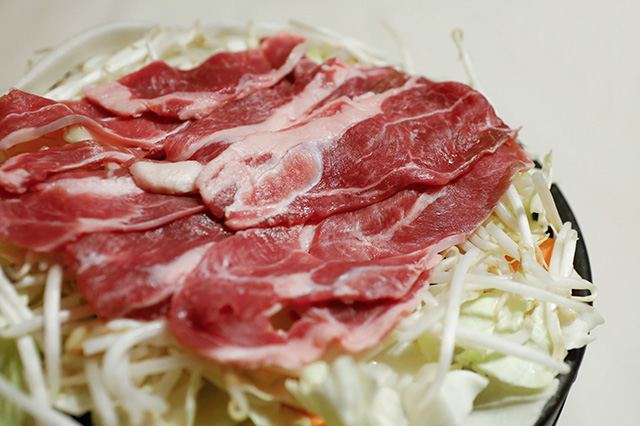
Jingisukan (ジンギスカン; "Genghis Khan") is a Japanese grilled mutton dish prepared on a convex metal skillet or other grill. It is often cooked alongside beansprouts, onions, mushrooms, and bell peppers, and served with a sauce based in either soy sauce or sake. The dish is particularly popular on the northern island of Hokkaidō and in China.
History
Jingisukan, originating from the Japanese transliteration of Genghis Khan, refers to a style of grilling mutton, which is also referred to as a type of yakiniku. The dish was conceived in Hokkaidō, where it has been a popular blue-collar dish that has only recently gained nationwide popularity. The name Jingisukan is thought to have been invented by Sapporo-born Tokuzo Komai, who was inspired by the grilled mutton dishes of Northeastern Chinese cuisine. The first written mention of the dish under this name was in 1931.
In 1918, according to the plan by the Japanese government to increase the flock to one million sheep, five sheep farms were established in Japan. However, all of them were demolished except in Hokkaido. Because of this, Hokkaido's residents began eating the meat from sheep that they sheared for their wool.
There is a dispute over from where the dish originated; candidates include Tokyo, Zaō Onsen, and Tōno. The first jingisukan dedicated restaurant was a Jingisu-sō (成吉思荘, "Genghis House") that opened in Tokyo in 1936.
Text adapted from the English Wikipedia article Jingisukan by its contributors, licensed CC BY-SA 4.0.
Dish data: Ministry of Agriculture, Forestry and Fisheries (MAFF), “Uchi no Kyodo Ryori” (Our Regional Cuisines) database, used under the Public Data License (PDL1.0); translated and adapted from the Japanese original.