Keiran けいらん
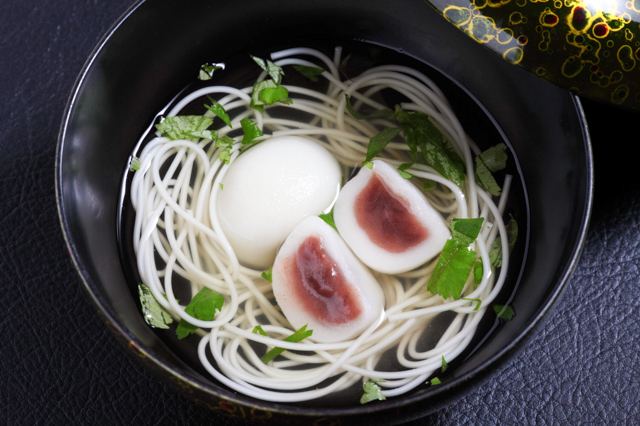
| Prefecture | Aomori (青森県) |
|---|---|
| Region | Tohoku |
| Japanese name | けいらん |
| Home area | Lower North |
| Main ingredients | I'll have rice powder. |
History and Origins
In November, when autumn is deep and the rice harvest is over and farming is down, there's a custom of "The fall is over." We invite neighbors and relatives to celebrate the success of ricemaking, and we work a year's farm work to make food for them. "Sweeting" is one of the most popular dishes of autumn dinners. When you open the lid, the name "sitting" comes from the thin, white - egged soup that floats and the dumplings look like chicken eggs. If you're eating a cup of tea, and eating a big "prick" that is growing around the end of the fall night, then you might as well eat it busy. It is said that originally it was a dish of Kyoto, and it was introduced to the Old Sun with a tradition of upper culture. It is now transmitted to the region of Aomori Prefecture, Iwate Prefecture, ZXXQQQQ064X, and it has different composition and flavor.
When It Is Eaten
Although originally acted as a funeral feast for autumn, we are now known as the most important dish on the crescendo. Usually white dumplings, but sometimes they are colored red and white and sometimes blue or green as small as an egg of a parrot. It's a sweet taste and a sweet flavor, and the delicate taste of the juice is appreciated by all.
How It Is Eaten
It is said that the rice flour is moistened in boiling water and then water is added and that the hardness of the ears is determined by this water, which is good and bad. I'm going to stick my fist in a thick bowl, and I'm going to boil it so that I don't break it with lots of water rolled into an egg shape. Sometimes it's not boiled. With your hand over the hot water, and while holding on to your heels, you serve as an egg-like egg. I'm going to pour the juice from the sauce and the cloth, and I'm going to put on three leaves and eat three leaves.
Recipe — Serves 20
Ingredients
- 195 g glutinous rice flour
- 150 ml lukewarm water
- 160 g (:=1:1、 a pinch ) smooth bean paste
- mitsuba, to taste
- to taste (、、) dashi stock
Method
- Add a little soft water into the rice flour and divide it into 40gs, slightly more solid than the ears.
- We divide the pepper into 20gs, wrap it in one piece of fabric, and then pick it up on the chicken egg.
- I'll cut the juice and cut it into pieces.
- Then add the citrus oil and a piece of chops into the soup.
- Three leaves are boiled and lightly tied.
- The bowl wrapped in a stick is boiled, and when the surface is clear, it will be caught, and it will rub cold water with its hands while it is warm and then place it on the surface of the bowl while it is holding it in shape.
- I'll put two bowls of rice in the bowl, and then I'll put some soup, three leaves and a bowl of rice.
More About Keiran
It's a local dish from northern Tohoku. It is a soup with a bowl of chicken in it, and its name comes from the fact that the chicken looks like a chicken egg.
There are many instances where it is observed in celebration of autumn harvests, weddings, daily dinners, visitors, and elaborate cooking during legal affairs.
History
The distribution is based on a convex dish that was introduced along with the north XTohoku (upside the north) and is part of the northern ZXZQ064X region of the southern region of Aomori and ZZQ60X. The climate is difficult to grow rice here, and it is widely passed on to the southern part of the country, where the Aomori Prefecture is now under the control of Aomori Prefecture. And yet, in recent years, there has been a decline in the number of makers, and in a 2008 survey of elementary school students in diapers, less than half of the children who had eaten snacks had been eaten.
As time goes on, the whistle is divided into two ways: sweets and old forms.
How to Cook
The last part of the 17th-century Cooking Story has all the awkward stuff on it and the following recipes are written:
The rice and ferret rice are ground into flour and mixed with 6:4. You'll have enough to do so and then add water and swell. The black sugar is mixed with a rough cloth and is folded into a round mass about the size of a goldfish. It's soy sauce, and it's served in rice.
The basic recipes of our time are not much different from the cook stories mentioned above. For example, I will write down the recipe for the construction in Tohoku Village, in the early days of the Shogun War.
We wash rice and dry it, and then we boil it into flour. Add a little hot water and more water, and then add a piece of fabric to the hardness of the ear. It will be folded into dough and shaped into an egg-like shape. Put it in a lot of hot water and stir it up in a bowl to prevent it from breaking its shape. There's also a recipe for boiling without steaming. When the bowl is lifted, pick it up and place it in two rows and put it in a soup. I'll add a lot of goods and bad things.
There are some differences in the area, and in the remote city, the juice is served as it is, not in the soup. There are also cases in remote areas where you can mix about 10 percent of the flour in rice and then fold it more tightly than usual so that it does not melt. Also, in deerhorn City, we put nuts and carved onions on board.
Text adapted and translated from the Japanese Wikipedia article けいらん by its contributors, licensed CC BY-SA 4.0.
Dish data: Ministry of Agriculture, Forestry and Fisheries (MAFF), “Uchi no Kyodo Ryori” (Our Regional Cuisines) database, used under the Public Data License (PDL1.0); translated and adapted from the Japanese original.