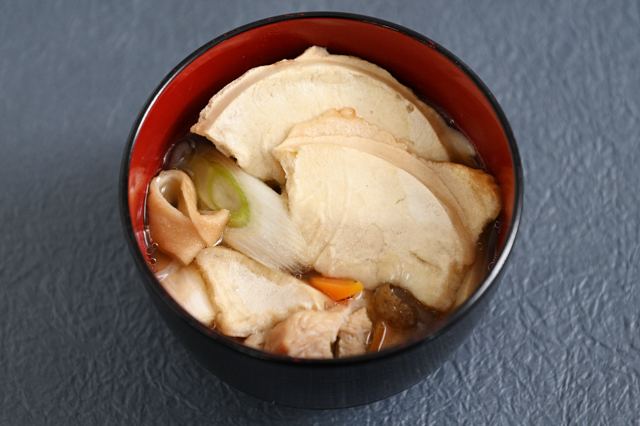
Senbeijiru せんべい汁
| Prefecture | Aomori (青森県) |
|---|---|
| Region | Tohoku |
| Japanese name | せんべい汁(せんべいじる) |
| Reading | Senbeijiru |
| Home area | Mijido City |
| Main ingredients | I'm not sure if I'm going to be able to do that. |
History and Origins
It is traditional food from the southeast to the north of Aomori Prefecture, which was the region of the Old Old West. It is ground with flour mixed with salt and water and ground with iron mold. Before the war, many farmers had iron molds, and the dish was a valuable reserve food in areas where rice was too cold and rice was not good. This is made from a soup or a pot and cooked with a "steak juice." Although there are many origins, the first thing I'm going to tell you is that before the war, I boiled the soup in the soup of the river gulli. Although this dish was passed on locally, it was not until it became plain that the name "Creep" came into play. To make what was thought to be a plain dish eaten only at home a tourist masterpiece, a tourist company in Yado City set up for PR. Now I'm a local actor who's known the name throughout the country.
When It Is Eaten
In the old days, each family was roasting cinders, but the farmer was not able to make them because they supplied iron pots during the war as supplies. After the war, manufacturers didn't boil down when they smoked the juice. They developed a gas-insected dishcloth and began selling it as a source of juice. Now, besides eating at a cold time in the home's soup and cooking bowls, they are known as major dishes for tourists in eating and drinking restaurants.
How It Is Eaten
It's a chicken, and it usually puts vegetables, thread and so on in a pot of soy sauce, mixes in a bowl and boils and eats. It's delicious even if you like to put in daisies and other mushrooms. In other cases, like port towns, it's easy to use sabbatical casserole in families like the port town of Tara and the roasts. There are many variations, such as the delicious citrus pot with its fine beef.
Recipe — Serves 4
Ingredients
- 8 せんべい
- 11/2 green onion
- 200 g chicken breast
- 200 g chicken thigh
- 160 g konnyaku noodles
- 10 g sheet wheat gluten
- 1/2 burdock root
- 1 frozen tofu
- 1/2 carrot
- Mix: 80 ml soy sauce
- Mix: 40 ml sake
- Mix: 20 g white miso
- Mix: a pinch salt
Method
- The meat is baked until the surface changes color.
- I put 1 and 1 in hot 2L and cook it with a weak flame.
- If you put a thread in it, it will be a strong fire and take a surface hatch. I'll try not to take the oil this time. )
- I put frozen tofu and carrots on top of it and cook more.
- Add a plate and if all the ingredients are cooked, add a flavor A and get a taste.
- Make sure you eat enough rice.
- In advance, let's keep chicken chicken in a small slice, and we'll cut it into a length of three centimeters, and then we'll cut it into two and a half inches, and then we'll cut it into a small slice of chicken. You like to add mushrooms, such as daisies.
More About Senbeijiru
They're making their names known as the "Ekka-Ko-Ko-Ko-Ko-Ko-Ko-Ko-Ko-Ko-Ko-Ko-K-K-K-K-K-K-K-K-K-K-K-K-K-K-K-K-K-K-K-K-K-K-K-E-N-N-N-N-N-N-N-N-N-N-N-N-N, and they're outside the area.
Overview
In the soup, I use the "sakisaki" that I baked exclusively in the rice bowl. This is broken by hand and cooked with chicken and pig juice, and other ingredients, such as mushrooms and onions. The soup in which it is consumed makes it feel like a "Kinji" tooth has been strengthened.
It is considered to be the use of a stored sauce instead of a bowl of wheat dough.
The "Schiki" style is used in the doughwork of the wheat.
In the meantime, the soup that didn't use the baked flour is now being made available for distribution on the Yado Station of the Tohoku Shinkansen Line in 2002. The Yinjigi Miyagi, which has been eaten in the former Kangi, with the same flour as the same material, and has been eaten in the former Yinjigi, and fried with oil, has been made famous by the JR group's Nintengi Hotel D'Estrey campaign of 2008.
Degrees
According to a study conducted in February 2008, which conducted more than 03 years of TED-Eyclopology, there are about 200 stores that have been found to be serving unbled juice, and 160 of them have been published in the "Auto Guide Map '08 edition.
A separate local translation shows that it is one house in the ZX058X, with 12 of the XZQ58X, except for 135 of the 8th or 8th of the 8th.
History
It is said that the soup was born in Yadoji during the Great Depression of the late Edo period. Then, over 200 years later, they were eaten in what is now the Southern District.
In March of 2000 (the Department of Agriculture and Development Plans of the Eighth Street Project) we will assemble the "Akward Tourism Plans" in that year. In July, the People's Committee on the Operations of the Operations of Yado Station was born. While setting up the Food and Culture Association, and organizing local food and Japanese food and rice, and jiichiichiichimura, the board of operations set up a multi-scale project towards the Food and Culture City of Eightdo.
Of these, a huge 3m-sized steel-stab in Eightdo Park was set up, and in the fall of 2000, the "Gentile Festival" was held, and the festival ended in 2004.
In November of 2003, the "Enquiry Institute" was founded, and the local soup - using gravy - began to rise, and the mass media and other local dishes became known locally.
On February 18th, 2006, the festival of "B-1 Lampuri" that gathered B-class Glum from all over the country, including the Y-axis, under the Y-axis of the Soap Institute Produs and under the Y-axis, was first held in the city of Eightdo. Also, official support songs were released in September of that year. And in addition, in a limited period from October 24th to November 20th of the same year, family juices were released at about 530 stores in Tohoku7 prefectures. A B-1 Glumli is the location of an altar that has a colorless color of competition.
The Jurassic Institute won the Gold Glow once at the 7th convention in 2012.
In 2022, the Department of Culture is recognized as a 100-year hood.
Official Songs
On September 21st, the following artist released the song as a song of lyo-fisty support.
"I love you! I love you!"
Other
B-1 Glumpli won first prize in the 7th Games, the 2nd round, the 2nd round, the 2nd round, the 2010s. In December 2008, at the "B-1 Winter Battle of the North Tohoku In the Great Indulgent Center" held at the Soyuz Institute of the North Tohoku Lampling Center, held in December.
Text adapted and translated from the Japanese Wikipedia article せんべい汁 by its contributors, licensed CC BY-SA 4.0.
Dish data: Ministry of Agriculture, Forestry and Fisheries (MAFF), “Uchi no Kyodo Ryori” (Our Regional Cuisines) database, used under the Public Data License (PDL1.0); translated and adapted from the Japanese original.