Home / Yamanashi / Dried persimmon
Dried persimmon 枯露柿
| Prefecture | Yamanashi (山梨県) |
|---|---|
| Region | Chubu |
| Japanese name | 枯露柿(ころがき) |
| Reading | Korogaki |
| Home area | I'm not sure if I can do that. |
| Main ingredients | Miyagi. |
History and Origins
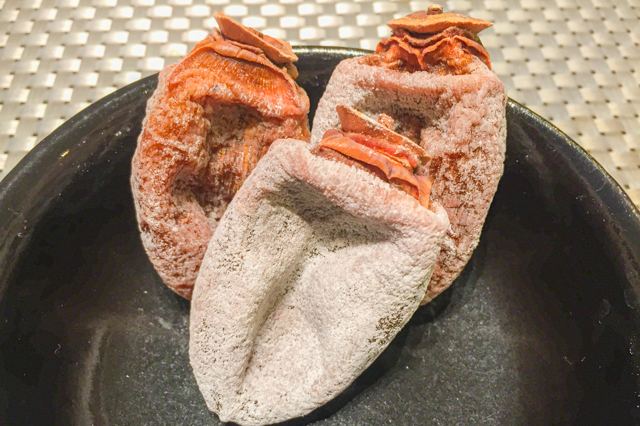
"Sunning" is common in the city of Chihua and South Alps. It is a candy - colored dry season with a large variety of seeds. The same dry season, with 50 percent softness, is called "silver," with a water content of 25 to 30 percent, with a sweet ingredient making crystallized white dust, and it is called "screw" and has been dry for a long time. It is said that the name "swallow" comes from the fact that when it is dried in the sun, the skin is arranged so that the sun's sun can be set on the whole surface. In the Matsuri region of Koyu, in the capital of Chihua, the big tundra will be taken, so it has long been known as the famous source of the "Daiji"; and from November to December, the sun - droughts on the fronts of the people's houses will be an orange curtain; and the autumn flavor will be popular.
When It Is Eaten
The end result of the "swallowing season" is sold from mid-December to late January and can be eaten. These days, storage techniques such as wrapping them can be developed and can be saved for about a month. If it freezes, it will last about a year. It's too sugary to freeze.
How It Is Eaten
About November, we harvest the ripe, redished plant in T characters, and then we dig through it, leaving only the tip of our ass skin and skin it. If possible, I'll let you take a bath in hot water to prevent caviar and to remove the under-the-side clavules. The plastic string is tied in a ring, and on both ends a T-stylus is tied together and tied together to a scythe, and the sun is set at the end of the house. You can take the rope off the rope and remove the string from the string and cut the stem with a slat and take off the mold in a small test. If it were, it would be wrapped between the rice bowls, and the powder would be so thick in cold and dark places. Sometimes you can put it in the "sour" of a traditional dish and make it "scroll" or put something hard on the ground.
Recipe
Ingredients
- as needed (※) 渋柿
- as needed (60cm) plastic Strings
Method
- About the middle of the month, we harvest a full reded bush in T-letters.
- I'm going around the knife, I'm going to look at the bad guy, and I'm going to skin him with only the tip of my ass. If possible, I'll make sure that I have a cavitto and a flat-stab on the surface to make it easier to handle. The skin is efficient when using a peanut. (If you make lots of them, you can get them to work with plastic gloves.)
- The plastic string is tied in a ring, and on both ends a T-stylus is tied together and tied together to a scythe, and the sun is set at the end of the house. (It's a good idea to keep the two of you dry.)
- With carefulness not to fall on the rain, I adjust the sun to the whole surface of the sea, and when it becomes soft about a week or so, I start to see my fingertips. It takes about a month to dry until your favorite softness. (Student December)
- You can take the rope off the rope and remove the string from the string and cut the stem with a slat and take off the mold in a small test.
- Then wrap it between the rice and let the powder fill in in cold and dark places. (End of the year)
More About Dried persimmon
Dried persimmon is a type of traditional dried fruit snack in East Asia with origins in China. They dried them to use them in other seasons. Known as shìbǐng (柿餅) in Chinese, hoshigaki (干し柿) in Japanese, gotgam (곶감) in Korean, and hồng khô in Vietnamese, it is traditionally made in the winter, by air drying Oriental persimmon. It is also used to make wine, put in traditional tea, and in creating other desserts.
In the Han dynasty, Yangshao dried persimmon was used as a tribute to the imperial court.
Production
Dried persimmon are made from various varieties of Oriental persimmon. Persimmons, when fully ripe, are thin-skinned, soft and sweet. Persimmons used to create dried persimmons are harvested when they are under-ripe, firm, astringent, and bitter.
China
In China, there are many different varieties of dried persimmon. The traditional way of drying persimmon is to choose fruits which are fully mature. After the persimmons are peeled and blemishes have been removed, a drying rack 0.8-1m high and covered with foil is placed in an area with sufficient light, air circulation, and sanitation. The persimmons are then placed stem-side up onto the rack and covered to prevent contact from rain or other environmental debris. The drying process causes the flesh to shrivel and a frosty layer to form on the surface. In addition, there are artificial drying methods, this method producing brighter-coloured persimmons. Each region in China has different production methods and dried fruit characteristics, of which Xi'an dried persimmon is more famous.
Japan
In Japan, the fruit are peeled and then suspended by strings from their stems. They are massaged daily after they have started to dry. This gives the dried persimmon from Japan a distinctive shape and texture that is different from those from China and Korea. Anpo-gaki is a variation of Japanese dried persimmon in which the persimmon is dried by fumigating with sulphur, resulting in a soft, juicy texture.
Korea
In Korea, the persimmons are peeled and dried, tied with saekki (rice straw ropes) and hung in sunny, well-ventilated place, for example to the eaves of the house. When the color turns brown and the outer part hardens, the seeds are removed and the persimmons are sealed again and flattened. After around three weeks, when the fruits reach 75% of their original weight, they are covered in dried rice straw and stored in a box in a cool place until the drying process is completed, and a white powdery crust of persimmon sugar forms on the outside. Sangju in North Gyeongsang Province is famous for its dried persimmons.
Nutrition
Korean gotgam usually consists of 32% moisture, 6.3% protein, 0.44% fat, 44.8% carbohydrate, 15% fiber, and 1.99% ash. calories (32g/ea) : 75.8kcal
Culinary use
In Chinese cuisine, dried persimmons can be directly consumed or used as an ingredient in other foods. For example, dried persimmon wrap is made by wrapping a walnut with dried persimmon. Dried persimmon is also served with pine nuts or fresh fruits.
In Japan, hoshigaki are eaten by themselves as a quick snack or eaten with walnuts and/or with traditional desserts like dango, mochi, or raindrop cake.
In popular culture
According to Chinese legend, Zhu Yuanzhang was forced to live in exile at the foot of Jinweng mountain in the north of Fuping. He was able to live because he ate local dried persimmons.
The Korean folktale "The Tiger and the Dried Persimmon" features a tiger scared of dried persimmon.
Text adapted from the English Wikipedia article Dried persimmon by its contributors, licensed CC BY-SA 4.0.
Dish data: Ministry of Agriculture, Forestry and Fisheries (MAFF), “Uchi no Kyodo Ryori” (Our Regional Cuisines) database, used under the Public Data License (PDL1.0); translated and adapted from the Japanese original.