Home / Yamagata / Shiokujirajiru
Shiokujirajiru 塩くじら汁
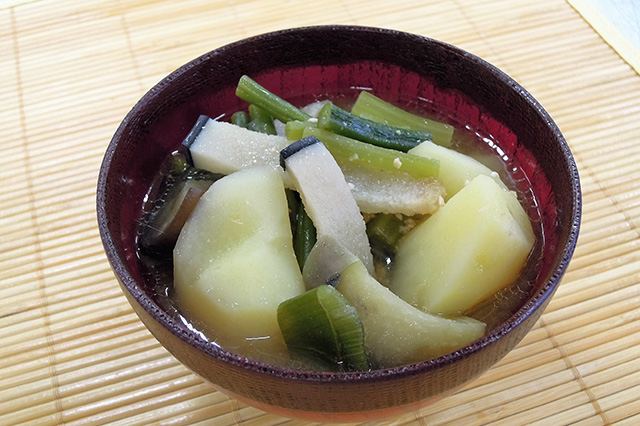
| Prefecture | Yamagata (山形県) |
|---|---|
| Region | Tohoku |
| Japanese name | 塩くじら汁(しおくじらじる) |
| Reading | Shiokujirajiru |
| Home area | All within the province. |
| Main ingredients | It's a little bit of a trick. |
History and Origins
The Salt Fabulous soup is traditional steaming to survive the hot summers in the interior. It is said to be a dish that was once preserved and that it was born to boil and eat summer vegetables together as a valuable source of animal protein in mountain areas and prepare for hot summers. The salt crumbs are salt-salted fats with the skin of the skiffs. Vegetables used for food use vegetables that are delicious in the summer, fresh potatoes, lentils, and so on. In the village area, it's also called "is there?" In Oecho, in the village district, when there were children's meetings in the town during summer vacation, they often made "are you there?" Mothers brought vegetables and food from their own homes and cooked them in a large pot. The ingredients will always come in with a salt rod and a fresh dish. Other things are sure to be added in summer, when they grow tall, but they can be peeled and eaten gently. In the top of the region, we use the "snap" of the mountain plants in "salt" with a sharp rip of our hands so that the taste can be soaked well, and we are called "silver and whittled."
When It Is Eaten
We eat during the hot season of July through September. One of the regular summer dishes still eaten at home. After a while, as the fall for the lily potato draws near, more families will produce "salt pepper" instead of "salt juice."
How It Is Eaten
Before cooking, the salt on the surface is washed in water, and the salt is soaked in water for about ten to thirty minutes to remove the salt. Then you drop the fat in hot water and cut it into short volumes, and it will be a very delicious finish. The salt crumbs become too boiling and so you have to be careful in cooking. The time to put it into the pot is when all the vegetables are soft. It's the point where you can take a whole taste and eat it well when you look at the saltity of the salt lotus. In the past, salts were used around salt lots, but now they are boiling and pouring water and water on the surface, while they are taking on a smell, so the salt needs to be satisfied. Because the taste buds smell off, the flavor is rich, but it can be tasteful and salt or oily.
Recipe — Serves 5
Ingredients
- 100 g 塩くじら
- 2 potato
- 1/2 carrot
- 2 eggplant
- 1/2 onion
- 10 green beans
- 1 long green onion
- 800mL water
- 1 tbsp1/2 miso
- as needed [村山地域]青みず菜
Method
- (The salt rod makes the surface salt dry in water and cuts a small volume of water.)
- The potatoes are peeled, cut into suitable size, put in water, and remove the pot.
- The carrots are also peeled and cut.
- If you do, peel it off, cut it into the right size, and remove the hatch.
- Onions are cut into strips of 1cm wide, and long lengths are cut in half. I'm going to cut it three centimeters long.
- If you boil a bowl of potatoes, carrots, water, and a bowl of salt, add a bit of onions, lentils, lentils, and so on, and cook until the vegetables are tender.
- You can taste it with a taste while looking at the salt that comes out of the salt crumbs.
- If you add a long string and boil it up, it will be finished.
Dish data: Ministry of Agriculture, Forestry and Fisheries (MAFF), “Uchi no Kyodo Ryori” (Our Regional Cuisines) database, used under the Public Data License (PDL1.0); translated and adapted from the Japanese original.