Home / Ishikawa / Tainokaramushi
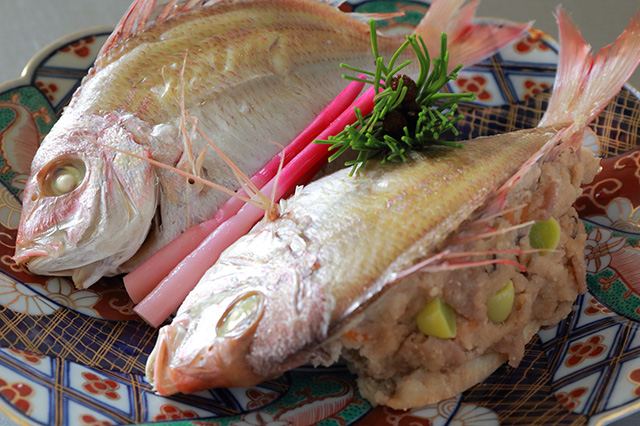
Tainokaramushi 鯛の唐蒸し
| Prefecture | Ishikawa (石川県) |
|---|---|
| Region | Chubu |
| Japanese name | 鯛の唐蒸し(たいのからむし) |
| Reading | Tainokaramushi |
| Home area | Kanazawa City area |
| Main ingredients | I'm going to have to do something about it. |
History and Origins
The soup is served in a soup made with steamed 5-year-olds, with a tie with tail heads, and a carrot, and a bowl of lentils, and a daisy and so forth. It's one of the local dishes that leaves behind the remnants of the warrior culture. The main flow is the placing of two Thailandes on the side. For every celebration, they are also eaten at wedding time. It is said that the dishes from Nagasaki, which are derived from Chinese food, were introduced through a co-worker who was trained in Chinese. Thailand is used not only for steaming but also for a variety of dishes, such as steaming, cooking, boiling, and tanning.
When It Is Eaten
During the wedding, the wives bring wine and granddad along with their wedding gear. I'm going to steam it with my son-in-law. We looked at the time when the feast was over and we gave him "The Sweat of the Sun." The guests behaved up, and the banquet was more excited. I separated my upper body from my guests only, and my lower bones were more likely to act and work against people who were underworked and neighbors. I learned to place two pieces of tie on one side, and I took this and I took it and I took it as a phrase: It's not an angry outburst, but it's a bad consequence of the belly. You can see the remnants of warrior culture around here. I hope it's a gift for children that's left in Thailand, and that's why it's so dirty. It's also eaten by the general family and at the festivals, and now it's part of the celebration at any season. For those who value tradition, I pray for prosperity at the festival in December. This time I made a steaming steam using a tie made to be served.
How It Is Eaten
From Thailand's fill-up, carrots, lentils, lentils, lentils, and so on, are roasted with raw pepper. Tasted with soup, soy sauce, sugar, and so on, it's just sweet. If you have steamed it for more than a half hour, then you can eat it with a good taste. I'm often placed on a plate of colorless Kusaka-kun, and I can make flowers for the feast.
Recipe — Serves 4
Ingredients
- 2 sea bream
- 2 cups okara (soy pulp) (okara)
- 20 g boiled bamboo shoot
- 1/2 burdock root
- 20 g carrot
- 6 wood ear mushrooms
- 8 ginkgo nuts
- 1 tsp 麻の実
- (A) 1 cups dashi stock
- (A) 6 tbsp sugar
- (A) 4 tbsp sake
- (A) 4 tbsp soy sauce
- (A) a pinch salt
Method
- Cooking mushrooms, seams, carrots, carrots, lentils, and other raw fish are cut into pieces and removed from their shells, they are left with a thin layer of rice.
- Thailand takes scales, puts them together on the back of the fish's fin, opens its back, takes out its entrails and washs them. You can mix salt with salt water like seawater for an hour or so.
- I'm going to make sure that I don't get burned up with a roast, a flavor of A, and a saucer and a saucer, and I'm going to mix and cool down with a mixture of lynx fruit.
- Three in the cut, and 40 in the air, about 50 minutes. (Customer:
More About Tainokaramushi
Ishikawa PrefectureXXKanazawa City native food.
Overview
I packed the rice in the bowl and boiled it up. It is common to mix citrus flowers with silver, carrots, goubaus and all kinds of flowers. It was once served as an essential dish for weddings and festivals, but today it is becoming scarce.
And yet, when you put the flower of the flower, it is always a matter of turning back, but this is because cutting it from the belly is associated with cutting it, and it's not liked. Line up the two crescendo on the stomach, and they're called "C" and "C" on the stomach.
It is said that Nagasaki's Chinese dish, derived from Chinese food, has been passed on through a master's master, Toshio.
Text adapted and translated from the Japanese Wikipedia article 鯛の唐蒸し by its contributors, licensed CC BY-SA 4.0.
Dish data: Ministry of Agriculture, Forestry and Fisheries (MAFF), “Uchi no Kyodo Ryori” (Our Regional Cuisines) database, used under the Public Data License (PDL1.0); translated and adapted from the Japanese original.