Basashi 馬刺し
| Prefecture | Fukushima (福島県) |
|---|---|
| Region | Tohoku |
| Japanese name | 馬刺し(ばさし) |
| Reading | Basashi |
| Home area | Iseshima City, Yamasaka Yamasaka. |
| Main ingredients | Horse meat. |
History and Origins
It was around the time of the Sung War that the beef diet spread on Fukushima. It is said that the first time a wounded person was brought into the province was to eat horse meat. After that, horse meat became a valuable source of protein and became a popular food for families like pork and chicken. At first it was common to heat up, but the fact that a popular proprietor who visited Shinzo Young Matsu ate raw has led to the spread of the culture of eating "horse stings." For now, "basically stab" is one of the fine local dishes of Chizu Matsu. Unlike other areas, it is characteristic of eating with a "same mustard" rooted in the fact that the popular proprietor brought it in.
When It Is Eaten
In the beginning, Chizu Matsu was an inland area and didn't like fresh raw fish. In the meantime, the stingings available in inland areas can be replaced by the stabs of fish.
How It Is Eaten
Fresh beef is sold at the meat shop in Chizu Matsu City. It's common to eat with a soy sauce sauce. It is also a feature that Chizu Matsu's beef does not contain red fat. They say that it is basically eaten in the home and that there are few cases where meat is enjoyed by eating out.
Recipe — Serves 4
Ingredients
- 3 miso
- 3 sake
- 3 mirin
- 3 mizuame syrup
- a pinch soy sauce
- a pinch salt
- 2 chili pepper
- 2 コチュジャン
- 1 会津人参粉末 (オタネ)
- 2 cloves garlic
Method
- I'll slice the garlic as fine as I can.
- Put the wine and wine in the pot and boil it and blow the alcohol.
- I'll put a rice citrus, soy sauce, pepper, citrus garlic, and I'll do it until I get your favorite medium.
- I can taste it with salt.
- We'll stop the fire. We'll add the powder to the carrots and we'll stick it together. I eat with my favorite horse sting.
More About Basashi
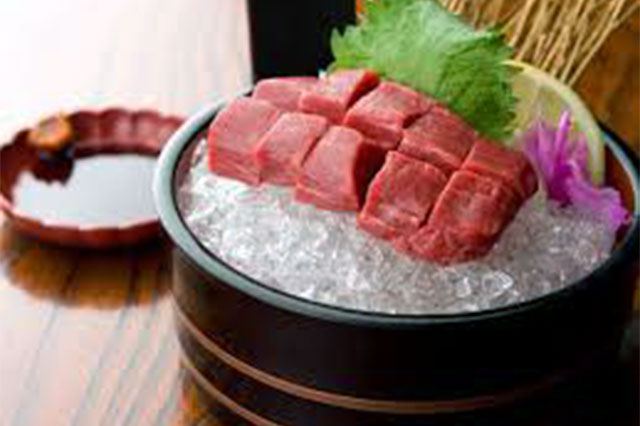
A horse sting is a Japanese dish where the meat of a horse is cut into thin cuts and eaten raw.
Overview
There are a lot of "tro" and "frozen" and "red" and a lot of stuff that can be taken from one end of the body, including the unusual "tatebic" and "statateback" - including the most smellless "breasts" and "tins." The area called "tro" is the top part of a rose and the areas where frost is in their red are called "frozen descent." Also, the three layers of meat spread from the shoulder of the horse on the rose are called "the daisy" and have a clear sense of smell. In addition to refrigerating, distribution is also done in terms of the freezing of food poisoning.
It is common to eat horse stings in the flavor of peppers, peppers, garlic and onions.
I've also come to see such things as horse-sharp, stabbed sushi, and sushi. Unlike cattle, beef oil has a lower melting point, and melts enough temperature in the mouth, and even frosted meat can be eaten with a knife. There are other cherry beans that eat small pieces of beef with a little soy sauce and natto. The red meat contains a synthetic "stuff" in it, and the frosty, meat is also in circulation.
Native food.
The region where the practice of horse eating is traditionally a favorite place for horses, and it is thought that the culture was rooted in the production of horses. Of these, Kumamoto Prefecture is a low-income horse production but makes up 40 percent of the post-cremination meat production, making it Japan's largest source of food. Moreover, many of the meats that now flow in Japan have been imported or imported and grown domesticly, and there are few pure national products.
A raw food processing facility.
By a notification from the Ministry of Health (then released on September 11, 1998) from the Department of Health and Food Safety, the final revision: In 2019, the only food levers ever handled are four places.
Aomori Prefecture Atom Eating Center Fukuoka Prefecture, XKumamoto Prefecture Center Kumamoto Prefecture Center for the Central Feat Center for the Bears.
These factories meet international health standards.
And this is what it looks like.
It's a heat-heated food.
If it's processed in a "living and processed facility" that meets the health standards, there's no concern about food poisoning by bacteria, but it can be contaminated by the meat process. There has also been a case of counterfeiting beef for "living food" from "heat-heating" as meat.
The live ovum worm.
The possibility of an eating poisoning caused by horse stings infected by the necrosis spores is suggested, and reported on on April 25, 2011, by the the Ministry of Health, Labour and Welfare drug department, Food and Agriculture Council of the Council of Food and Agriculture Associations, Food and Agriculture Association. The S.fridi test measure is being notified on August 23, 2011.
Prevention
According to the Ministry of Health, Labour and Welfare, these risks are reduced by freezing at central temperature minus 20 degrees below 48 hours. If you use a freezing device for more than 36 hours at -20C and -40C and faster at -40C, for details, you need to keep 18 hours at -30C and more than one hour at a time in liquid nitrogen.
Kumamoto Prefecture announced that in May 2011, meat fairs and city officials were shipping out to see if there was a disease such as E.E.A. and salmonella bacteria. But in September of that year, they did not freeze Canadian horse wool rather than frozen it.
Text adapted and translated from the Japanese Wikipedia article 馬刺し by its contributors, licensed CC BY-SA 4.0.
Dish data: Ministry of Agriculture, Forestry and Fisheries (MAFF), “Uchi no Kyodo Ryori” (Our Regional Cuisines) database, used under the Public Data License (PDL1.0); translated and adapted from the Japanese original.